On air · 1 of 3 networks
RightMetric
- rightmetric.co
- CA
- 19 employees
RightMetric’s ads on LinkedIn, Meta and Google, recorded by adsrunning. Browse the latest here for free. Sign up free to see all 54. Watch RightMetric with Starter to get each new one in your feed.
Watchlist with Starter · $49/mo
| Network | Status | Live ads | Nov 2025LinkedIn activity · 52 weeksOct 2026 | Checked | Next step |
|---|---|---|---|---|---|
| Running | 54 | Checked 29 Oct 2026 | See all 54 ads → | ||
| Meta | Not checked | — | |||
| None recorded | 0 | No ads found on the Google Ads Transparency Center | Checked 8 Oct 2026 | Collect them with the API → |
RightMetric has 54 live LinkedIn ads. We recorded no Google ads on 8 Oct 2026.
Latest ads
- LINKEDIN · IMAGERecorded 27 Oct 2026
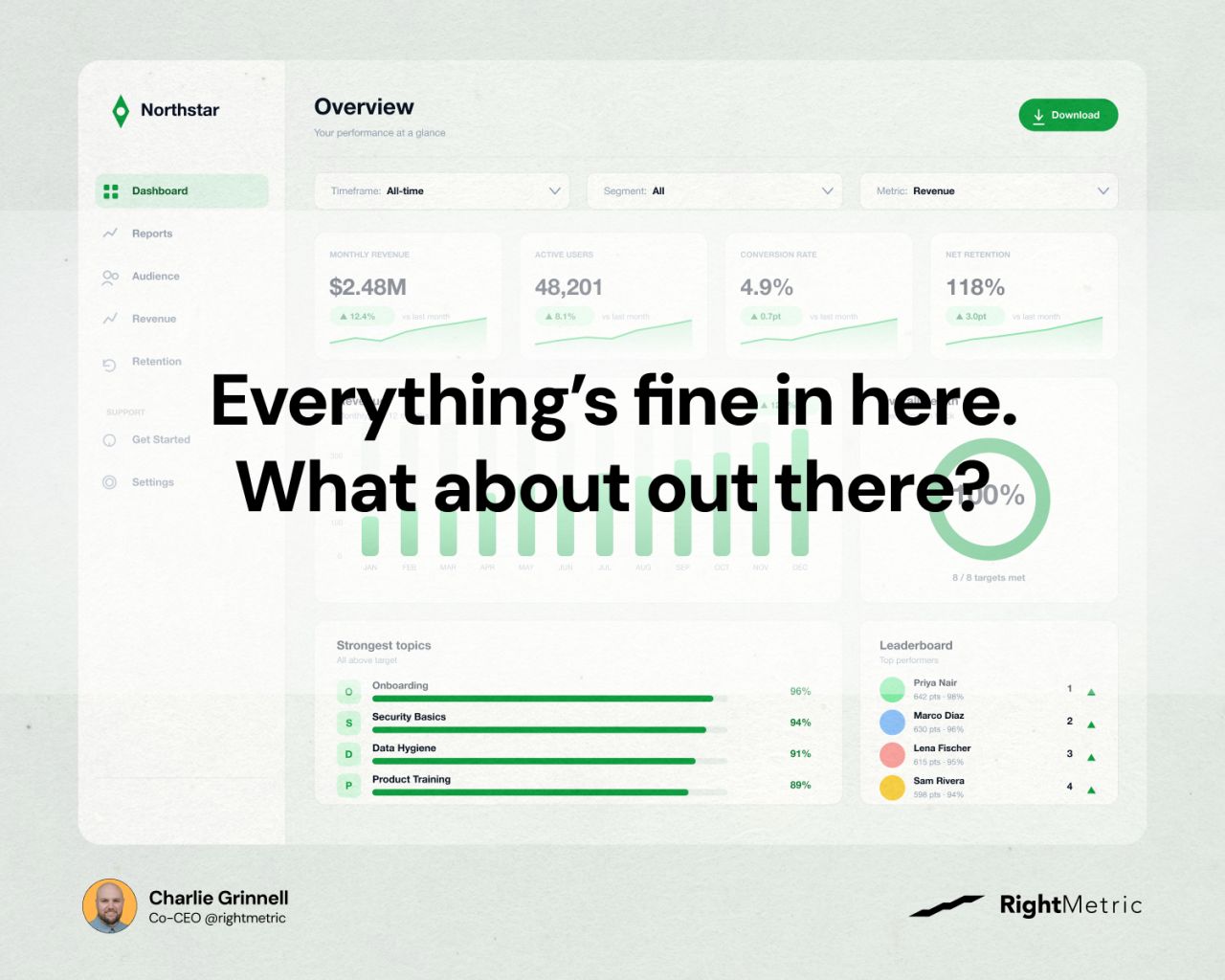
The most dangerous dashboard in marketing is the one where everything's green. All it means is you're measuring the things you already knew to look at. By the time it shows up in your numbers, the shift has already been underway for months. And the dashboard stayed green the whole way. Your dashboard shows you what's happening inside your ecosystem. It has nothing to say about what's happening outside it. And those are two very different reads on reality. It won't show you the competitor that entered your category six months ago and is winning your next generation of customers. It won't show you the platform where your audience moved their trust conversations. It won't show you the content format pulling your category forward while you're still optimizing last year's playbook. A few things I'd add to your next quarterly review: 1. Search your category on Reddit and YouTube without your brand name. Screenshot the top results. Note what's moving in your market that your internal data would never surface. 2. Look at the top three pieces of organic content getting traction in your category right now that you didn't create. Screenshot them. Who made them? What are they saying? What format are they using? 3. Check if any new competitors, creators, or communities have gained meaningful traction in the last 90 days that have never come up in an internal meeting. Screenshot anything you find. 4. Drop all those screenshots into the AI tool of your choice and ask: "My internal dashboards show healthy metrics. Here is what's getting organic traction in my category right now outside my own brand. What market shifts, emerging competitors, or audience behavior changes should I be paying attention to that my internal data would never flag?" 5. Write down the one thing moving in your market right now that your dashboard would never surface, then put it in front of your team where it's impossible to ignore. This takes about 15 minutes. And it will tell you more about where your market is going than any dashboard ever could.
- LINKEDIN · IMAGERecorded 27 Oct 2026
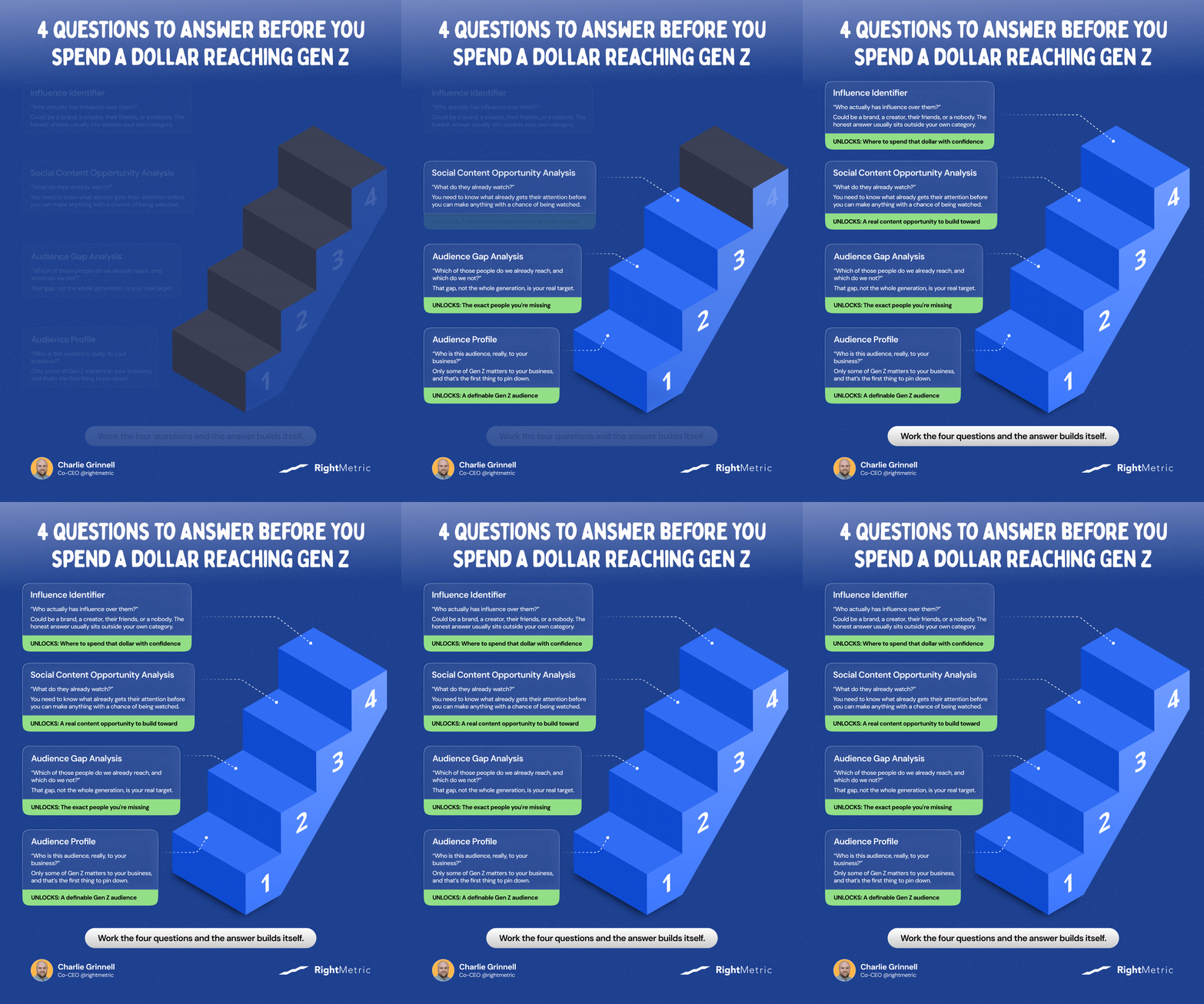
No one can answer "how do we reach Gen Z?", including us. It's one of the most common questions we get, and it's the reason research comes back useless. Ask about gold bars, though, and we'll answer "Costco". (I'll come back to this). Ask "how do we reach Gen Z" out loud and someone will answer it. An agency will. A trend report will. You'll get forty slides on Gen Z that are true of Gen Z in every country and every category, and true of nothing in your business. The question gets answered. Nothing gets decided. I call these macro questions. There's no single study, single report or single data point that answers one. You only get there by answering four micro questions underneath it, and the order matters, because each answer is what makes the next one askable. Start with who Gen Z actually is to your business, because it's never all of them. Then which of those people you already reach, and which ones you don't. That gap is your real target. Only then can you ask what they consume, you need to know what they already watch before you make something that gets watched. And last, who has influence over them. Could be another brand, could be a creator, could be their friends, could be a nobody. That last question is where most teams stop short, because the honest answer usually sits outside their own category. Which brings me back to the gold bars. We've been looking into it for a business that sells them. The people making content about it? Credit card point hackers. They run $20,000 through a rewards card at Costco, sell the bars back, pocket the points. Costco can't keep gold on the shelves. Nobody in precious metals would have looked there. But that's who has influence. So no, I can't tell you how to reach Gen Z. Nobody can, not in one answer. Work the four questions underneath it and the answer builds itself. Skip them and you'll get a deck that's right about Gen Z and completely useless to you.
- LINKEDIN · IMAGERecorded 26 Oct 2026
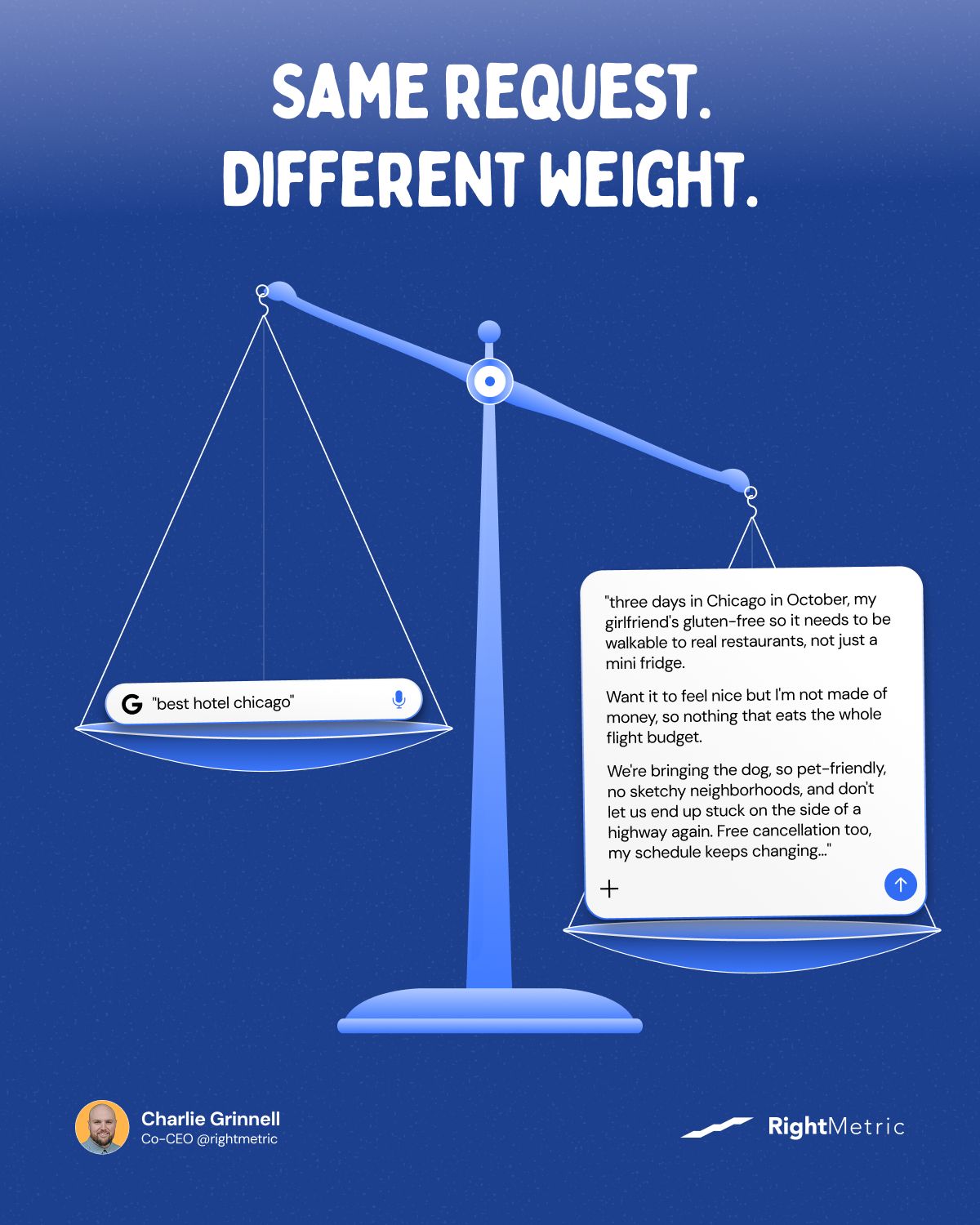
You've spent 15 years being trained to type four words into Google. That muscle memory doesn't transfer to a chat box. And a lot of us are still publishing content built for the four-word version. Into Google: "best hotel Chicago." Into an LLM: three days in Chicago, girlfriend's gluten-free, want somewhere decent, not made of money, don't want to end up stuck on the side of a highway. We stopped typing search terms. We started typing search paragraphs. The headline version of this is "search is dead, long live ChatGPT." That's a head fake. Google still owns search. This year they made AI Mode the global default and rebuilt the search box for the first time in 25 years so it can handle a paragraph instead of a query. It's already past a billion monthly users. They'll copy whatever works and roll it into their ecosystem, the same way they always have. So the platform argument is the wrong one to be having. Whoever wins, the behavior already changed. If I were running content at a brand right now, I'd increase cadence. Not for volume's sake. Specificity is the point, and you can't cover a hundred narrow situations with twelve pages of product content. Pull up one page you published this quarter and ask which version it answers. If it only holds up against four words, it's already behind. But you can't guess which hundred paragraphs to write next. Those are being typed into windows you don't own, on platforms that don't report back to you. The only way to know what your market is asking is to go outside your own four walls and look. That's what I mean by Outsight. Search is still here. It's just longer now, and more specific, and the version that matters is a paragraph you haven't read yet. We read them for a living: rightmetric.co
- LINKEDIN · IMAGERecorded 14 Oct 2026
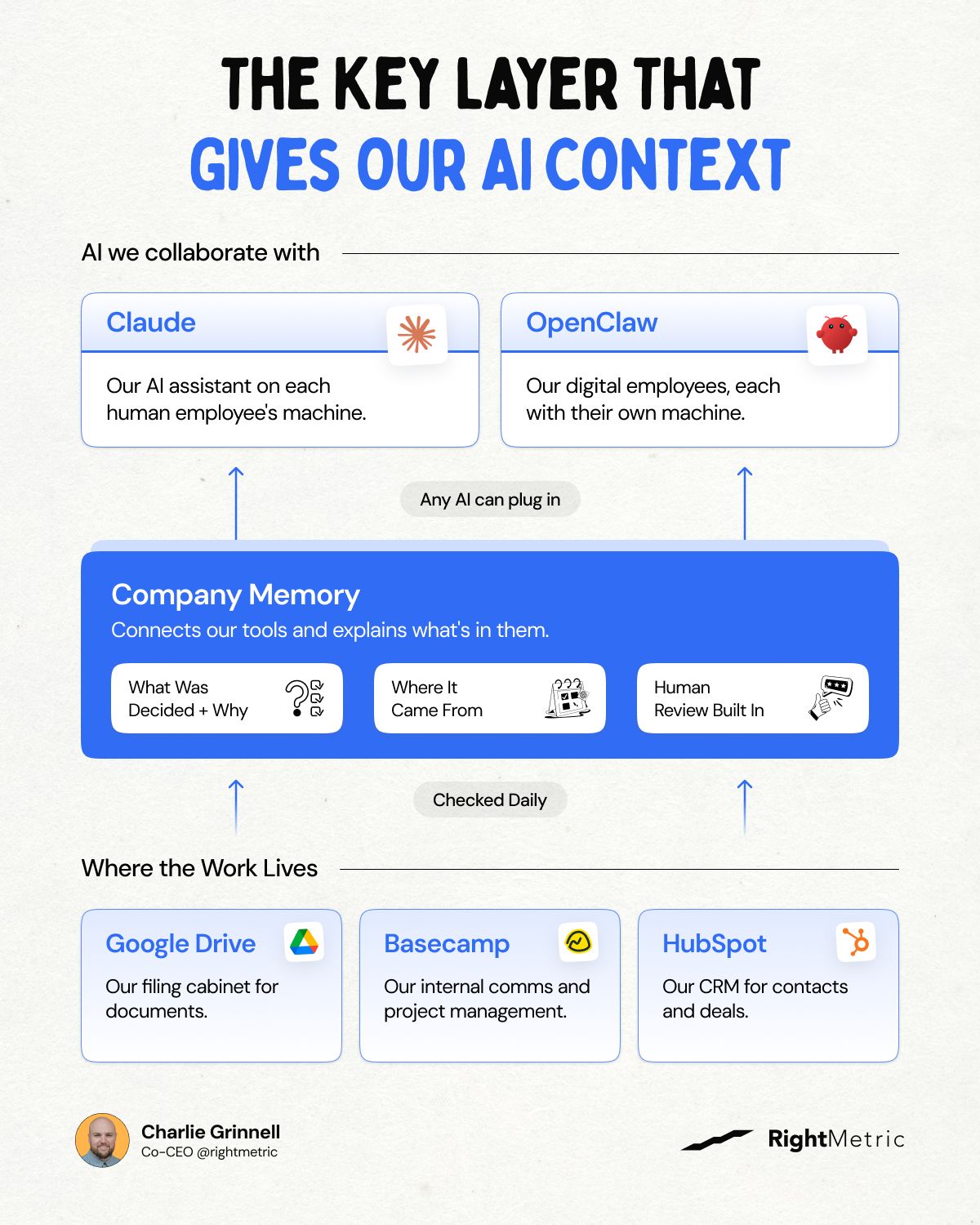
If I tell you "I'm all sweaty, I was watching Cops," anyone who has seen the movie Step Brothers would know the reference. An AI tool reading the transcript of a call mentioning that wouldn't get it. It would summarize it anyway, with total confidence. AI products are getting very good at collecting context. Record the call, save the transcript, done. But a transcript gives AI the words, not necessarily the meaning. And that's dangerous, because AI doesn't tell you when it's missing the meaning. A transcript of me talking is context. But I use slang. I make jokes. My friend Jared Henriques calls the missing layer contextual texture. Context is what was said. Texture is everything around it that tells you how to read it: the inside jokes, the shared references, the cultural knowledge nobody ever wrote down. We're building for it at RightMetric right now. Our Google Drive is the filing cabinet. Any AI can read a filing cabinet. What we're building next to it is the map for how to read it, and the map updates every day. Every day it checks our recorded calls, Basecamp threads and Drive for anything new, and writes down what got decided and why, with a link back to the call it came from. When it needs context only we have, it asks a person in Basecamp, and the answer becomes the source it writes from. Dates and dollar figures it can't source get marked missing instead of guessed, and everything it writes stays labeled "proposed" until someone on the team has reviewed it. Nothing gets deleted. When a decision changes, the old one is marked superseded and points to what replaced it, because a memory should record what we used to believe. Capturing the transcript is the easy part. The hard part is building a system that's honest about what it doesn't know. Ours isn't perfect, which is why a person still reads what it writes. If you're building something like this for your own team, ask one question first: what does it do when it isn't sure? If the answer is "it guesses," it thinks I was actually watching Cops. What's the best inside joke an AI has completely missed for you? If you want to know more about how we're building ours, send me a DM and I'm happy to share our process.
- LINKEDIN · IMAGERecorded 14 Oct 2026
10 years ago I was a social manager. I proudly told my CEO we'd grown avg. engagements by 20%. He responded: "Is that supposed to be good?" I was leading social for the fashion brand Aritzia. When he asked if 20% was good, I opened my mouth to answer and realized I had nothing. He pushed harder. "How much did Zara grow? Club Monaco? Lululemon?" I didn't know. I'd never looked. He said if the rest of the category grew 80% and we grew 20%, maybe he should be firing me. Kinda brutal. But also very true. He was asking a basic business question. And I couldn't answer it. Because I'd never looked outside our own four walls. This is the difference between insight marketing vs. outsight marketing. INSIGHT MARKETING: → static persona deck → copying competitors → trying to post on every platform → only monitoring likes & comments → decisions based off vibes OUTSIGHT MARKETING: → where your audience spends time → where competitors are over-indexing → what platforms have whitespace → what your audience is watching → cultural signals on trends for your niche 99% of marketing is insight first. The best marketing is outsight first. So before your next leadership meeting: pull up your best metric this quarter, and ask yourself the question my CEO asked me. Is it actually good? If the only place you can check is your own dashboard, you don't have an answer. If you want to actually learn if it’s good, reach out.
- LINKEDIN · VIDEORecorded 9 Oct 2026
Somewhere along the way, dashboards started writing marketing strategy. Nobody voted on it. It just became whatever the software happened to be able to count. Buy the platform, then build the strategy around whatever it happens to track. That's the order almost everywhere runs it in, and it's backwards. The tool can't be the one driving what we count. We have to figure out what matters most to the business first. Then go get the ability to count it. Marketers have been at the mercy of this for the last 10 years of marketing software. I understand why. Until recently, if no tool tracked the thing that actually mattered, you were stuck. That excuse is gone. What's exciting about AI is it gives you the chance to step back, zoom out, and run the sequence in the right order: What are the most important things for our business to count? Is there a tool that already counts them? If not, can I use AI to build one that does? The tools you own decide what you see. Which means they also decide what you miss. Your software has been making that call for you long enough. It doesn't get to make it anymore.
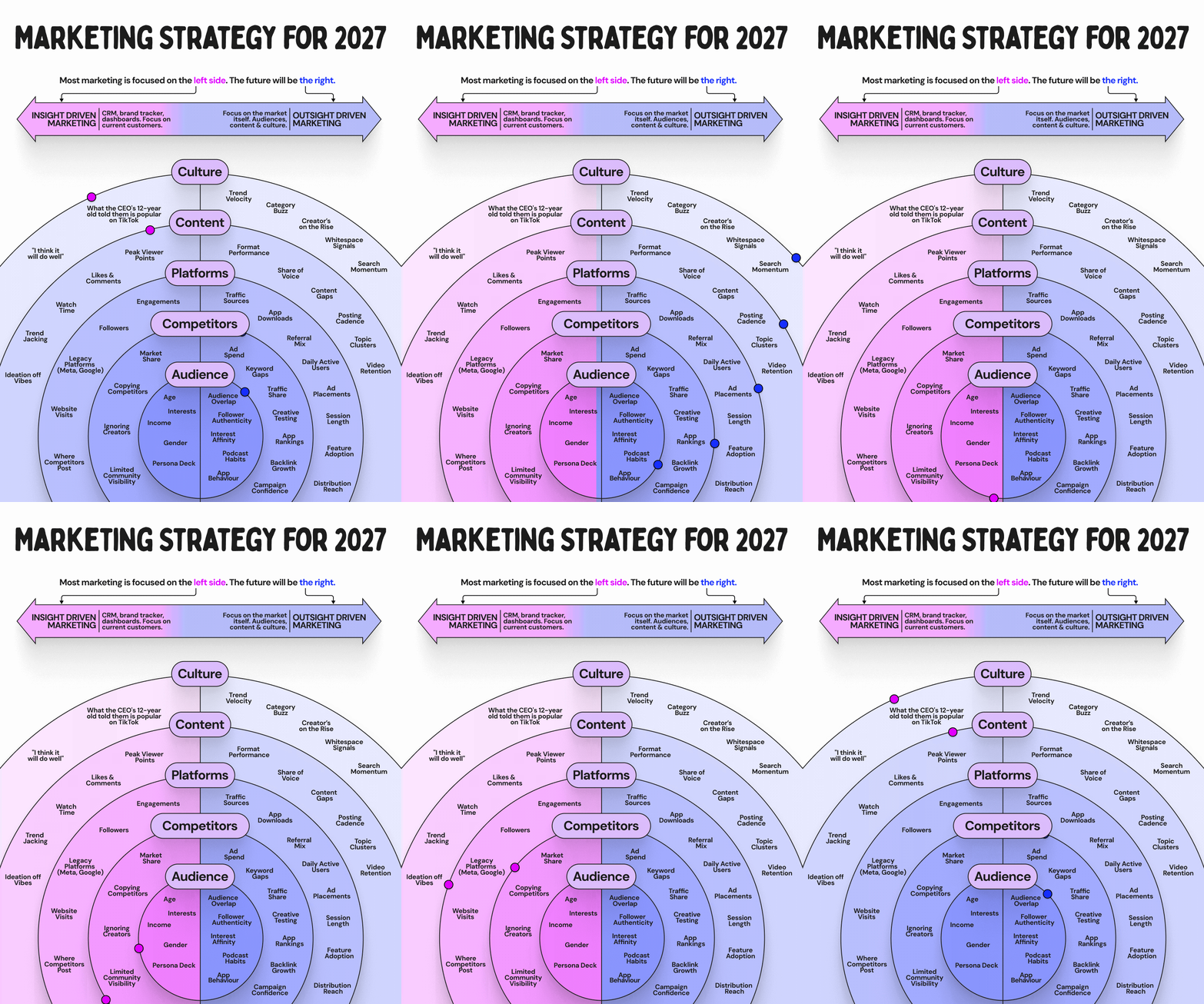
6 of 54 adsSign up to see every RightMetric ad, filter by format and date, and get alerts on new ones.
See all 54 adsWatch the companies you care about.
Filter every ad by industry, country, format and network, and get alerts when a company you watch starts running new ads.