Not on air · 2 of 3 networks checked
RetentionX
- retentionx.com
- Data Infrastructure and Analytics
- US
- 16 employees
RetentionX’s ads on LinkedIn, Meta and Google, recorded by adsrunning. Browse the latest here for free. Sign up free to see all 691. Watch RetentionX with Starter to get each new one in your feed.
Watchlist with Starter · $49/mo
| Network | Status | Live ads | Nov 2025LinkedIn activity · 52 weeksNov 2026 | Checked | Next step |
|---|---|---|---|---|---|
| None recorded | 0 | Checked 1 Nov 2026 | See all 691 ads → | ||
| Meta | Not checked | — | |||
| Recently | 62 | Ads on the Google Ads Transparency Center | Checked 8 Oct 2026 | Collect them with the API → |
RetentionX has no live LinkedIn ads. We recorded 62 Google ads on 8 Oct 2026.
Latest ads
- LINKEDIN · IMAGESince 22 Oct 2026
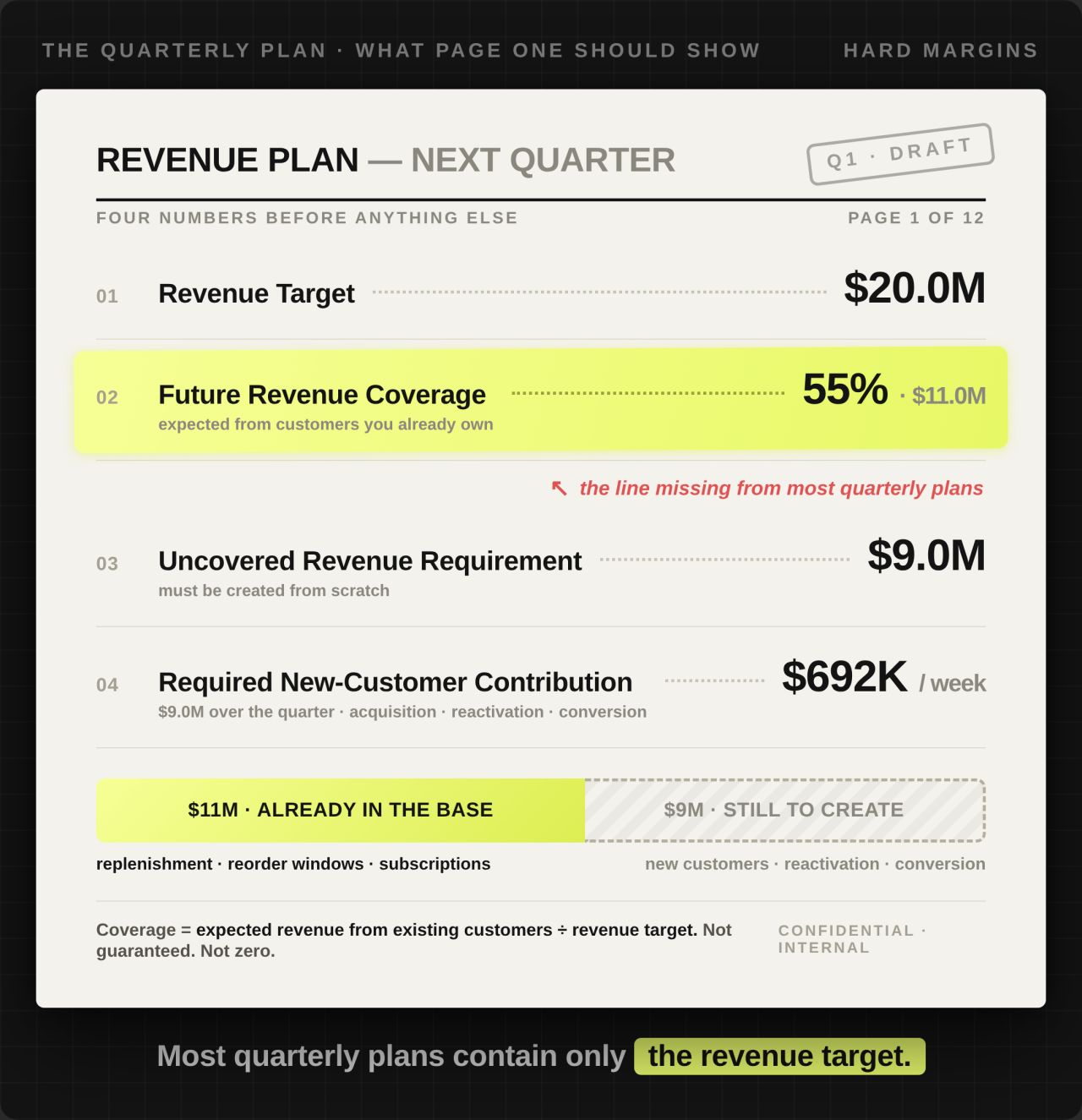
SaaS founders walk into a quarter already knowing most of the number. Ecommerce walks in acting like the number is zero. New quarter, new target, new campaigns, new money. The same fight from scratch, four times a year. But if customers are replenishing, reordering, subscribed, a piece of next quarter's revenue already exists. It just isn't labeled. I call it Future Revenue Coverage: the share of your next-quarter target that existing customers are expected to deliver, before you acquire anyone new. Coverage = expected revenue from existing customers ÷ next-quarter revenue target. Two brands, one target. Both need $20M next quarter. Brand A's customer base is expected to deliver $11M of it. Coverage: 55%. The quarter starts at $11M, and the job is to create $9M. Brand B's base covers $4M. Coverage: 20%. The job is to find $16M in ninety days. Same target. Completely different quarters. One team is executing a plan. The other is placing a bet. Nobody signed a contract for Brand A's $11M. But it isn't hope either. It's replenishment cycles, open reorder windows, active subscriptions. Behavior you can count. Once you see coverage, the plan splits in two. Protect the $11M: that's retention work, and it needs an owner and a budget. Create the $9M: that's acquisition, with a different owner and different math. Most plans skip straight to the second job and leave the first one unmanaged. That's how covered revenue quietly leaks out while everyone is busy chasing new customers. How much of your next quarter already exists? Full piece here: https://lnkd.in/gN6zMKVK
- LINKEDIN · IMAGESince 2 Oct 2026
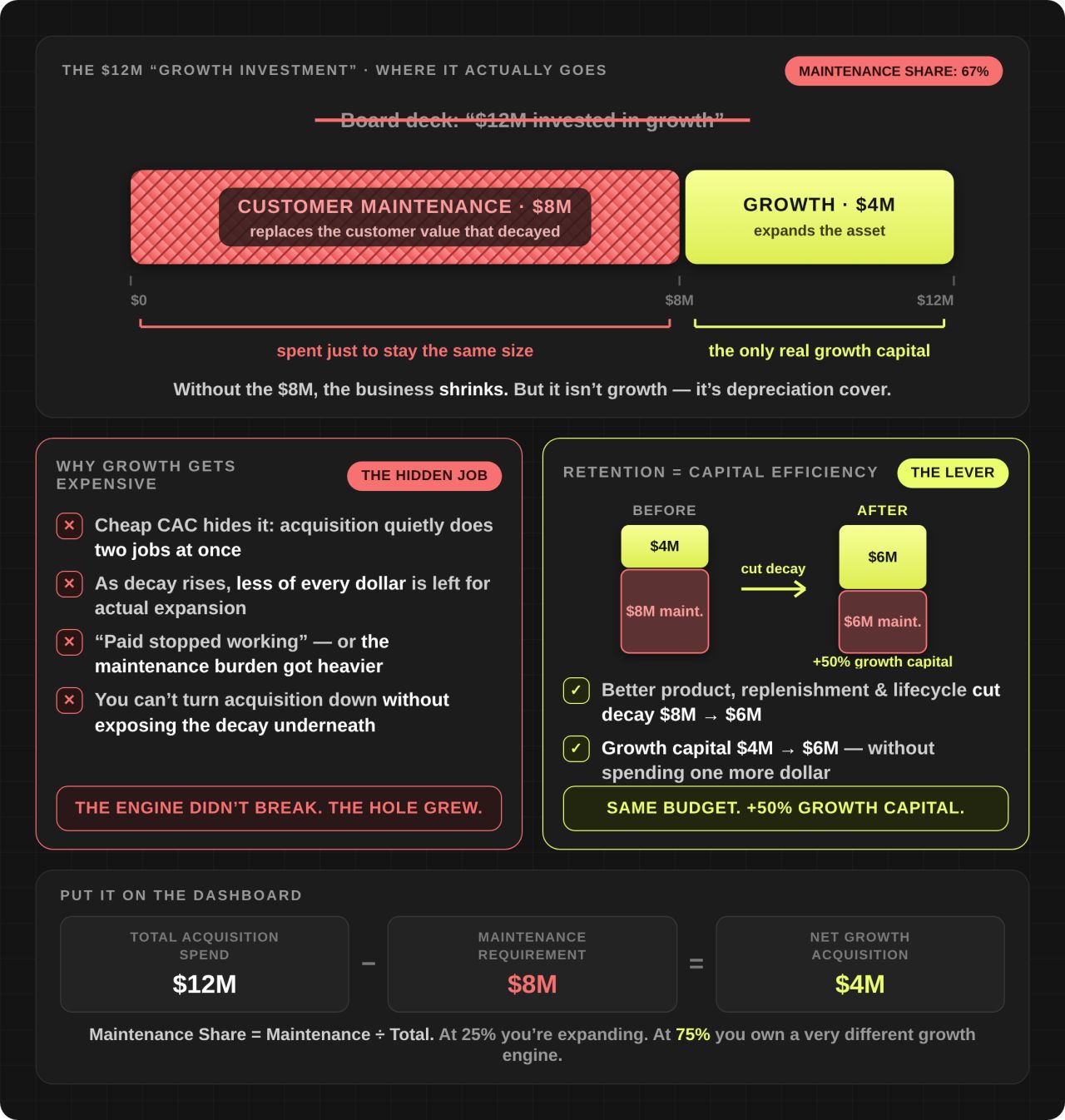
Acquisition spend isn’t all growth spend. Some of it is maintenance capex. Imagine a brand spends $12M a year acquiring new customers. The board deck says: $12M invested in growth. But the existing customer base is constantly decaying. Customers stop buying. Relationships go dormant. Future customer value disappears. And $8M of that acquisition spend is effectively required just to replace what was lost. So the economics actually look more like: $12M acquisition spend → $8M maintenance → $4M actual expansion That $8M is still necessary. But it isn’t really growing the customer asset. It is keeping the machine at its current size. I think brands should separate acquisition into: Maintenance Acquisition What you need just to offset customer-base decay. Growth Acquisition What actually expands the business beyond where it started. The interesting part is what happens when you connect this to retention. A more durable customer base doesn’t just generate more repeat revenue. It also frees up acquisition dollars that were previously being consumed by replacement. Which leads to a question I’d want every CEO to know: How much do we have to spend on acquisition before we grow by even one dollar? I wrote the full framework on Customer Maintenance Capex and why I think it changes how we should look at CAC, retention and growth budgets. If you have to spend it just to stay the same size, it isn’t growth capital. Full article: https://lnkd.in/gX-Gaypw
- LINKEDIN · IMAGESince 19 Sept 2026
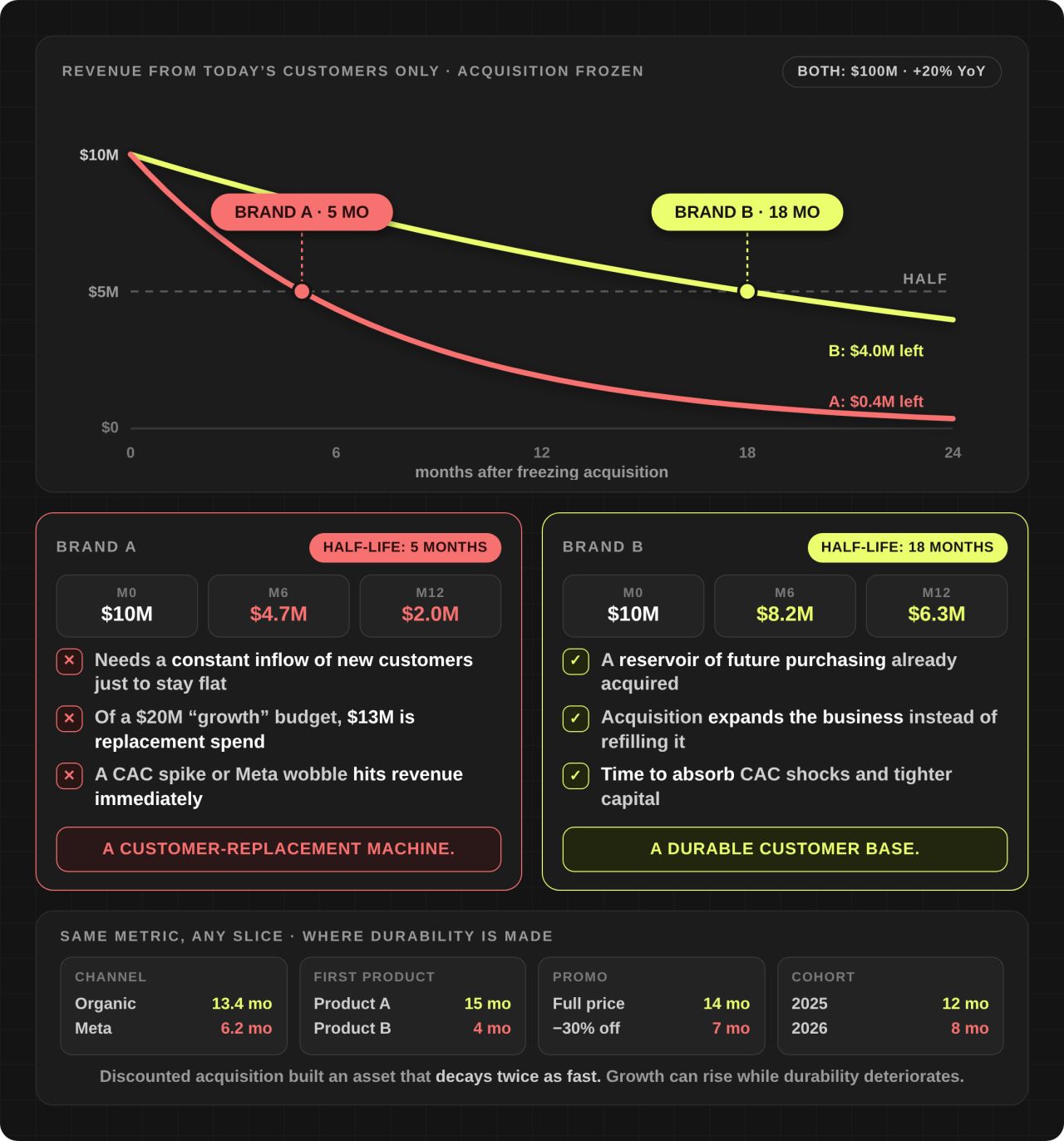
If you stopped acquiring customers today, how long would it take for half your existing-customer revenue to disappear? 3 months? 9 months? 2 years? I think that number tells you something fundamental about the quality of the business. I'd call it: Customer Base Half-Life. Repeat purchase rate doesn't show how long purchasing persists. LTV tells you how much value exists, not how quickly the customer base decays. Revenue growth can actually hide the problem completely because acquisition keeps replacing the customers disappearing underneath. What gets really interesting is calculating half-life by: • acquisition channel • first product • discount level • cohort • geography Imagine discovering: Meta-acquired customer half-life: 5.8 months Organic customer half-life: 14.2 months Or: Full-price customer half-life: 16 months Promo-acquired customer half-life: 7 months Suddenly "customer quality" becomes much more tangible. I wrote the full framework for calculating this and why I think it belongs on an executive ecommerce dashboard. Revenue tells you how big the business is today. Customer half-life tells you how quickly it disappears without replacement. Full article: https://lnkd.in/e9uvpU46
- LINKEDIN · IMAGESince 10 Sept 2026
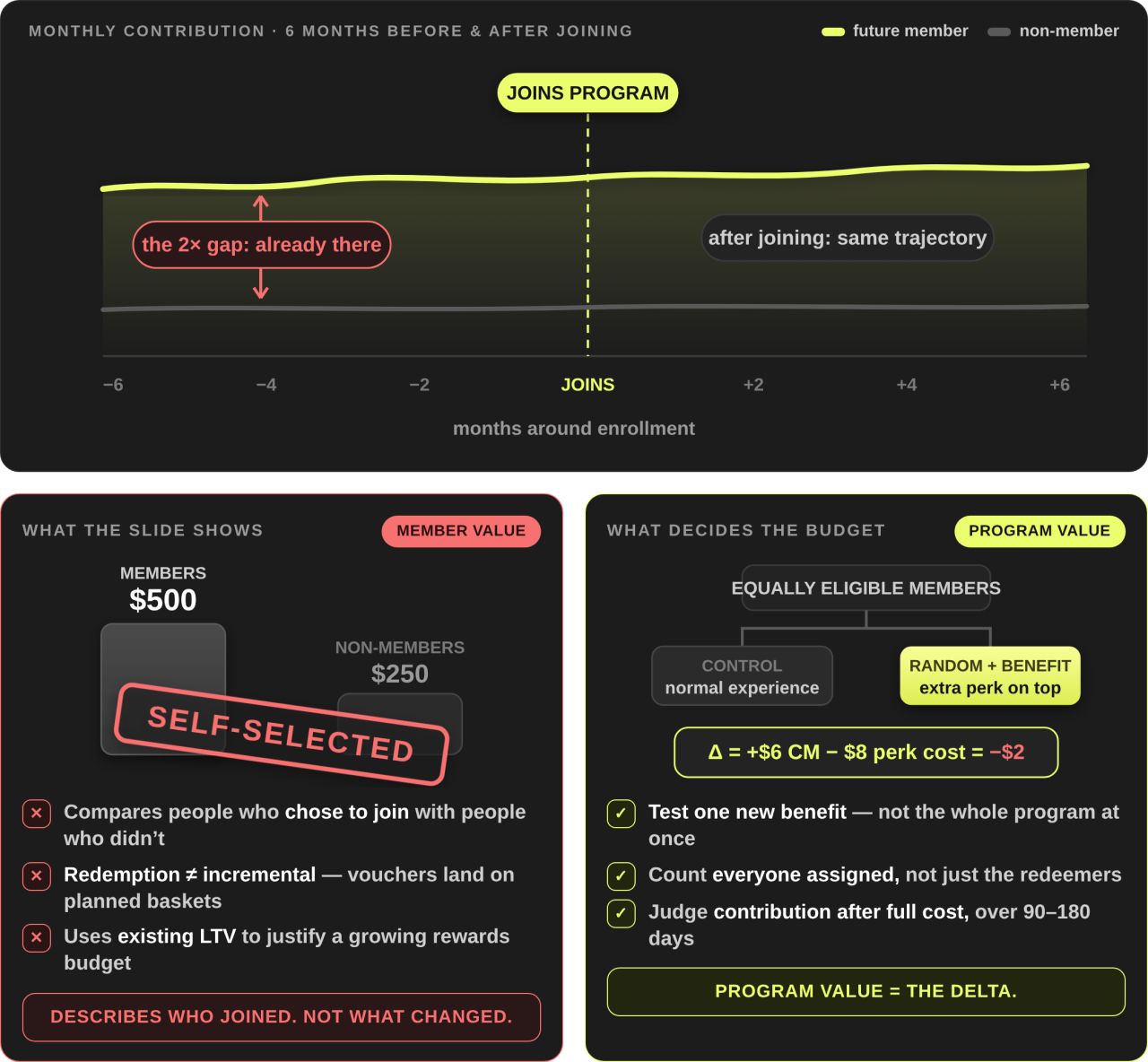
Your loyalty program might be paying for loyalty it never created. "Members spend twice as much as non-members." That sounds like a reason to increase the rewards budget. Until someone asks: What did those customers look like before they joined? Imagine you check the purchase history and discover that your future members were already: • buying more frequently • shopping across more categories • spending more at full price They didn’t become your best customers because they joined. They joined because they were already your best customers. The program may have attracted loyalty rather than created it. That doesn’t make it useless. Recognition matters. Keeping a good customer can be valuable even when their spending doesn’t increase. But it does make the usual member-versus-non-member comparison a weak justification for the budget. The uncomfortable question is: Are we changing customer behavior – or paying for behavior we already had? Getting this wrong doesn’t just waste reward costs. It can make you expand a program precisely because it is good at enrolling people who need the least incentive to buy. I unpacked this in the full article: how to spot the problem in your customer history, what to measure beyond redemption, and how to test a benefit without taking away rewards you’ve already promised: https://lnkd.in/gzt_Qyuj
- LINKEDIN · IMAGESince 3 Sept 2026
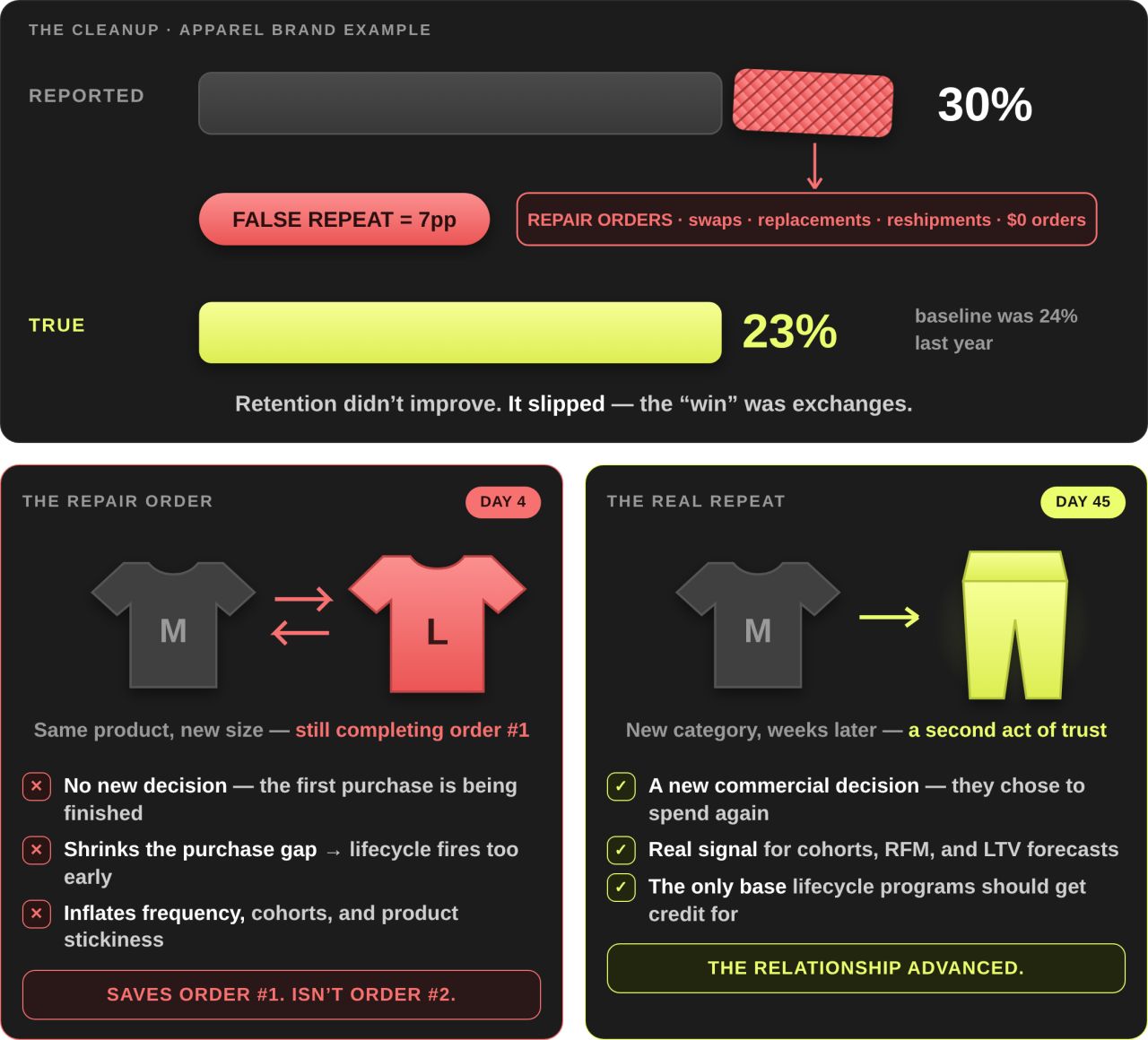
Not every second order is retention. Sometimes it’s just the brand repairing the first one. This is especially easy to miss in apparel. Imagine your dashboard says: First → second order rate: 30% Looks great. But buried inside those “repeat purchases” are customers who: • exchanged a medium for a large • swapped one color for another • received a replacement for a damaged item • had an order corrected or reshipped Technically, another order happened. Commercially, something very different happened. The customer didn’t make a second buying decision. They were still trying to complete the first one. And once you see that distinction, a surprisingly uncomfortable question comes up: How much of your reported retention is actually repair behavior? Because this doesn’t just distort repeat purchase rate. It can change what you believe about: • how quickly customers come back • which products are sticky • which cohorts are improving • which customers are loyal • and whether your lifecycle program is actually working The most dangerous part? You can end up solving the completely wrong problem. A brand may think it needs better CRM when the real issue is sizing, product expectations, quality, or fulfillment. I went much deeper on this in this week’s Hard Margins – including the metric I’d use instead, the other retention KPIs this contaminates, and how we separate genuine repeat from repair orders inside RetentionX. The second order happened. The relationship didn’t necessarily advance. Full article: https://lnkd.in/eKutB-Ru
- LINKEDIN · IMAGESince 27 Aug 2026
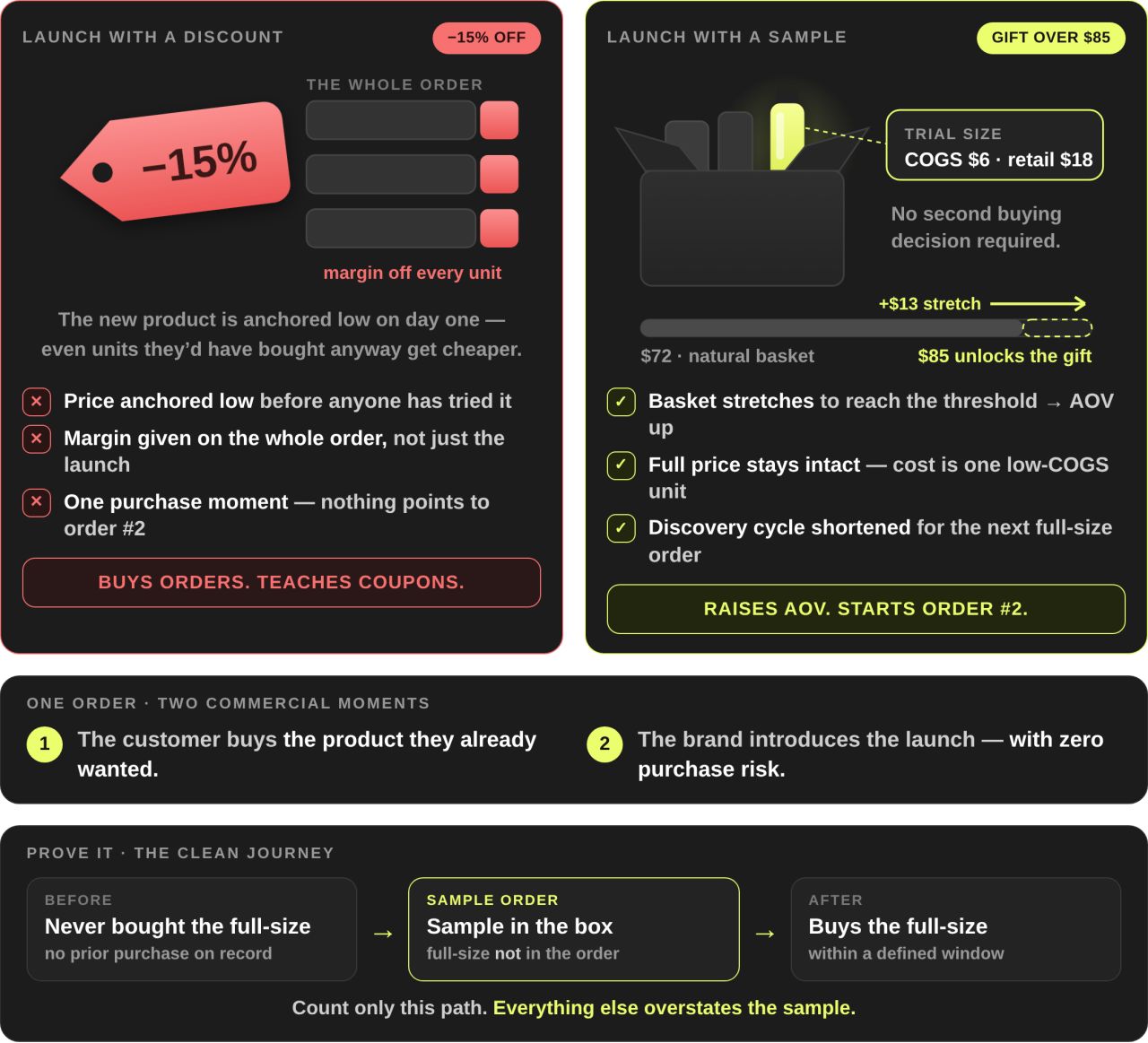
Your cheapest retention lever may already fit inside the shipping box. Most brands still treat samples as freebies. A nice unboxing touch. Something customers enjoy, but finance struggles to justify. That misses the much bigger opportunity. The right sample can influence two orders at once: • It can make the current offer stronger without discounting it. • It can introduce the product most likely to create the customer’s next purchase. That makes sampling useful for far more than product launches. It can help you: • increase AOV through gift-with-purchase thresholds • move customers into new categories • accelerate discovery of your stickiest products • create a cleaner path into order 2 But most brands have no reliable way to prove whether the sample actually worked. If a customer later buys the full-size product: Did the sample cause it? Had they purchased it before? Was the full-size product already in the same order? Would they have converted anyway? Without isolating the exact customer journey, a "successful" sampling campaign can be little more than an attractive assumption. I wrote a full breakdown on: • how to choose the right product to sample • why a gift can outperform another discount • how to structure the threshold • and how to measure true sample-to-full-size conversion without overstating the result Because the strategic question isn’t: What can we afford to give away? It’s: Which product do we want the customer to discover next — and what would that discovery be worth? Read the full article here: https://lnkd.in/eGiWPa_J
6 of 691 adsSign up to see every RetentionX ad, filter by format and date, and get alerts on new ones.
See all 691 adsWatch the companies you care about.
Filter every ad by industry, country, format and network, and get alerts when a company you watch starts running new ads.