Not on air · 2 of 3 networks checked
Relativ.ai | Conversational Analytics
- relativ.ai
- IT Services and IT Consulting
- US
- 5 employees
Relativ.ai | Conversational Analytics’s ads on LinkedIn, Meta and Google, recorded by adsrunning. Browse the latest here for free. Sign up free to see all 20. Watch Relativ.ai | Conversational Analytics on any plan to get each new one in your feed.
Watchlist included in every plan
| Network | Status | Live ads | Nov 2025LinkedIn activity · 52 weeksNov 2026 | Checked | Next step |
|---|---|---|---|---|---|
| None recorded | 0 | Checked 2 Nov 2026 | See all 20 ads → | ||
| Meta | Not checked | — | |||
| None recorded | 0 | No ads found on the Google Ads Transparency Center | Checked 17 Oct 2026 | Collect them with the API → |
Relativ.ai | Conversational Analytics has no live LinkedIn ads. We recorded no Google ads on 17 Oct 2026.
Latest ads
- LINKEDIN · IMAGERecorded 14 Oct 2026
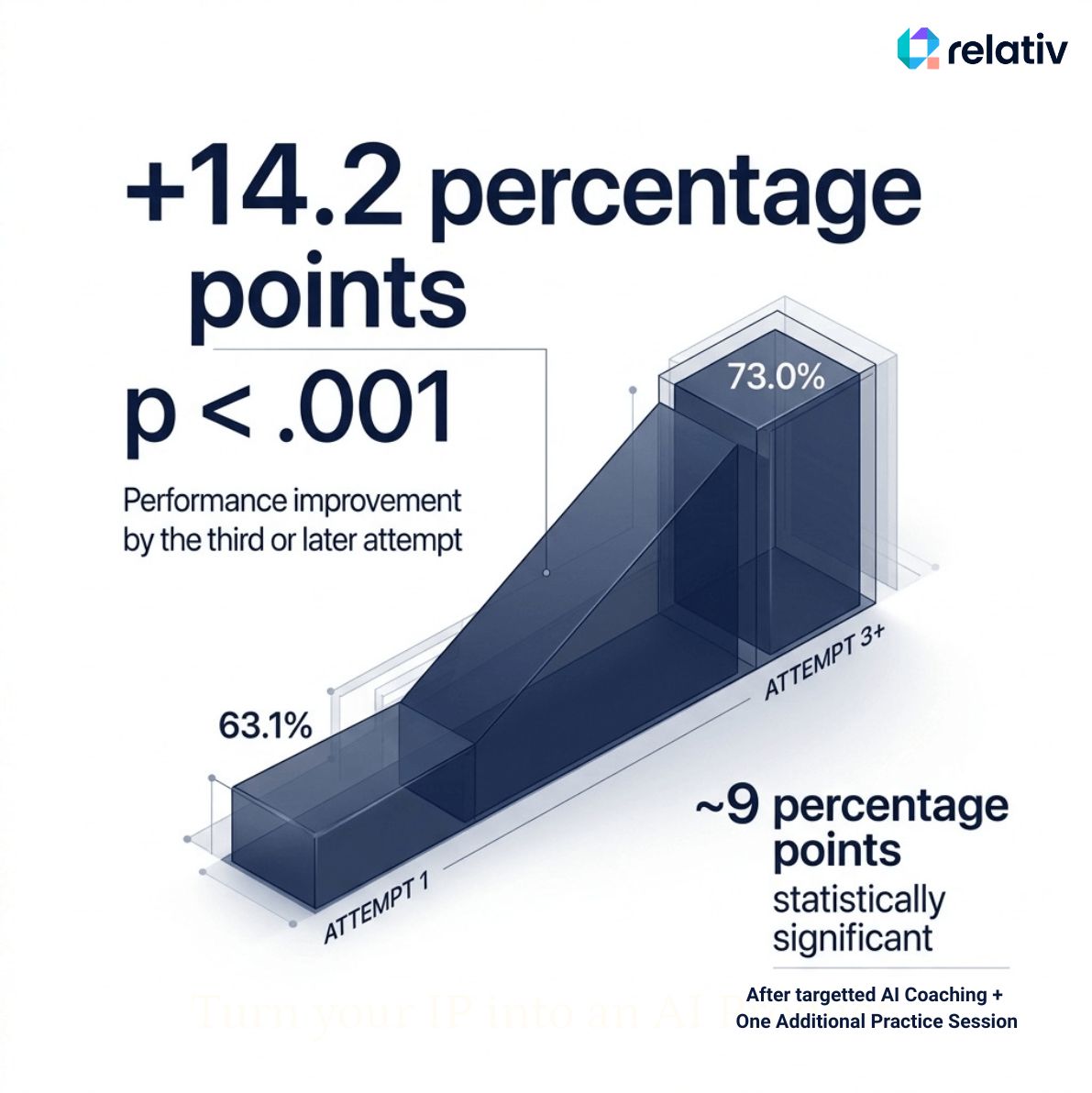
I’m really excited that Relativ.ai | Conversational Analytics is now approved for use in IRB-reviewed research studies. Across two separate studies, we’ve seen early evidence that AI models, when specifically designed to coach and support deliberate practice, can produce measurable behavioral improvement. How an AI model is trained to recognize, evaluate, and respond to specific behaviors is where much of the expertise lives. In one study, 80+ learners completed 150+ simulated practice sessions, with performance roughly 14 percentage points higher by the third or later attempt (p < 0.001). In another, 150+ professionals completed ~600 AI-facilitated coaching sessions, with one additional targeted practice session producing a roughly 9-point improvement. IRB approval means we have to hold our AI coaching to a higher standard. In a market crowded with shiny AI toys and checkbox pilots, we’re grateful to work with so many organizations that are genuinely interested in performance improvement and behavior change.
- LINKEDIN · IMAGERecorded 14 Oct 2026
A lot of the current AI tooling for creating simulations / roleplay focuses on prompting, personas, and authoring workflows. Useful, but those are still mostly surface-level representations of something much harder - human conversation is incredibly nuanced. Before we can reliably create simulated environments for practicing real conversations, AI needs to understand what is actually happening within them - because doing something in a conversation does not guarantee a particular outcome. That’s a big part of the R&D work we’re doing at Relativ.ai | Conversational Analytics - understanding the relationship between what someone does, how the other person responds, and what happens next. We’re working on how to solve that. More soon. In the meantime, here is an interesting resource from Google Research for anyone thinking about this: https://lnkd.in/g5pchQGt
- LINKEDIN · IMAGERecorded 14 Oct 2026
Use AI To 10X Your Coaching Methodology Without Replacing Your Coaches. One of the hardest parts of turning coaching expertise into a scalable product isn't building the technology. It's getting the methodology out of the coach's head. A good place to start is one high-value conversation -- define the participant, the challenge, and what you're actually asking them to do. Then document what good performance looks like, add examples from your coaching practice, and turn those behaviors into a scoring rubric. But there's an important step between building the rubric and putting it in front of learners: - Expert calibration. My work with human-labeled analytics eventually contributed to a Nature paper. One thing that work taught me: - Expert examples and disagreements are product data, not editorial comments. AI can generate a score very easily. That doesn't make the score meaningful. Your coaches need to define the behaviors, review examples, and challenge the system when its judgment doesn't match theirs. That's how you start turning unstated expertise into something an AI system can actually apply. And there's another benefit: Productizing the methodology exposes where it is clear, where it is still unstated, and where experienced coaches don't actually agree. That, in turn, can make the underlying training program better too. Once calibrated, that expertise doesn't clock out. It's available 24/7, in multiple languages, ready to support a learner whenever they're ready to practice. The technology scales the opportunity. The firm still owns the standard. We've built the architecture behind a white-label AI practice product. Now you can steal it. The blueprint includes: - A conversation-design template. - An observable-rubric framework. - The expert-calibration workflow. - A pilot-readiness checklist. Use it to evaluate vendors, brief your developers, or design your first AI coaching product without hiring an internal software team. P.S. - See here how ➡️ relativ.ai turns your own methodology into a branded AI product that meets all your clients' AI expectations, and creates recurring revenue at scale
- LINKEDIN · IMAGERecorded 14 Oct 2026
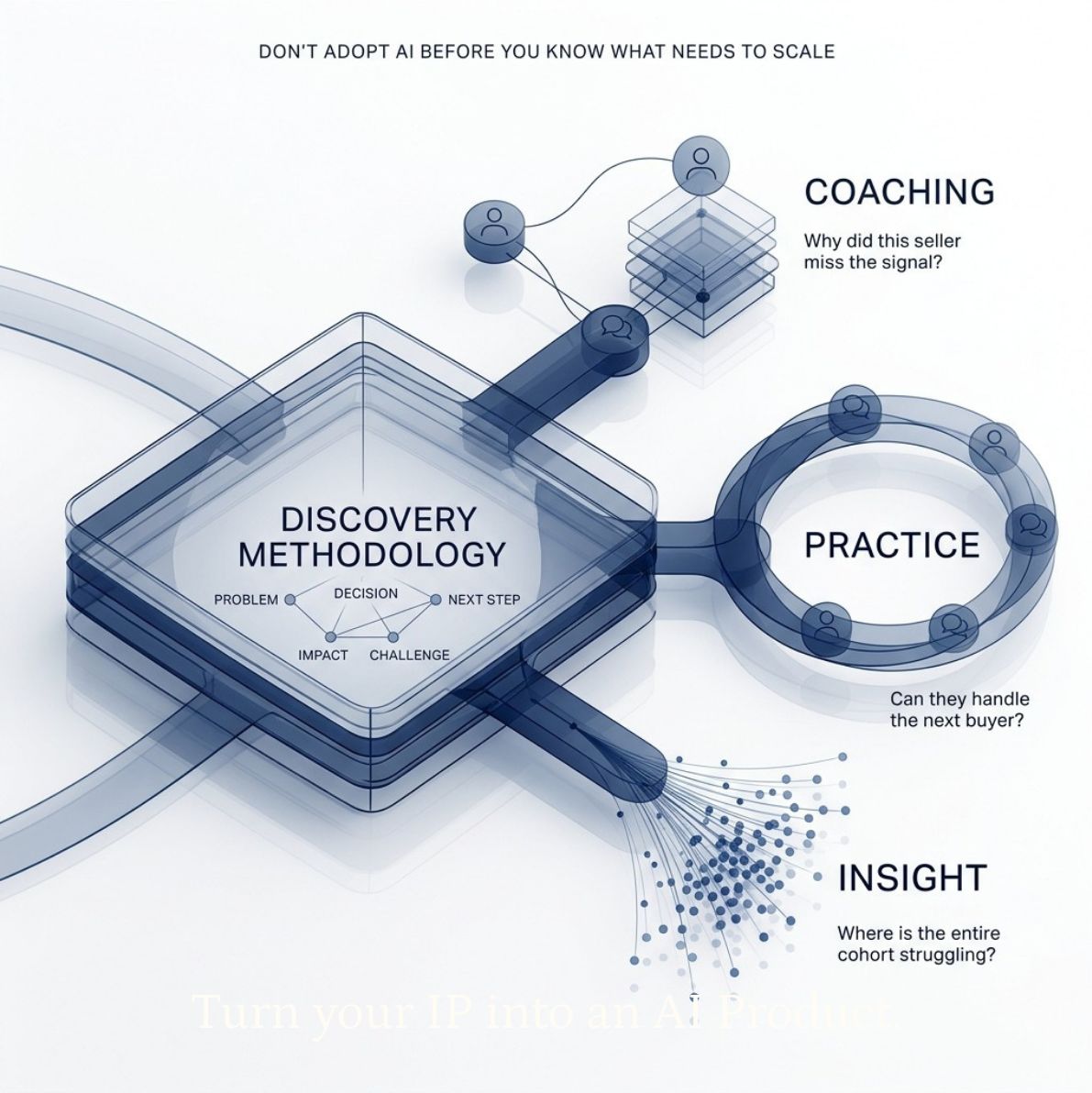
I get a number of requests to leverage AI from organizations looking to drive human performance and behavior change. My advice to them is always the same: "Don't adopt an AI product until you know what part of your methodology needs to scale." Executive coaching firms may want to extend premium human coaching with AI-assisted reflection, preparation, and private rehearsal. Sales enablement firms may want to turn their methodology into repeated conversation practice between coaching sessions. Leadership and enterprise training firms may want to measure how behavior changes across an entire cohort - not just what happened in the classroom. These are different markets with different jobs, but just one underlying asset: the methodology. The mistake is adopting a generic AI product and expecting it to perform work that was previously reserved for premium human interaction. Start with the expertise you already own. Ask what your clients need more of: coaching, practice, or measurable insight. Then build the AI layer around that job. Don't start with AI. Start with the part of your methodology that deserves to scale. P.S. - See here how ➡️ relativ.ai turns your own methodology into a branded AI product that meets all your clients' AI expectations, and creates recurring revenue at scale.
- LINKEDIN · IMAGERecorded 14 Oct 2026
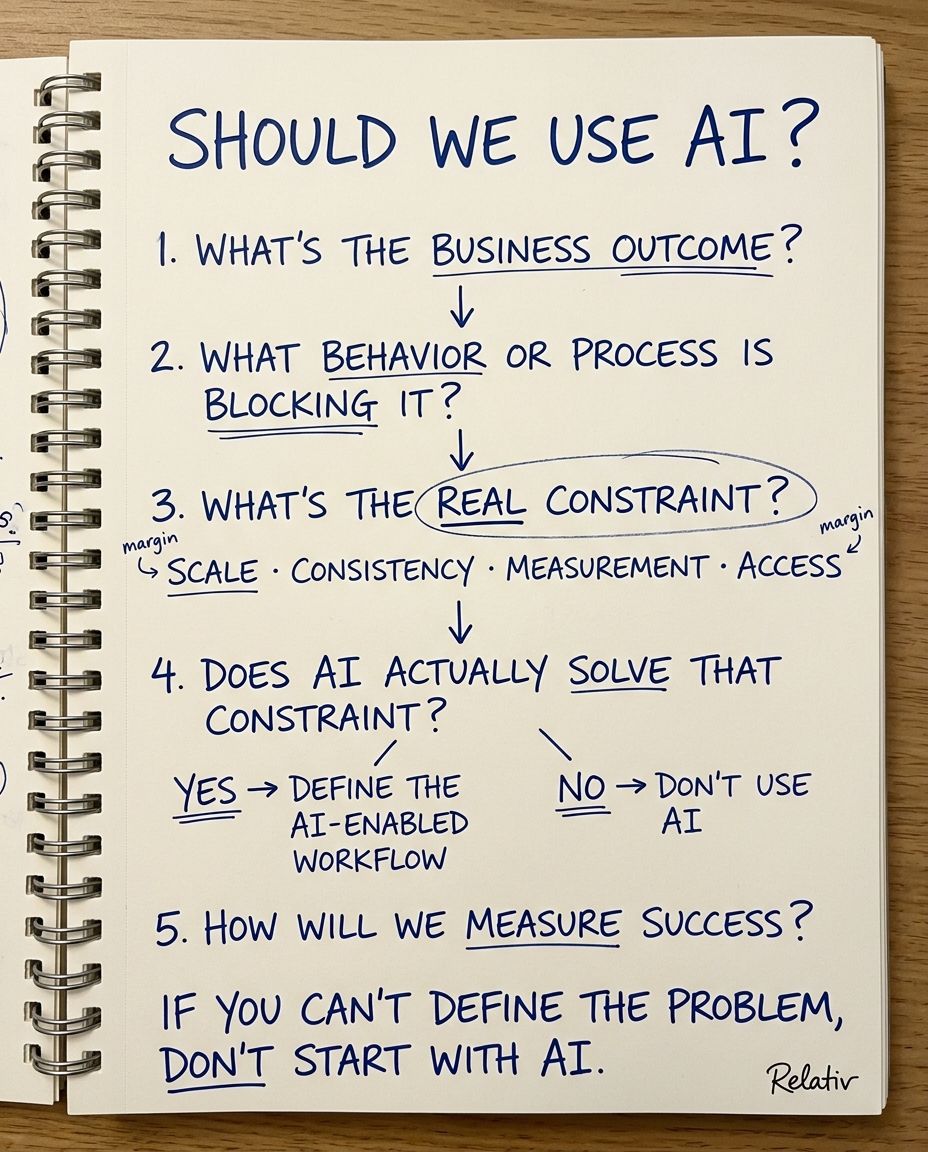
I’m in a lot of conversations about what organizations are doing with AI, particularly when it comes to AI coaching and human performance. A recent public roundtable about the work behind Relativ.ai | Conversational Analytics had me reflecting on a fundamental question: What problem are you actually trying to solve? I have lost count of the number of times this sequence is reversed. Someone discovers a new AI capability, and the organization starts looking for a problem that capability might solve. Please don’t. If you're looking at AI coaching, start with the business outcome. Identify the behavior or process getting in the way. Ask whether the real constraint is scale, consistency, measurement, or access. Then decide whether AI belongs in the solution. I can’t emphasize how much this matters, especially when it involves human performance. AI might help extend coaching between sessions, create more opportunities for deliberate practice, or measure behavior change across a cohort. But those are very different jobs from simply "using AI". AI is an enabling technology. Its value comes from making possible what the organization couldn't reliably or efficiently do before. Stop treating AI capability as a strategy. Ask yourself: What does the organization need to do something more reliably or efficiently than we can today? I'm developing a series of posts about how to technically architect AI systems that reliably improve human performance (after a gap has been identified). Stay tuned for more. P.S. - See here how ➡️ relativ.ai turns your own methodology into a branded AI product that meets all your clients' AI expectations, and creates recurring revenue at scale
- LINKEDIN · IMAGERecorded 14 Oct 2026
If you run a training firm, recurring revenue is trapped in your calendar. Every time you add learners, you add facilitator hours - and because training is inherently simultaneous and 1:1, your growth is ultimately constrained by how many people you can put in a room at once. AI changes these economics, but ONLY when it carries your methodology. Not when it simply acts like another chatbot. Your workshop and one-one sessions teach the concept. AI learns from it, and lets every learner practice it repeatedly, on demand, between sessions. Your rubrics allow the AI to measure the behavior, and your coaches spend their time on the moments where human expertise matters most. That means your firm's most valuable asset, its methodology, can keep working long after the workshop ends. You cannot (and should not) replace human coaches - but you *can* turn their expertise into a scalable product. Want to learn more about how training firms are already increasing their revenue streams using Relativ ? P.S. - See here how ➡️ relativ.ai turns your own methodology into a branded AI product that meets all your clients' AI expectations, and creates recurring revenue at scale



6 of 20 adsSign up to see every Relativ.ai | Conversational Analytics ad, filter by format and date, and get alerts on new ones.
See all 20 adsWatch the companies you care about.
Filter every ad by industry, country, format and network, and get alerts when a company you watch starts running new ads.