On air · 2 of 3 networks
Recursion
- recursion.com
- US
- 761 employees
Recursion’s ads on LinkedIn, Meta and Google, recorded by adsrunning. Browse the latest here for free. Sign up free to see all 87. Watch Recursion with Starter to get each new one in your feed.
Watchlist with Starter · $49/mo
| Network | Status | Live ads | Nov 2025LinkedIn activity · 52 weeksOct 2026 | Checked | Next step |
|---|---|---|---|---|---|
| Running | 28 | Checked 29 Oct 2026 | See all 87 ads → | ||
| Meta | Running | 2 | Active ads on the Meta Ad Library, all countries | Checked 28 Oct 2026 | Collect them with the API → |
| None recorded | 0 | No ads found on the Google Ads Transparency Center | Checked 28 Oct 2026 | Collect them with the API → |
Recursion has 28 live LinkedIn ads. Its Facebook page had 2 active ads on 28 Oct 2026, and we recorded no Google ads on 28 Oct 2026.
Latest ads
- LINKEDIN · IMAGESince 2 Sept 2026
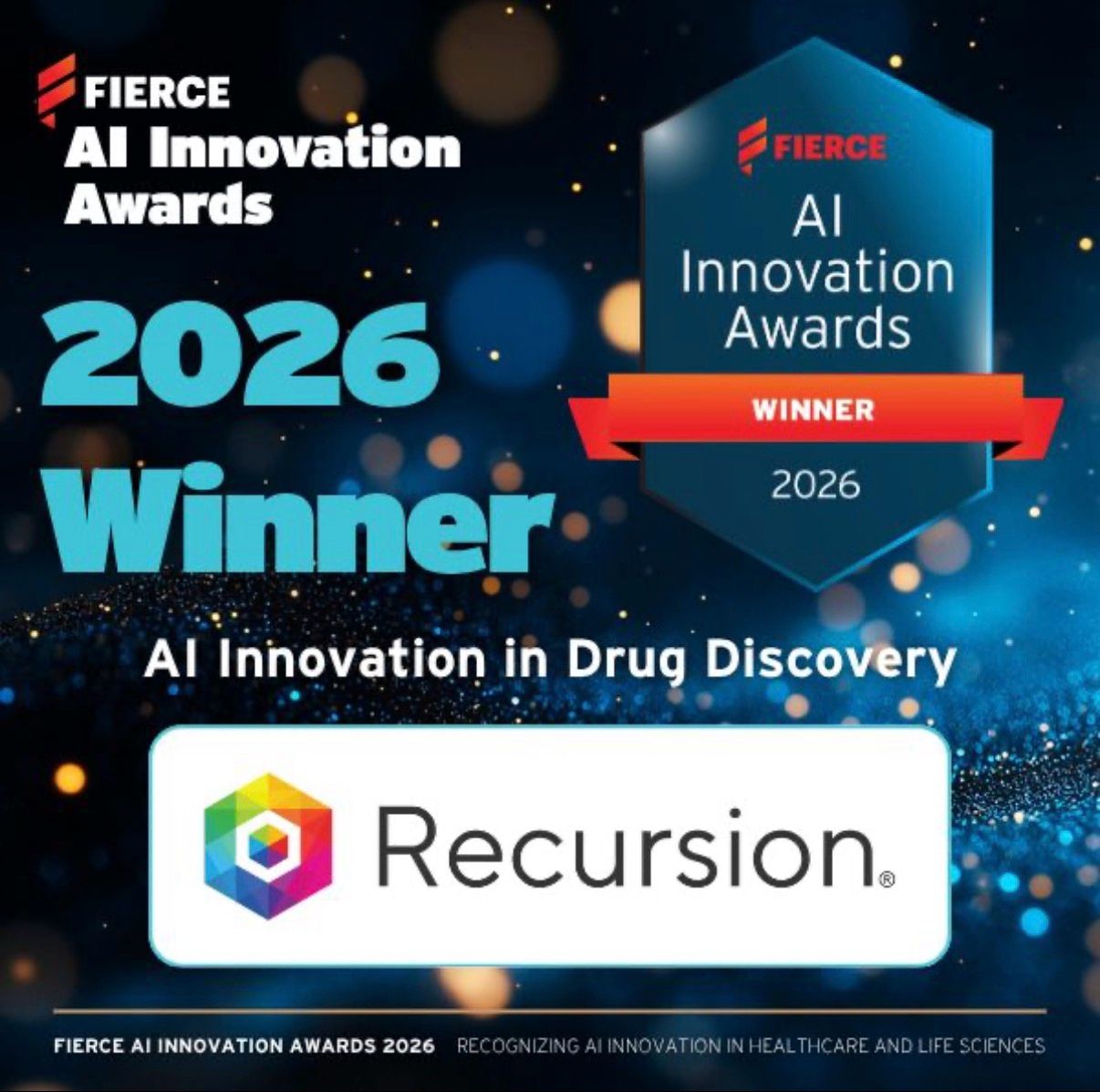
Proud to see Recursion recognized by Fierce as the winner for AI Innovation in Drug Discovery. This recognition belongs to the incredible team at Recursion and I particularly appreciated what Fierce highlighted about why our approach is different. As AI becomes ubiquitous, access to powerful models alone won’t be enough. I believe the real opportunity in drug discovery comes from bringing together AI with proprietary data, deep biology and chemistry, scaled experimentation and clinical development - creating a system that can learn at every step. That is what we have been building at Recursion. And the Recursion OS of today is fundamentally different from the one we started with. It has evolved from our pioneering work in phenomics into an integrated system spanning multimodal biology, chemistry and clinical development - allowing our scientists to ask questions, generate hypotheses and test them at a scale and resolution that simply wasn’t possible before. What excites me most is seeing that system begin to translate repeatable into the real world. - In FAP, REC-4881 has generated encouraging Phase 2 data in a rare cancer-predisposition syndrome where there are no approved pharmacologic therapies today. We have the opportunity to pursue a first-in-class medicine for a disease with significant unmet need - In difficult-to-treat solid tumors, REC-1245 represents journey from computational insight to a potential first-in-class medicine now being tested in patients. There is much more to learn here and much more to come. - And with Roche and Genentech, we have uncovered a previously unexplored neuroscience target in an area where novel, actionable biology has been remarkably scarce. It emerged from a first-of-its-kind map built using more than 1 trillion neurons manufactured in our labs and is now advancing into joint drug discovery. We’re grateful to our partners at Roche and Genentech for sharing the ambition to go after biology that has historically been so difficult to reach. - We are also seeing this engine generate new molecules across our collaboration with Sanofi in I&I and Oncology, further testing the ability of the platform to produce important discoveries across different therapeutic areas and partners. To me, these aren’t simply individual programs. They are glimpses of what becomes possible when biology, chemistry, data, AI and experimentation operate as one system. We have much more to prove. And ultimately, none of this will be measured by the sophistication of our models or the scale of our data. It will be measured by whether we can create medicines that meaningfully change patients’ lives. That is why we built Recursion. Today, though, I’m taking a moment to celebrate the extraordinary people building it. Congratulations, Team Recursion. Proud of how far we’ve come - and incredibly excited about where we are going. 🚀 https://lnkd.in/eefTEsVu
- LINKEDIN · VIDEOSince 6 Aug 2026
AI won't be measured by benchmarks. It will be measured by new biology – and ultimately by better medicines. Yesterday, Recursion announced an important milestone in our collaboration with Roche and Genentech: Genentech exercised the first Validated Target Option, advancing a previously unexplored neuroscience target into a joint early discovery program. To me, this milestone isn't about a single target. It's about demonstrating a new way of discovering medicines. For decades, neuroscience has been one of medicine's greatest challenges. Human neurons are extraordinarily difficult to study at scale, disease biology remains incompletely understood, and much of the genome has remained unexplored in disease-relevant systems. As a result, we've often returned to the same handful of biological pathways – not because we've lacked creativity, but because we've lacked a systematic way to discover and build confidence in new biology. Together with Roche and Genentech, we took a different approach. Rather than testing one hypothesis at a time, we built one of the largest AI-native Maps of Biology in neuroscience, generating more than one trillion human neurons, systematically perturbing 17,000+ genes, capturing 30 million cellular images, and training foundation models on those data. But AI predictions alone don't become medicines. Every prediction was challenged through rigorous wet- and dry-lab validation developed jointly with Roche and Genentech. Only the strongest targets advanced through increasingly stringent pathway, functional, and disease validation experiments. To me, that's the real story. AI is advancing at an incredible pace, but no single model will define the future of drug discovery. The real opportunity lies in building a recursive learning system – one that combines industrial-scale disease-relevant data, foundation models, experimental validation, and deep scientific collaboration so that every experiment improves the next discovery. I believe approaches like this can help open the door to a new generation of medicines. Thank you to the incredible teams at Recursion, Roche and Genentech whose collaboration made this milestone possible. This is just the beginning. Learn more about this effort: 📰 Article in Bloomberg News by Fabienne Kinzelmann-Opel (gift link): https://lnkd.in/givRYDBw 👉 Blog: https://lnkd.in/gVjPYC6r #TechBio #DrugDiscovery
- LINKEDIN · VIDEOSince 5 Aug 2026
At Recursion, we believe success won't be defined by a single breakthrough. It will come from building an AI-native product engine that can repeatedly discover, design & develop differentiated medicines. Our second quarter marks another important step in that journey.A few highlights: 🔹 A milestone in our Roche and Genentech partnership Today, we announced that Genentech exercised the first Validated Target Option under our neuroscience collaboration, advancing a previously unexplored neuroscience target into a joint early discovery program. While it's still early, this is an important milestone for Recursion and the broader field. Neuroscience remains one of medicine's most challenging areas, where decades of research have yielded relatively few new targets. This milestone provides early evidence that an AI-native approach can discover, experimentally validate, and advance novel biology. This is a fundamentally different approach: one that brings together disease-relevant data generated at industrial scale, purpose-built foundation models, rigorous wet- & dry-lab validation, and deep scientific collaboration. I'll share more tomorrow re: how we reached this milestone. 🔹 Advancing toward a potential transformational therapy for FAP REC-4881 continues to make encouraging progress. Additional Phase 2 safety & efficacy data have been selected for a Presidential Plenary presentation at the CGA-IGC Annual Meeting in November. FAP is a devastating inherited cancer predisposition syndrome with no approved medicines. Patients today often face repeated surgeries & lifelong surveillance. We have initiated discussions with the FDA on a potential registrational path and expect to provide a regulatory update later this year. 🔹 Bringing a differentiated PI3K program into the clinic Earlier this week, the FDA cleared the IND for REC-7735, our mutant-selective PI3Kα H1047R inhibitor, and we plan to initiate the Phase 1/2 ZINNIA study later this year. REC-7735 was precision-designed to improve therapeutic index by enabling deep suppression of the H1047R driver mutation while sparing wild-type PI3Kα. The program demonstrates what's possible with an AI-native product engine, moving from first hit to development candidate in just 10 months across only 242 compounds. 🔹 Executing with discipline Innovation & financial discipline must go hand in hand. This quarter, we reduced our expected 2026 cash operating expenses to <$375M, while continuing to expect our cash runway into early 2028. None of these milestones happen in isolation. They reflect the work of exceptional teams across biology, chemistry, engineering, AI, translational science, clinical development & operations, all working toward one goal: turning advances in AI into better medicines for patients. I'm incredibly proud of what our team accomplished this quarter and excited about what comes next. Read our press release at the link in comments. #TechBio #DrugDiscovery
- LINKEDIN · IMAGESince 27 Jul 2026
I'm thrilled to welcome Dr. Hoifung Poon to Recursion as our first Chief AI Officer. At Recursion, we've always believed that building an AI-native biotech company means integrating AI across every stage of research and development, from understanding biology and designing chemistry to translational science and clinical development. AI isn't a function at Recursion; it's foundational to how we discover and develop medicines. As AI reshapes what's possible in science, we're investing accordingly. We believe the next era of drug discovery will be led by organizations that don't simply adopt AI – they help define what's possible with it. Bringing in world-class AI leadership is one of the most important investments we can make. Hoifung joins us after more than 15 years at Microsoft, most recently serving as General Manager of Microsoft Research, where he led pioneering work in biomedical AI, multimodal foundation models, and causal machine learning. His contributions – including PubMedBERT, GigaPath, and GigaTIME – have helped shape the field and are advancing biomedical research around the world. As one of the pioneers in biomedical AI, Hoifung had opportunities across technology, biotech, and pharma. His decision to join Recursion reflects our shared belief that we're entering a new era – one where the deepest advances in AI will come not from models alone, but from tightly integrating AI with experiments, data generation, and drug discovery to create medicines. What stood out to me throughout our conversations wasn't just Hoifung's technical depth – though it's exceptional. It was his conviction that AI should ultimately be judged by the scientific questions it helps answer and the patients it ultimately serves. He understands that AI isn't the destination – it's the engine that helps us uncover new biology, generate better evidence, make better decisions, and ultimately deliver better medicines. That philosophy couldn't be more aligned with our vision at Recursion. Our AI-powered product engine is built around a continuous learning loop between computation and experimentation, where every experiment strengthens our models, every model guides the next experiment, and every cycle brings us closer to discovering and developing better medicines. As our first Chief AI Officer, Hoifung will help accelerate that engine - bringing together frontier AI research and applied AI to further scale our ability to translate biology into products. Beyond his scientific accomplishments, Hoifung is an exceptional leader. He's thoughtful, humble, deeply collaborative, and passionate about developing teams. I'm excited to partner with him as we continue building the future of AI-enabled drug discovery. Welcome to the team, Hoifung. I can't wait to see what we'll build together. Onwards and upwards! 🚀 #TechBio #DrugDiscovery #ArtificialIntelligence
- LINKEDIN · VIDEOSince 20 Jul 2026
Predicting how tightly a molecule binds to its target is one of the fundamental challenges in drug discovery. Until now, researchers have largely faced a tradeoff: fast methods sacrifice accuracy, while more accurate approaches are often too computationally expensive to use at the scale modern drug discovery demands. Last year, our team at Recursion worked with the Massachusetts Institute of Technology to advance the field with Boltz-2, showing that AI could make binding affinity prediction both more accurate and more accessible. Today, we are excited to share the next release from our Valence Labs: Nesso-1, which we are also open sourcing. For years, there’s been an assumption that achieving better binding affinity prediction requires increasingly detailed, atomistic models. But Nesso-1 builds on thoughtfully-designed course-grained representations architecture to achieve comparable predictive performance at a fraction of the computational cost. The result is a model that predicts binding affinity in approximately 1 second on a single GPU – up to 20× faster than Boltz-2 – while matching or surpassing its performance across public benchmarks and, importantly, a diverse set of internal biochemical assays that better reflect real-world medicinal chemistry. By leveraging NVIDIA cuEquivariance, we've also accelerated training and inference by an additional 2–3×. Why does this matter? Because in AI-native drug discovery, speed isn't just an engineering metric – it determines how much science you can explore. Faster affinity prediction means screening much larger chemical libraries, running many more design iterations, and bringing autonomous drug discovery workflows closer to reality. Instead of forcing researchers to choose between computational efficiency and predictive performance, it demonstrates that thoughtful model design can advance both simultaneously. We're already using Nesso-1 internally alongside our proprietary datasets to accelerate active drug discovery programs, and we're excited to continue improving it with the community. Open science accelerates innovation. We hope Nesso-1 becomes a foundation the community can build on as we collectively push toward faster, more effective drug discovery. Weights and code are fully open source: GitHub: https://lnkd.in/grwpVc5Z HuggingFace: https://lnkd.in/g5ST7scJ Technical Report: https://lnkd.in/gyTgU7u3 #Nesso1 #DrugDiscovery #ArtificialIntelligence #OpenScience #MachineLearning #TechBio
- LINKEDIN · IMAGESince 26 Jun 2026
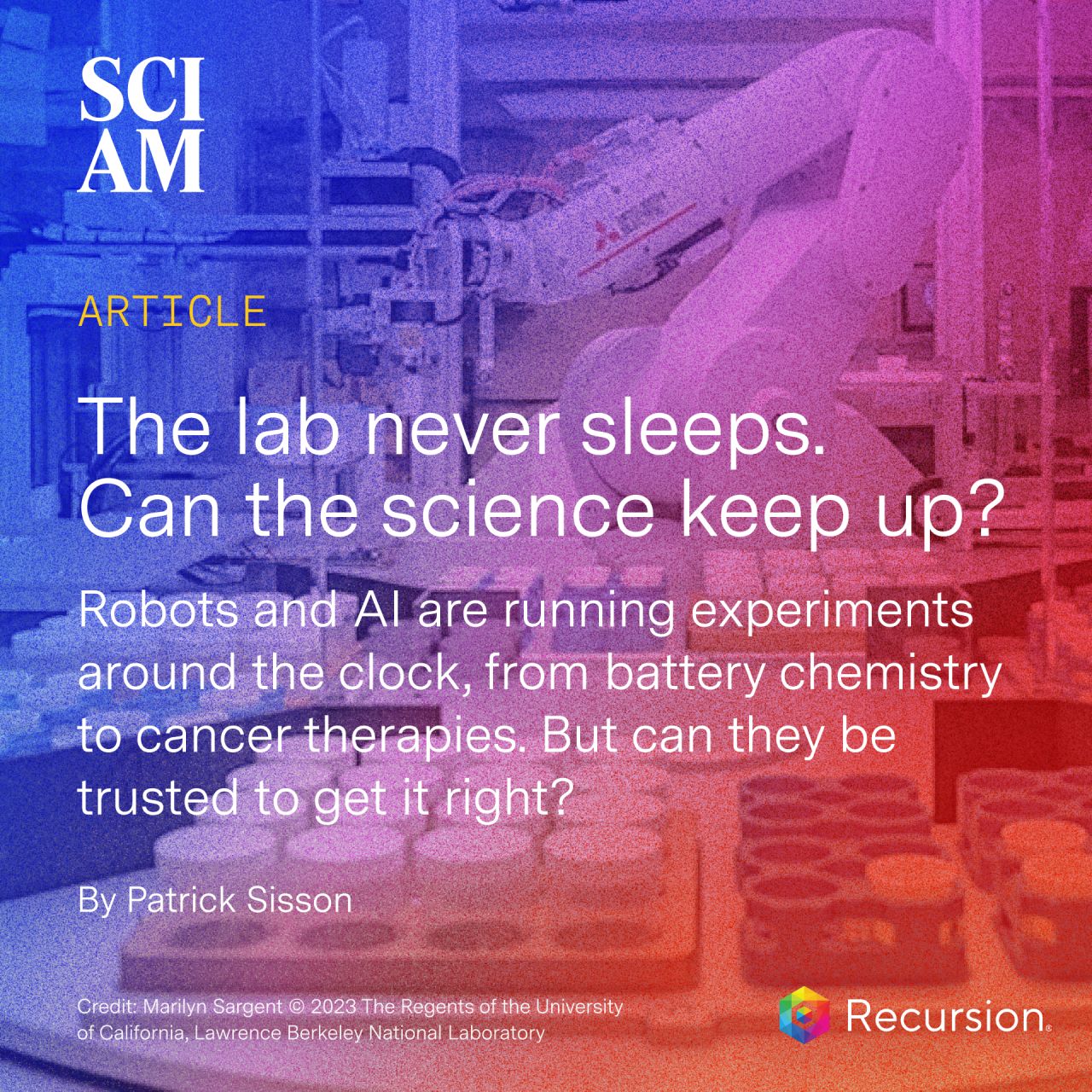
The next generation of drug discovery will be built on integrated, AI-native systems that connect automation, experimentation, computation, and machine learning into a continuous cycle of learning where every experiment makes the next one smarter. A recent article in Scientific American by Patrick Sisson explores how this new research infrastructure is beginning to take shape and highlights Recursion's pioneering work in this space. At Recursion, we run up to 2.2 million experiments each week and leverage more than 50 petabytes of proprietary biological, chemical, and patient data as part of an end-to-end learning engine for drug discovery and development. But scale alone isn't the differentiator. The real opportunity lies in transforming multimodal data into biological understanding and ultimately into new medicines. Take our neuroscience collaboration with Roche and Genentech. For decades, neuroscience drug discovery has been constrained by repeatedly investigating the same well-studied targets. To move beyond those limitations and explore entirely new biology, our teams developed advanced cell manufacturing capabilities to produce more than 100 billion human iPSC-derived microglia, the brain's resident immune cells, which are notoriously difficult to generate and study at scale. The result is a first-of-its-kind whole-genome Microglia Map comprising 46 million cellular images across 17,000 genes. This systems-level view of biology allows our AI models to move beyond traditional approaches, uncover novel biological insights, and identify therapeutic opportunities that may have otherwise remained hidden. What excites me most is what comes next. These maps – and the AI models trained on them – are the foundation. The real opportunity is translating them into novel, first-in-class therapeutic programs. That's the frontier we're pioneering: turning systems-level biological understanding into medicines for patients. There's still important work ahead, but we're making meaningful progress, and I'm excited about what's possible as we continue to push the boundaries of AI-native drug discovery. Stay tuned. #AI #DrugDiscovery #TechBio #Biotechnology #MachineLearning

6 of 87 adsSign up to see every Recursion ad, filter by format and date, and get alerts on new ones.
See all 87 adsWatch the companies you care about.
Filter every ad by industry, country, format and network, and get alerts when a company you watch starts running new ads.