Not on air · 2 of 3 networks checked
Recast
- getrecast.com
- Software Development
- US
- 80 employees
Recast’s ads on LinkedIn, Meta and Google, recorded by adsrunning. Browse the latest here for free. Sign up free to see all 455. Watch Recast on any plan to get each new one in your feed.
Watchlist included in every plan
| Network | Status | Live ads | Nov 2025LinkedIn activity · 52 weeksNov 2026 | Checked | Next step |
|---|---|---|---|---|---|
| None recorded | 0 | Checked 3 Nov 2026 | See all 455 ads → | ||
| Meta | Not checked | — | |||
| Recently | 7 | Ads on the Google Ads Transparency Center | Checked 8 Oct 2026 | Collect them with the API → |
Recast has no live LinkedIn ads. We recorded 7 Google ads on 8 Oct 2026.
Latest ads
- LINKEDIN · IMAGESince 4 Sept 2026
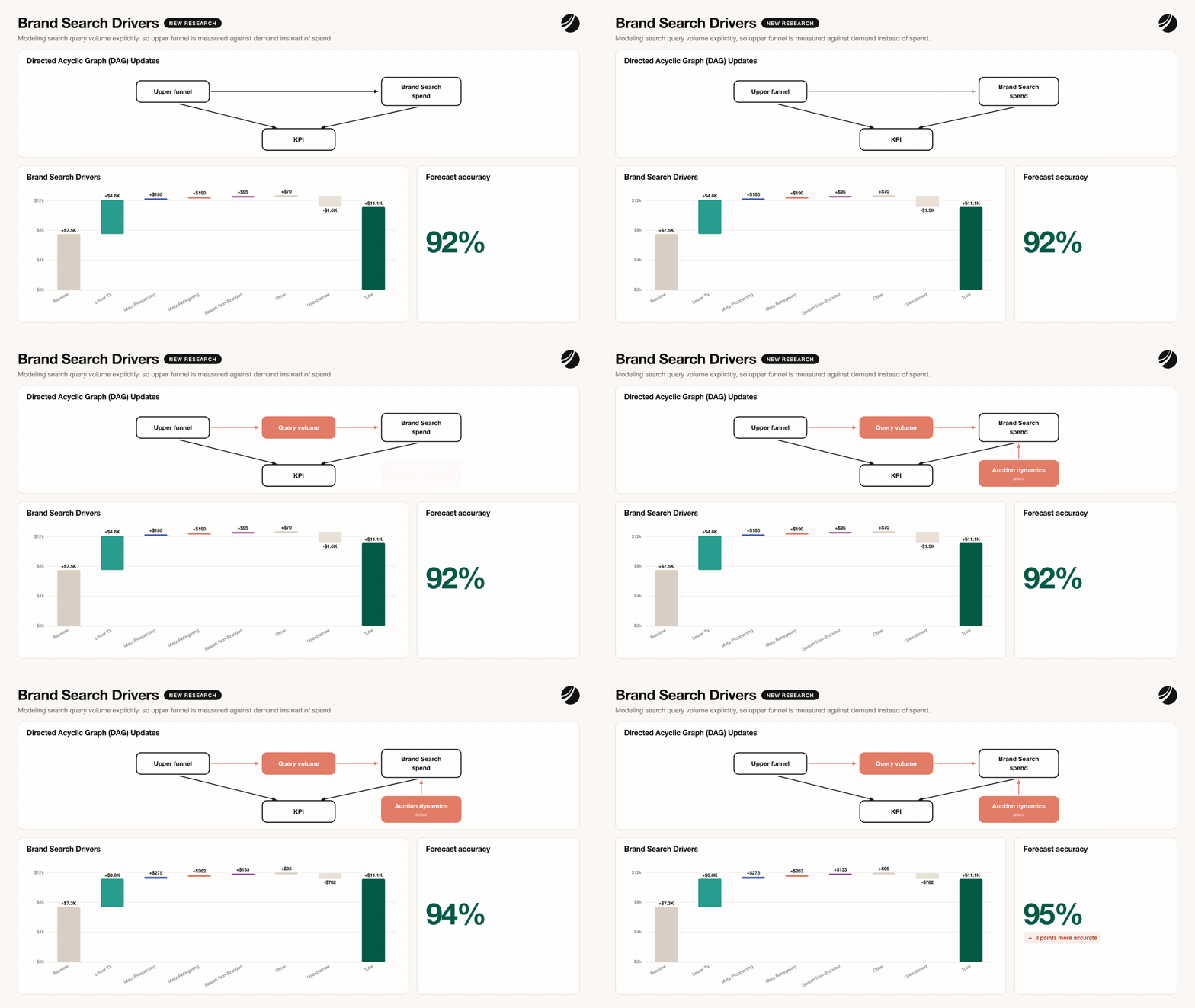
Another breakthrough just shipped from our research team: Brand Search Drivers. 2026 has turned the research team's attention to two main things: improving our underlying Recast engine and solving really hard customer problems. Brand Search Drivers came from the latter. A customer reached out to us a few months back and noticed that their upper funnel channels kept showing drops in ROI that couldn't be explained by creative changes, targeting changes, or any other strategic shifts. And, when our research team went digging, they found that these drops lined up almost exactly with periods where this brand had pulled back on Brand Search spend. That was strange. There's no good reason to believe that Meta should suddenly look less effective because you spent less on Google Brand Search that week. We even pulled Google Trends data for the brand and found that search demand hadn't moved at all. What had actually changed was something inside their ad account, most likely a bid or budget change. This was a structural problem that Brendan Matthew G.at Brendan Matthew G. and Gregor Pirš on our research team dove into. And their time was well spent, as they ultimately came back with a change to our DAG itself where search query volume can now sit as its own node between upper funnel channels and Brand Search spend. After implementing their research, they validated it on synthetic data as well as production Recast models – as we do with all research before it ships into customer’s hands. The part I like most is that this started as a quirk in one customer's data, and will soon be a solution we roll out to everyone using Recast. That's how we want our research to work, and we are full steam ahead on a number of other solutions that I’ll be sharing soon. For the full story on Brand Search Drivers, I wrote a short article linked in the comments.
- LINKEDIN · IMAGESince 18 Aug 2026
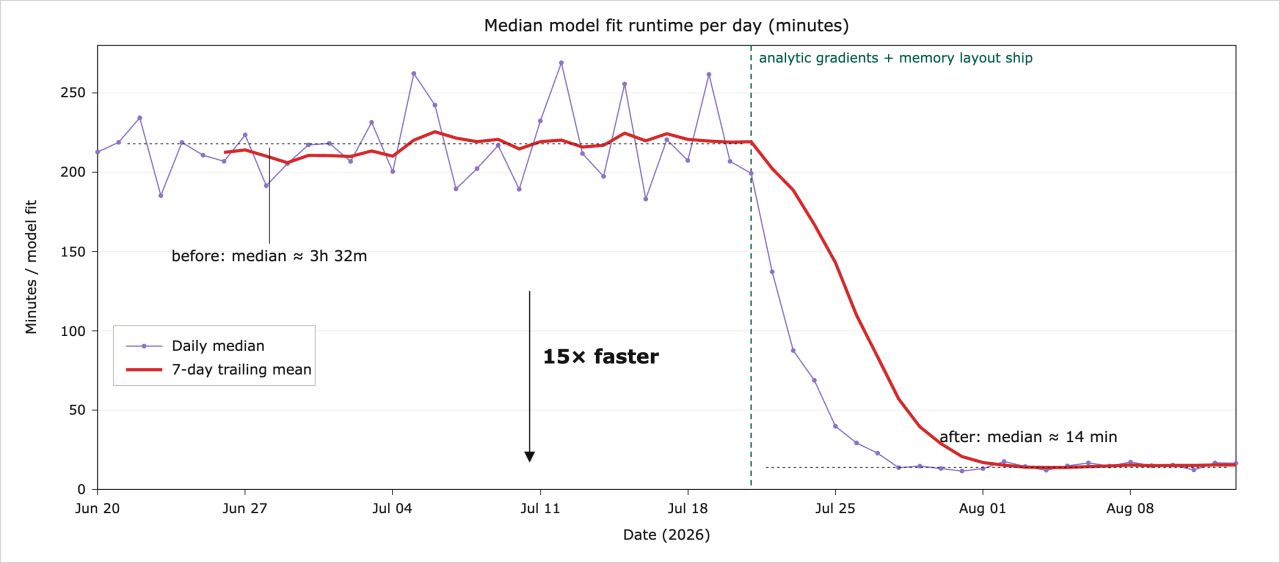
Bayesian models don't have to be slow, and our research team took that personally. Every so often someone asks why Recast models take a while to fit. It's a fair question! And it usually comes with a suspicion that we've built something needlessly complex. MMM doesn't involve very much data after all, and you can fit a regression to historical channel spend and your KPIs in a few seconds. Only, we don't fit a regression at Recast because that would mean asserting things about marketing that we don't actually believe. Like that a channel's ROI is exactly the same today as it was in 2024… or that one number can capture how fast an ad decays or where a channel saturates… or that point estimates without uncertainty are enough to make decisions with… None of that is true. So in Recast’s model, ROIs can move over time, each paid media channel gets its own saturation curve, holidays and promos can take their own unique shapes, every estimate is delivered with uncertainty, and so on. A 20-channel Recast model, then, carries roughly 30,000 parameters and evaluates itself against the data around over 250,000 times to fit. That's why Recast was “slow”, because we demanded a model that reflects how marketing actually works. Now for the good news. Rok and Drew on our research team just made Recast 5-20x faster. Our median run time is now ~14 minutes, down from several hours, without simplifying the model, loosening any priors, or dropping parameters. They did this by going down to the bones of our model and stopping the computer from wasting time. The speedups were hiding in four unglamorous places. Stan's general-purpose gradient machinery, which we replaced with gradients derived by hand for our exact model; an inefficient memory layout; independent calculations running in sequence for no reason; and tens of thousands of intermediate values written to disk that nothing downstream ever read. What I care about most here isn't the headline runtime number, but the added benefits for our customers. Fourteen minutes is short enough to rerun a model the moment something looks off, to test a different assumption before committing to it, and (soon) for Recast customers to change their own assumptions and watch their forecasts and plans update in near real time. Super proud of the research team for this one. More from them is coming very soon!
- LINKEDIN · IMAGESince 31 Jul 2026
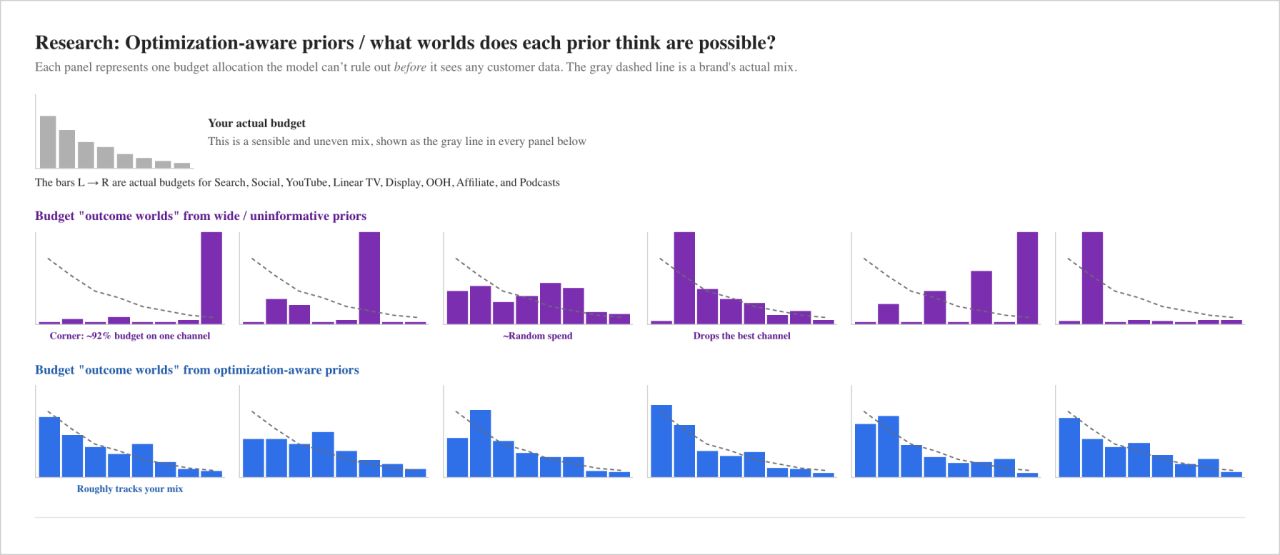
We do a lot of simulation work with our media mix models and a key area of research has been around “optimization aware” priors. It sounds a bit in the weeds, but the findings have actually been extremely practical. To back up a step, every Bayesian model starts with a prior (everything it holds to be possible) before it sees any customer data. There's a clean way to audit that prior, which is by simulating from it alone and looking at the “possible worlds of marketing performance” that are generated. Put another way, if you built a model to explain why some adults are taller than others, and when you simulated from its prior, you generated people anywhere from -100 to 10,000 feet tall, you'd know something was broken. A prior that can't rule out a 10,000-foot person is not neutral (it’s wrong about the “possible worlds”) and needs to be corrected before you take any further steps with it. In marketing science, we did the standard practice for years, which is to keep our MMM's priors wide or “uninformative”. This gave every channel a similar and broad ROI range so we weren't tilting the model toward any one answer. It also felt like the objective choice, as it “let the data decide”. But when we simulated from those uninformative priors, the results implied something we flatly don't believe. The simulations said that our customers had allocated their past budgets close to at random, and that their historical spend was very far from optimal. This was most pronounced on ambiguous data, where models would often land on corner solutions where one channel was responsible for nearly all of a brand’s growth and everything else was basically worthless. Our customers are smart; they have built fast-growing brands or have stewarded the success of decades-old institutions. A model that implied that they had been doing the wrong things consistently for years is something we did not believe. When a model tells you something from the start that looks obviously wrong, you probably shouldn’t trust it. So we've been moving towards what we call an “optimization-aware” prior. Instead of assuming nothing, it starts from the belief that what a customer was doing before working with Recast was probably roughly sensible. Perhaps not the most optimal budget allocation but also not done at random. That's a truer description of a sophisticated marketer, and the result of using these optimization-aware priors has been a more stable model that’s more useful the first time you open it. But there is a tradeoff: this method introduces some bias by design. If a customer really had been running their budget poorly, the model now needs more evidence to see that, and whether we've set that dial in exactly the right place is something we're still testing across thousands of model runs. But the direction of optimization-aware priors is clearly right in my opinion. A model should start from what you actually believe about the world and how marketers allocate their budgets.
- LINKEDIN · IMAGESince 31 Jul 2026
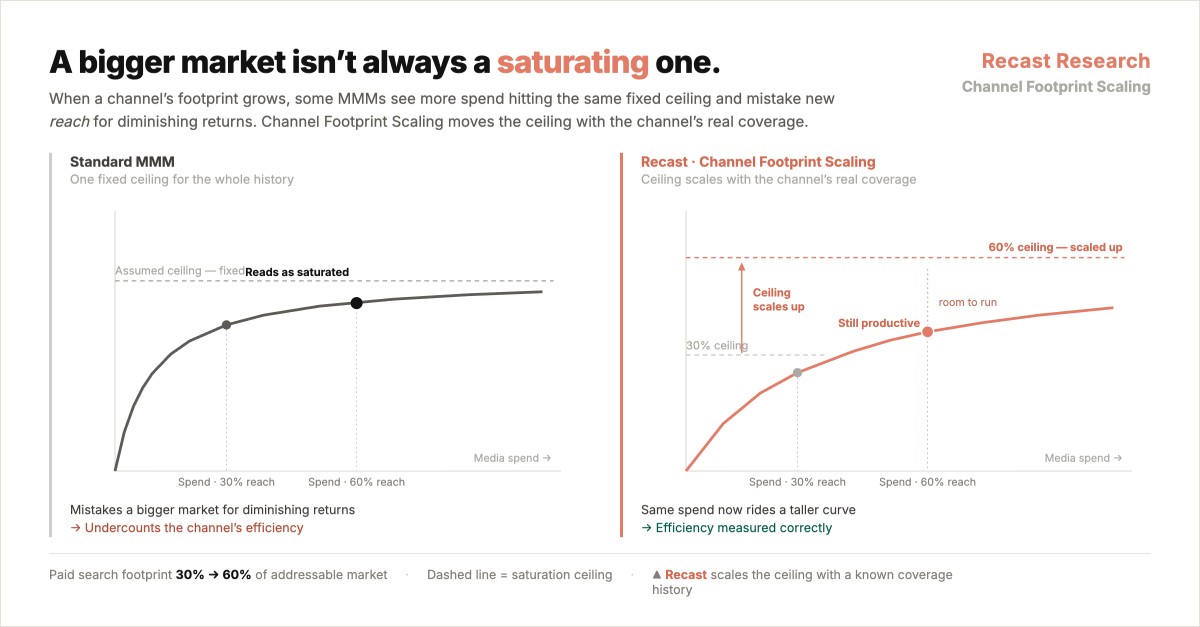
We’re full steam ahead in the Recast research lab and just shipped Channel Footprint Scaling. It addresses the case where a paid media channel that once reached 30% of the country is now targeting 80% of it. Both sales and spend likely climbed as this change happened, and the MMM has to navigate some tricky territory. ➡️ If it’s overweighting *past* data, it will treat the new increased spend as climbing up the existing (low-ceiling) response curve, and under-report recent performance. ➡️ If it’s overweighting *recent* data, it will overwrite the old response curve, and over-report past performance. Left alone, most models will take one of those wrong turns, which can lead to bad decisions: if it sees extra spend rising along an outdated saturation curve and reads that as the channel running out of room, it will mark down its performance. This can lead to pulling back spend on the channel when it’s actually working as it was intended. That’s one of the reasons why I’m excited about Channel Footprint Scaling. Recast can now take in a channel’s coverage history (when it expanded coverage and how much of the addressable market it’s reached over time) so the model’s saturation ceiling grows with the channel’s footprint, instead of penalizing it for spending into a bigger market. Channel Footprint Scaling is available now to all Recast MMM customers. Just reach out to your MDS team to see whether it’s a fit.
- LINKEDIN · IMAGESince 13 Jul 2026
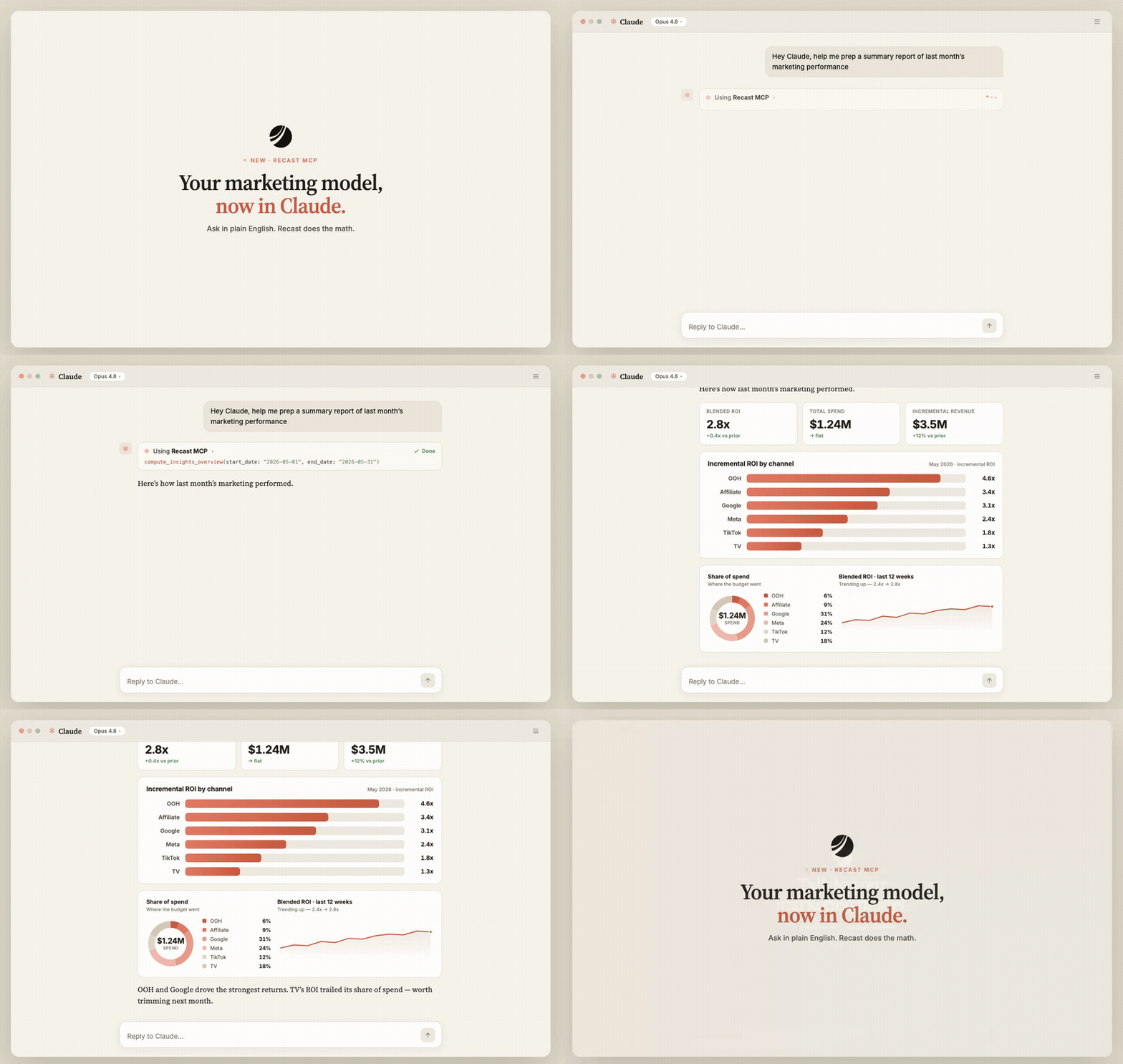
Recast MCP and our new Claude plugin are live and I’m really proud of what the team shipped. The full Recast engine now plugs into the AI assistants our users are already working in, whether it’s Claude, ChatGPT or something else. They can now ask questions in plain English and get answers straight from their live Recast models. They might ask Claude to sort 2025’s promotions by incremental impact, then push the top 5 results into Slack. Or maybe plot how their model’s OOS forecast accuracy has trended over time. All of that (and much more) is now possible. Today, Recast MCP and our Claude plugin open up 20 of our proprietary reports and more functionality is coming very soon. We’re shipping faster than ever but our goal is the same: to open more and more of the Recast engine to our customers. Recast MCP and our Claude plugin are now available to all Recast customers. Check out more at the link in the comments.
- LINKEDIN · IMAGESince 13 Jul 2026
Recast MCP and our new Claude plugin are live. Both follow our goal of putting more and more of the Recast engine in the hands of our users. For the first time, Recast is directly in reach of the LLMs our customers are already using (Claude, ChatGPT, etc) and lets them ask questions and get answers straight from their live models. A few examples of what you can do on day one: • Use the Spike Detail report to rank every promo from last year by the actual incremental value it drove and then use the google slides MCP to make a board-ready presentation. • Pull Recast's incremental ROI estimates alongside your Google Ads or Meta export, and flag discrepancies between them. Then set up a recurring report to publish the biggest differences to Slack via MCP every week. • Run Spend Response Curves across all your channels and rank them by how much room each still has before it saturates. • Use the Lower Funnel Waterfall to tie every lower-funnel channel back to the upstream spend that fed it, then rank your upper-funnel channels by the downstream revenue they generated. • Sort your channels by marginal ROI and drop the results into Slack so your team can discuss budgets. And much, much more. Today the MCP and plugin open up 20 of our proprietary reports, with more coming very soon. The big goal here is to fit Recast into how your team already works. This is the foundation for a much bigger shift in how teams operate Recast, and we’ll have a lot more to share over the coming weeks. The Recast MCP and Claude plugin are now available to all Recast customers. Full launch details are at the link in the comments.

6 of 455 adsSign up to see every Recast ad, filter by format and date, and get alerts on new ones.
See all 455 adsWatch the companies you care about.
Filter every ad by industry, country, format and network, and get alerts when a company you watch starts running new ads.