Not on air · 3 of 3 networks checked
PolyStruc
- polystruc.com
- Software Development
- DK
- 7 employees
PolyStruc’s ads on LinkedIn, Meta and Google, recorded by adsrunning. Browse the latest here for free. Sign up free to see all 57. Watch PolyStruc with Starter to get each new one in your feed.
Watchlist with Starter · $49/mo
| Network | Status | Live ads | Nov 2025LinkedIn activity · 52 weeksNov 2026 | Checked | Next step |
|---|---|---|---|---|---|
| None recorded | 0 | Checked 1 Nov 2026 | See all 57 ads → | ||
| Meta | None recorded | 0 | No active ads recorded on the Meta Ad Library | Checked 24 Oct 2026 | Collect them with the API → |
| Recently | 4 | Ads on the Google Ads Transparency Center | Checked 7 Oct 2026 | Collect them with the API → |
PolyStruc has no live LinkedIn ads. Its Facebook page had no active ads on 24 Oct 2026, and we recorded 4 Google ads on 7 Oct 2026.
Latest ads
- LINKEDIN · IMAGESince 27 Oct 2026
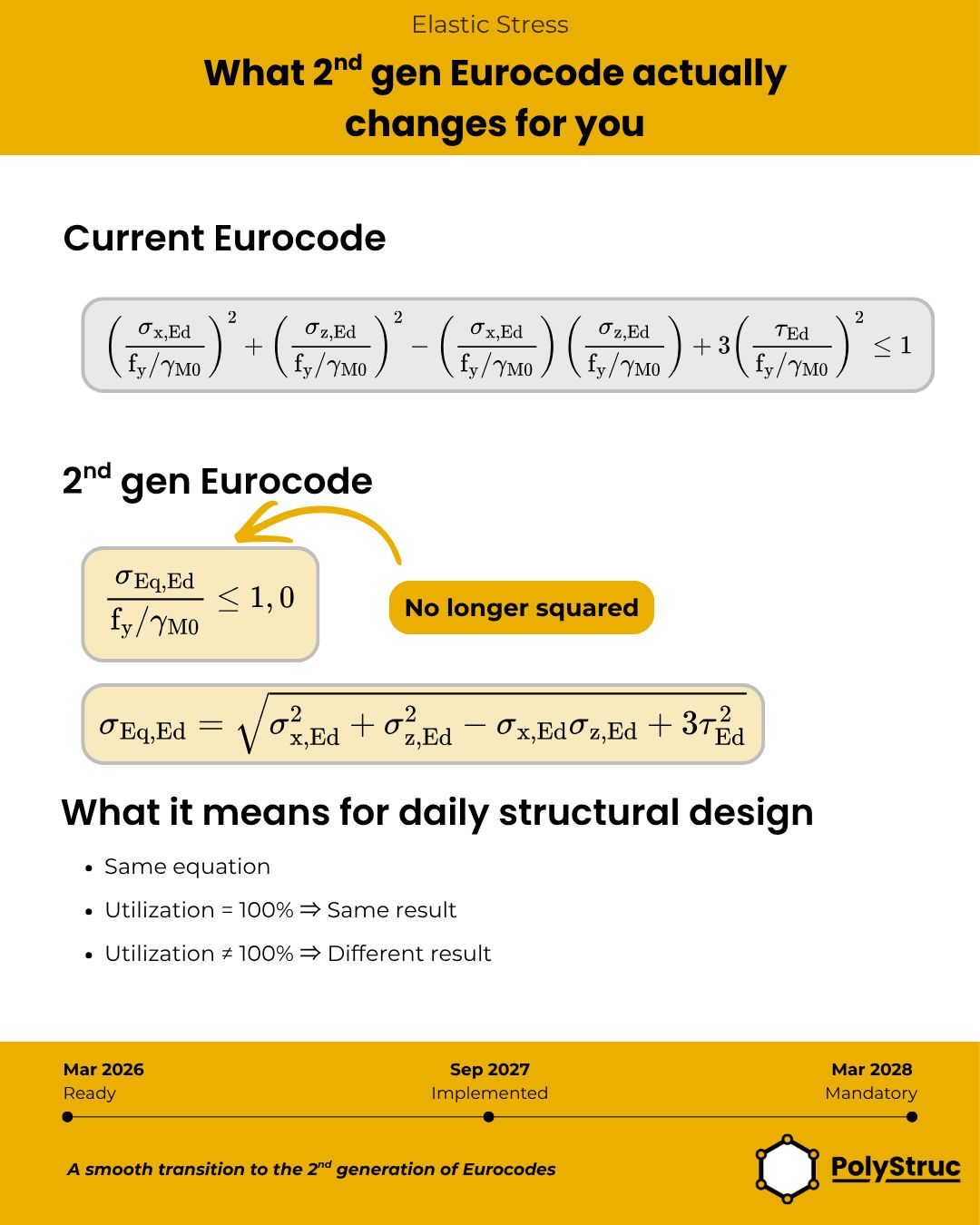
70% utilization becomes 83%. 144% becomes 120%. 100% stays 100%. The old elastic stress check squares each stress ratio before summing. The new one puts it all under a square root. Better or worse? I don't know. Maybe just simpler. Reminder either way: not every design check is linear. PS: Our goal at PolyStruc is to make engineering as easy as possible. Read more at https://lnkd.in/ezsk22wV
- LINKEDIN · IMAGESince 26 Oct 2026
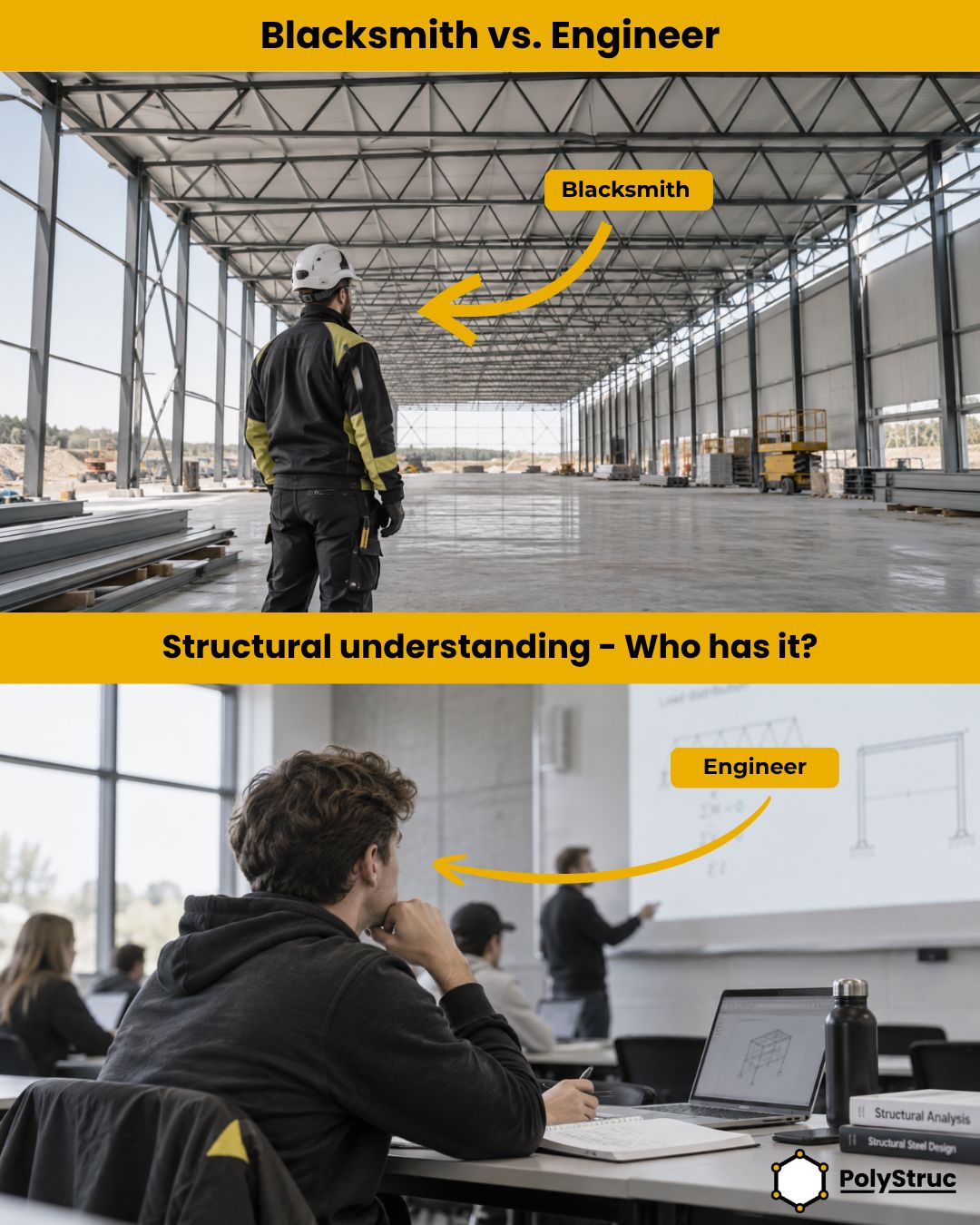
A dyslexic blacksmith had a better structural understanding than most engineers I've met. We ended up talking about how he braces the trusses he builds. He corrected himself twice during the conversation: "I'm not an engineer. Just a smith." Every time he described a structure, he could tell me exactly why it stood: which diagonal carried the load, and what would happen the moment you left it out. Ask him to check a bolted connection against Eurocode, and he'd have nothing. Following Eurocode doesn't make you an engineer. Understanding why a structure stands does. Most of us were never taught that properly. PS: We build software that helps engineers understand their structures. Read more at https://lnkd.in/ezsRm2ui
- LINKEDIN · IMAGESince 26 Oct 2026
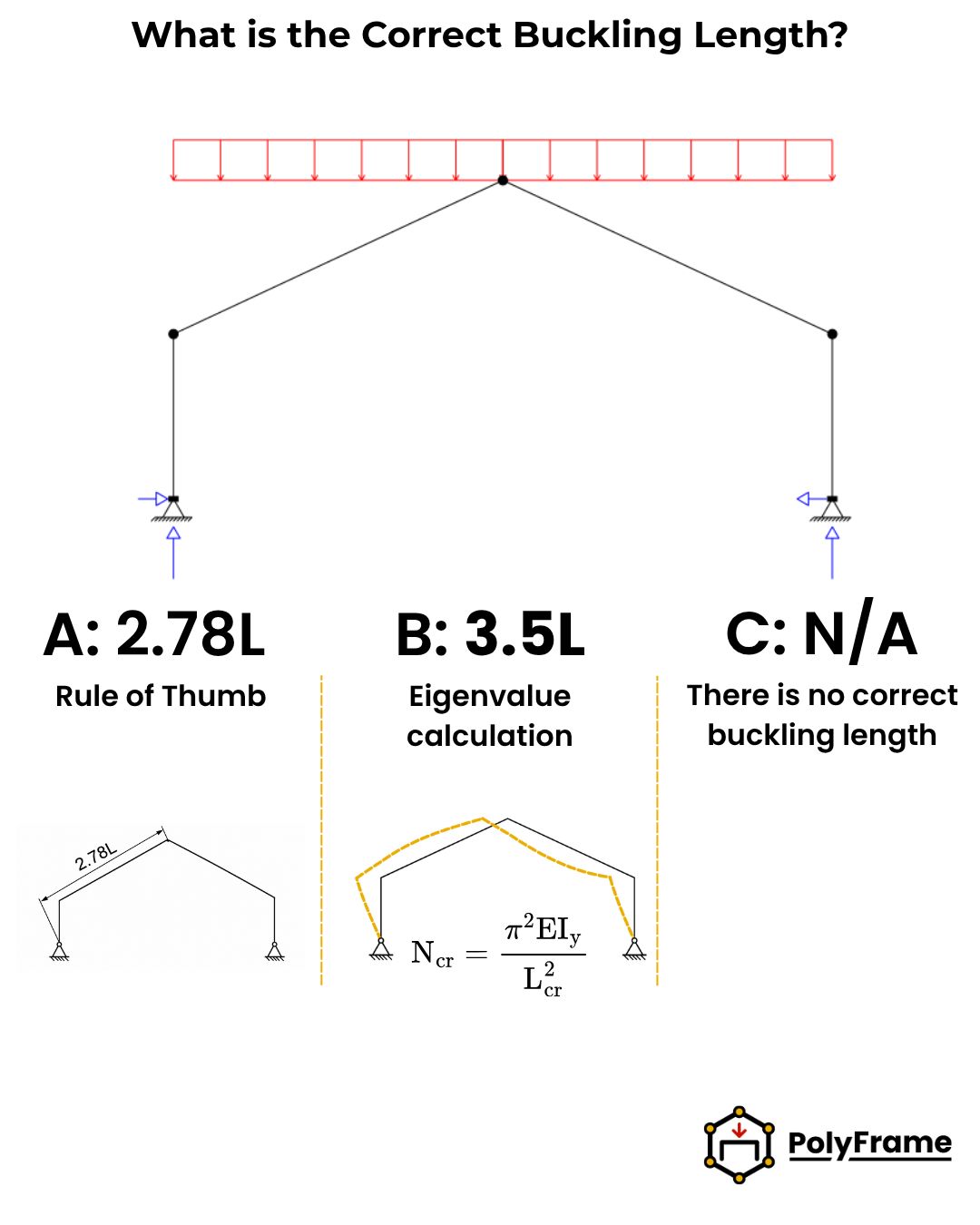
530 kN separates two engineers looking at the same column. One of them is wrong, and it isn't a calculation error. One used the rule of thumb and got a buckling length of 2.78L. The other ran an eigenvalue analysis and got 3.5L. Ncr scales with the square of the length. So a 26% gap in buckling length isn't a 26% gap in capacity — it's a third of the column. One of these isn't an approximation. It's an error. And there's a third answer that never asks the question at all. PS: Want to check your own frame? Try our free buckling length calculator: https://lnkd.in/ektQ5Fpx
- LINKEDIN · IMAGESince 26 Oct 2026
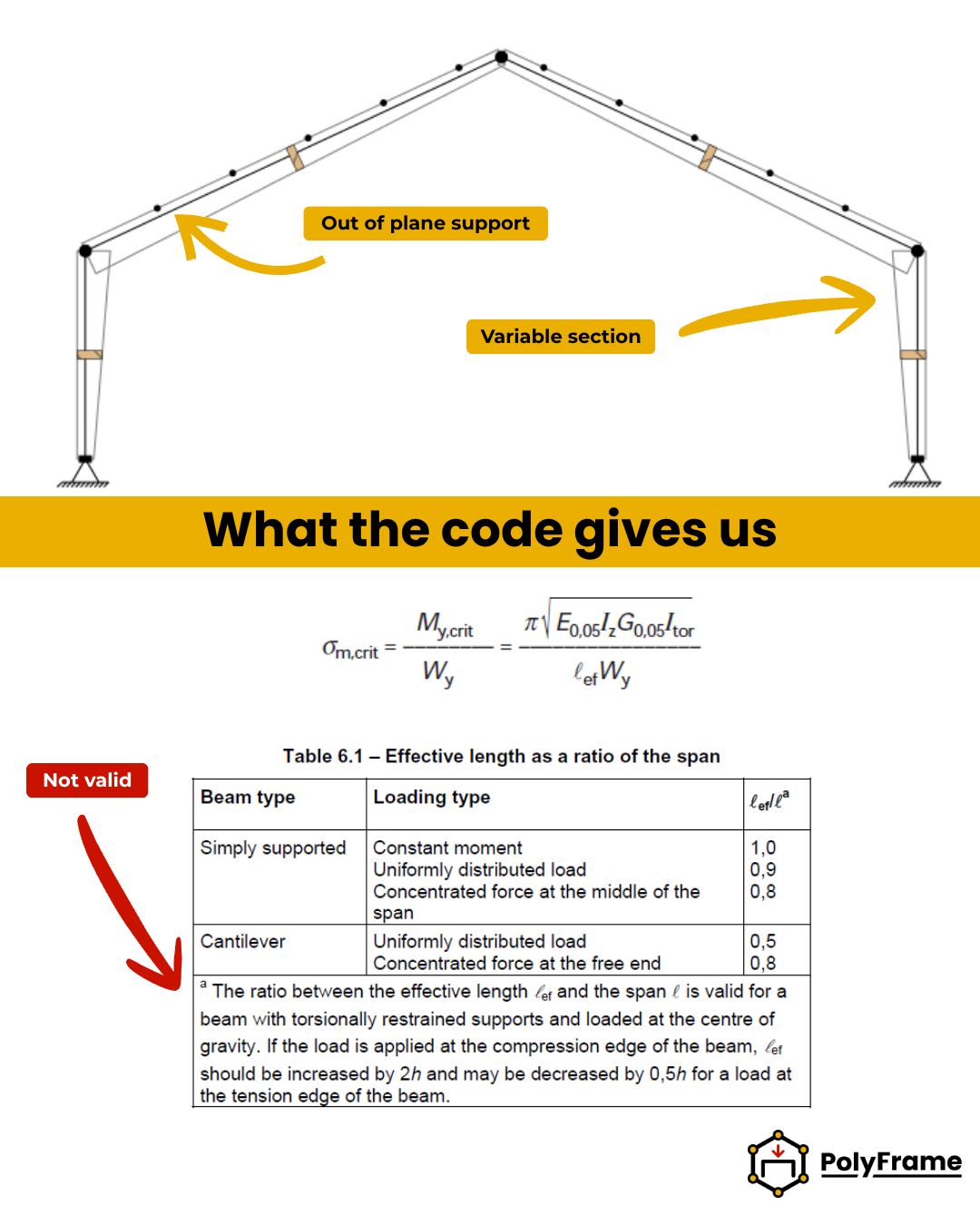
One of our customers begged us to solve this. They were doing it the hard way. 𝗪𝗵𝗮𝘁 𝘁𝗵𝗲𝘆 𝗱𝗶𝗱, 𝗲𝘃𝗲𝗿𝘆 𝘁𝗶𝗺𝗲: 1. Guessed the critical load combination. 2. Built a 3D FE model with out-of-plane supports and the loading from that assumed combination. 3. Ran an eigenvalue analysis, found the critical moment, converted it into an equivalent buckling length. 4. Entered that length into their regular 2D timber software — and hoped it was right. The problem isn't that they did this. It's that most software leaves it up to the user to do the hard part in the first place. There are real gaps in Eurocode. Lateral-torsional buckling in timber is one of them — and a variable cross-section frame is exactly where it shows. The code doesn't give you a valid method. So we did what this customer already knew worked: borrowed the principles from steel, where this was solved properly decades ago, and built them into the check itself. We believe choices like this belong in the software — not with a busy user who might not know any better. PS: This is exactly what we built PolyFrame for. Try a free trial here: https://lnkd.in/e5VjE8Ec
- LINKEDIN · IMAGESince 26 Oct 2026
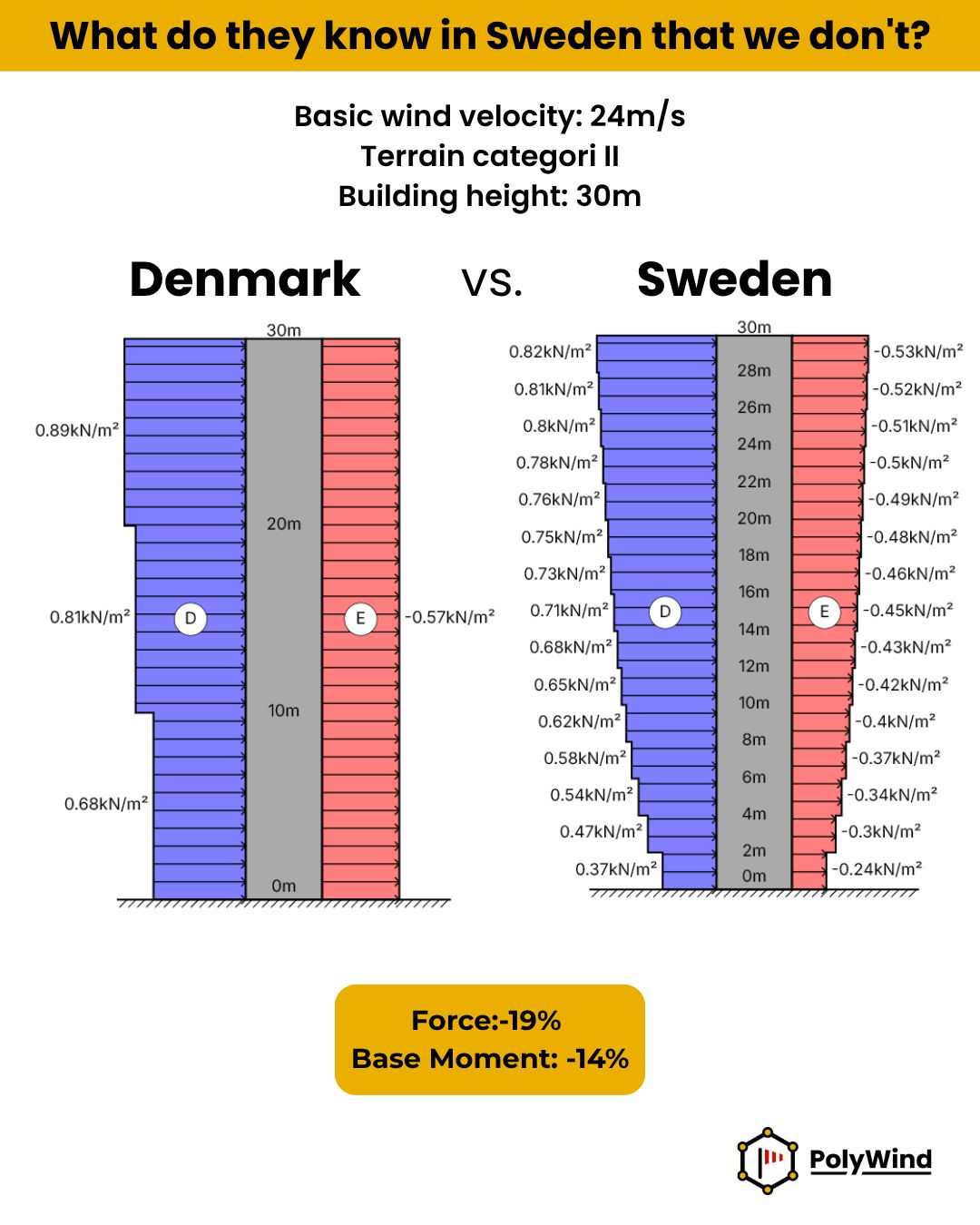
They know something in Sweden that we don't in Denmark. Basic wind velocity: 24 m/s. Terrain category II. 30 m building. In the Swedish national annex, both zone D and zone E can be optimized with height, in fine steps. In Eurocode, only zone D can be optimized, and only across a few coarse height bands. Zone E gets one flat value for the entire building. 19% less total wind force. 14% less base moment. A Swedish customer told me this goes back to older Swedish wind load tests. Does anyone know the research behind this? PS: We built PolyWind to make determining wind loads as easy as possible. Try it for free here: https://lnkd.in/eiybFdEC
- LINKEDIN · IMAGESince 26 Oct 2026
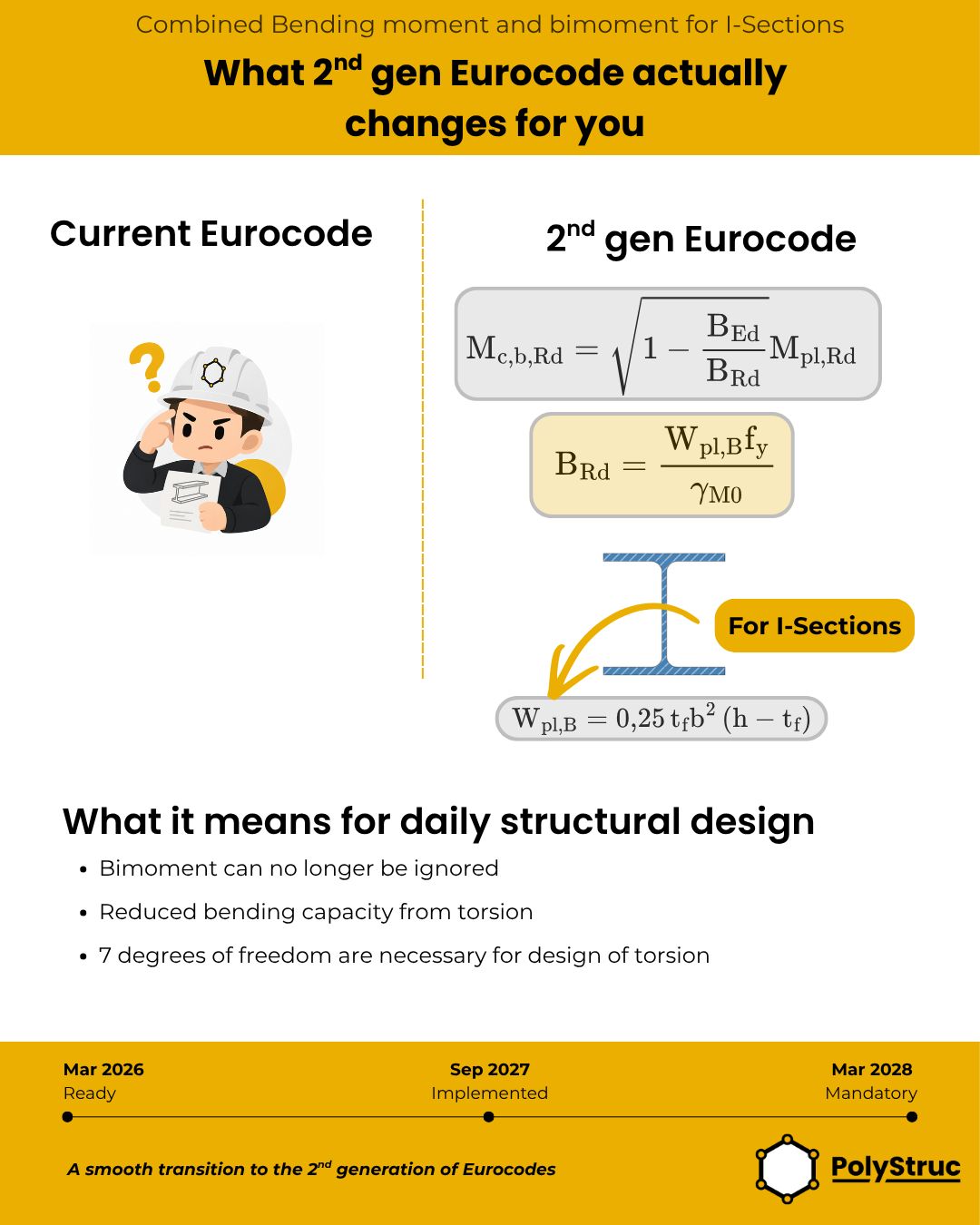
In the 2nd generation Eurocode, torsion reduces the bending capacity of your I-beam. In practice, the bimoment is often left out today. Bending and torsion are checked separately. That's no longer an option. Here's the catch: a standard beam model with 6 degrees of freedom can't give you B_Ed. Warping needs a 7th. No 7th degree of freedom, no check. Worth knowing what your software can do before then. PolyBeam already calculates with 7. PS: Our goal at PolyStruc is to make engineering as easy as possible. Read more at https://lnkd.in/e-_bZXkv
6 of 57 adsSign up to see every PolyStruc ad, filter by format and date, and get alerts on new ones.
See all 57 adsWatch the companies you care about.
Filter every ad by industry, country, format and network, and get alerts when a company you watch starts running new ads.