Not on air · 2 of 3 networks checked
Paradromics
- paradromics.com
- Biotechnology Research
- US
- 124 employees
Paradromics’s ads on LinkedIn, Meta and Google, recorded by adsrunning. Browse the latest here for free. Sign up free to see all 20. Watch Paradromics on any plan to get each new one in your feed.
Watchlist included in every plan
| Network | Status | Live ads | Nov 2025LinkedIn activity · 52 weeksNov 2026 | Checked | Next step |
|---|---|---|---|---|---|
| None recorded | 0 | Checked 3 Nov 2026 | See all 20 ads → | ||
| Meta | Not checked | — | |||
| None recorded | 0 | No ads found on the Google Ads Transparency Center | Checked 6 Oct 2026 | Collect them with the API → |
Paradromics has no live LinkedIn ads. We recorded no Google ads on 6 Oct 2026.
Latest ads
- LINKEDIN · IMAGERecorded 12 Oct 2026
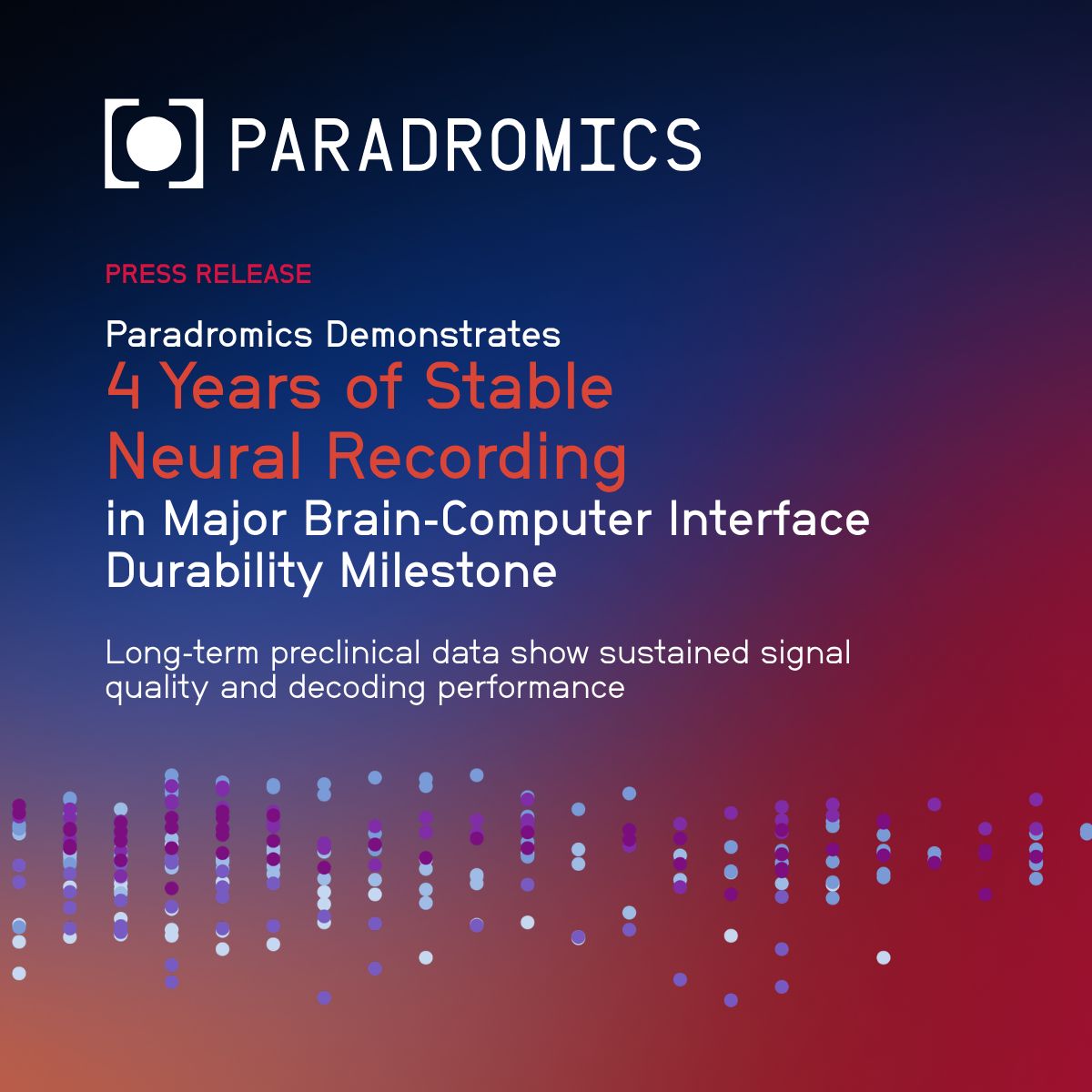
For years, it seemed like the field of implantable brain-computer interfaces (BCIs) would have to choose between peak performance and long-term stability. Our accumulating preclinical data suggests otherwise. Paradromics’ cortical modules representative of the electrode array in the Connexus® BCI have now passed four years of stable neural recording and decoding in sheep. Spike signal-to-noise (SNR) ratio has held steady throughout, and no electrode array migration has been observed. In a separate study of the fully implanted Connexus BCI system, we have now achieved two-year timepoints with similar results. “This is really big news. This is the first time we're showing that we can get four years of a cortical implant that is reading high density, high resolution signals with minimal loss of signal.” said Dr. Stephen Ryu, Chief Medical Officer. “Every time a patient undergoes surgery, they're exposed to additional risks. And I think that we need to adjust to minimize this as much as possible. No implant should go in and the patient should be told or expect it to fail and have to be replaced in only a few years.” This durability is attributable to the deliberate choices we made when we designed our platform: proven medical-grade materials, a surgical approach built to prevent electrode migration, and microwires thinner than a human hair to reduce foreign body response. Now with the Connect-One Early Feasibility Study underway, we are excited to track our participants’ BCIs for many more years. Read the full announcement at the link in the comments. *Connexus BCI is an investigational device limited by United States law to investigational use.
- LINKEDIN · IMAGERecorded 28 Sept 2026
When we implanted the Connexus® Brain-Computer Interface (BCI) in June, we crossed a threshold into long-term human use. Today, we crossed another: The first participant in our Connect-One study is now choosing her own words and using neural activity to communicate in real time. She has a progressive motor neuron disease that has significantly affected her ability to speak. Through the Connexus BCI, she answered open-ended questions, spoke freely, and called her grandchildren, asking them questions and responding in a voice generated by the system. Asked what she would tell someone considering this research, she said: "Don't be afraid. It's a wonderful experience to be able to help others by your participation in the research study." Every word she intended was decoded exactly as she meant it. To our first participant: Thank you for your trust, your courage, and the words you have chosen to share with all of us. Our focus begins with restoring communication for people who have lost the ability to speak. Today, it meant that one woman could say what she wanted to say, in her own words, to the people she loves. Read the full release at the link in the comments below. CAUTION: The Connexus® BCI is an investigational device limited by United States law to investigational use.
- LINKEDIN · IMAGERecorded 28 Sept 2026
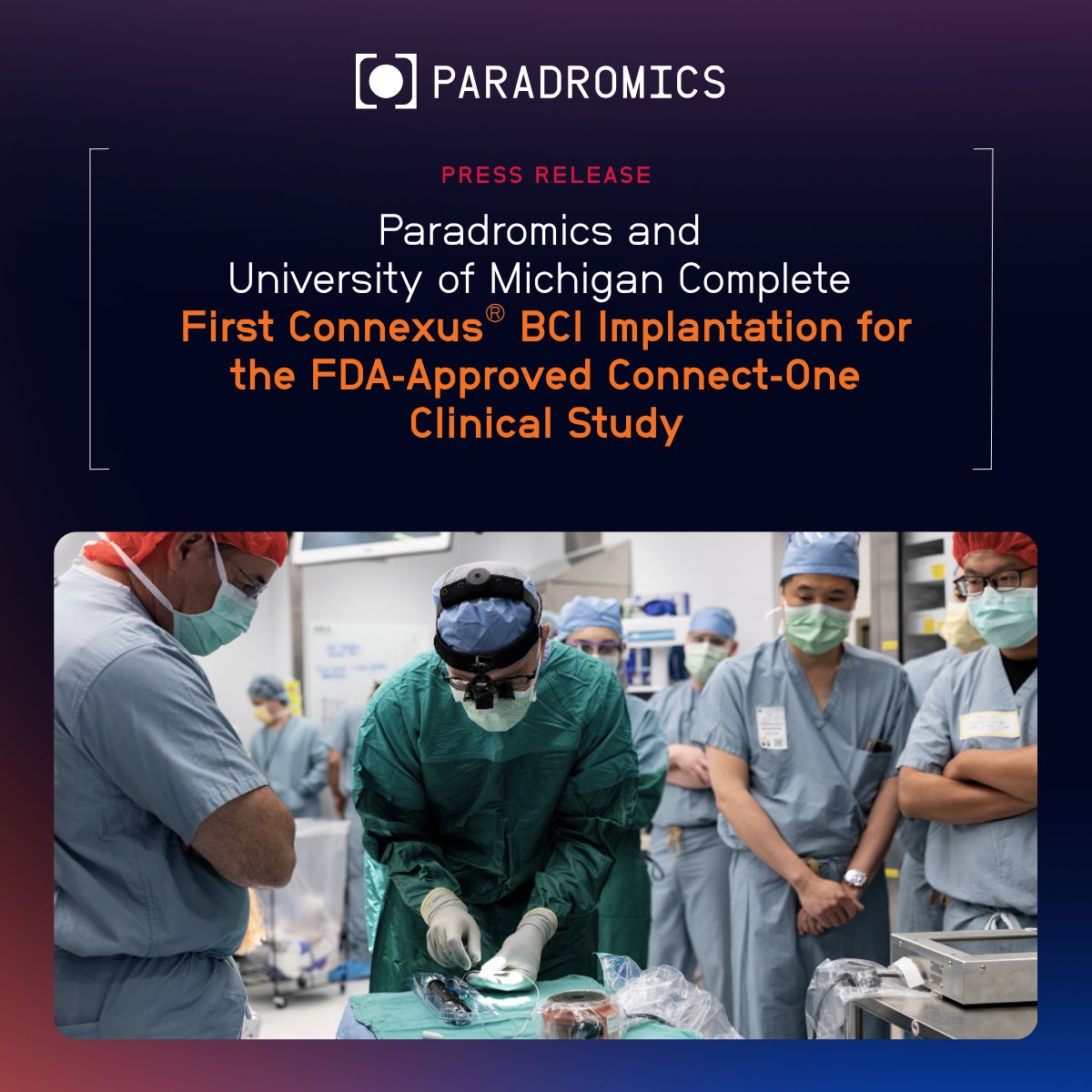
For someone living with severe motor impairment, the most devastating loss is the ability to turn what they know, feel, and want to say into speech and expression. Today, we are proud to announce that Paradromics has implanted our first clinical trial participant with the Connexus® Brain-Computer Interface (BCI) as part of the FDA-approved Connect-One Early Feasibility Study at University of Michigan Health. It is a major milestone for our company and for the field of high-performance BCI. We've spent years building the technology, conducting rigorous testing, and refining every detail of a system designed to do something that once seemed impossible: restore the ability to speak for someone who has lost it – and alongside it, the connection and independence that come from being able to express who they are. The courage that opens the door to possibility belongs entirely to our first participant, who said yes, placed her trust in this study, and helped bring this moment to life. Thank you to our participant, her caregivers and family, and the extraordinary team at Paradromics that made this possible. We are also deeply grateful to our partners at University of Michigan Health, including Dr. Matthew Willsey, Dr. Aditya Pandey, and the multidisciplinary clinical team, whose leadership, care, and commitment helped make this first implantation possible. From the first signal to the future of restored communication, the field of BCI is finding its voice. We cannot wait to hear what it has to say next. Read the full release at the link in the comments. Caution: Connexus BCI is an investigational device limited by United States law to investigational use. Photo Credit: University of Michigan & Paradromics
- LINKEDIN · IMAGERecorded 28 Sept 2026
A brain-computer interface (BCI) succeeds only if its design can deliver purposeful, reliable functionality for the people it is intended to serve. Achieving that requires deliberate engineering choices built around three foundational pillars: safety, performance, and durability. Decades of experience with implantable medical devices and neurosurgery have demonstrated that long-term implantation can be performed safely. For any BCI designed to remain in the body for years, however, safety must always be the first non-negotiable pillar. Performance determines whether a BCI can capture neural intent at the highest possible resolution and translate it into meaningful improvements in communication and mobility. Durability ensures that the device can continue delivering reliable function for a decade or longer without requiring replacement. Only by delivering all three can BCIs become trusted, clinically viable technologies capable of reaching the people who depend on them. In our latest blog, Chief Scientific Officer Vikash Gilja, PhD, and Chief Medical Officer Stephen Ryu, MD, explain the engineering design choices behind the Connexus® BCI, why safety, performance, and durability guide our work, and why they should set the standard for BCI development. Head to the link in the comments to learn more.
- LINKEDIN · VIDEORecorded 28 Sept 2026
Even when someone can no longer move the muscles required for speech, the part of the brain that plans those movements can remain active. It may still be sending the signals for ideas the body can no longer express. That is why Paradromics developed the Connexus® BCI, the highest-data-rate brain-computer interface in the world. By recording and decoding neural activity from individual neurons and processing that data in real time, the device is designed to restore natural human speech for those who have lost it. We cannot yet cure every disease. But we can help restore one of the most human capabilities of all: not just communication, but the ability to express who we are.
- LINKEDIN · IMAGERecorded 28 Sept 2026
Six years ago, pioneering neurotechnology leader and computational neuroscientist Maryam Shanechi, PhD, posed a bold question: While most neurotechnology has focused on restoring movement, could a new class of closed-loop brain–computer interfaces be developed to decode and regulate mood? Since then, her Center for Neurotechnology at University of Southern California has been developing AI-driven systems to answer that question, and emerging evidence suggests the answer may be yes. As our scientific advisor, Maryam has contributed a guest post outlining the path toward a future of personalized, adaptive mental health treatment powered by next-generation brain–computer interfaces. Read more at the link in the comments.


6 of 20 adsSign up to see every Paradromics ad, filter by format and date, and get alerts on new ones.
See all 20 adsWatch the companies you care about.
Filter every ad by industry, country, format and network, and get alerts when a company you watch starts running new ads.