On air · 1 of 3 networks
Overcut
- overcut.ai
- IL
- 15 employees
Overcut’s ads on LinkedIn, Meta and Google, recorded by adsrunning. Browse the latest here for free. Sign up free to see all 43. Watch Overcut with Starter to get each new one in your feed.
Watchlist with Starter · $49/mo
| Network | Status | Live ads | Nov 2025LinkedIn activity · 52 weeksOct 2026 | Checked | Next step |
|---|---|---|---|---|---|
| Running | 43 | Checked 29 Oct 2026 | See all 43 ads → | ||
| Meta | Not checked | — | |||
| None recorded | 0 | No ads found on the Google Ads Transparency Center | Checked 6 Oct 2026 | Collect them with the API → |
Overcut has 43 live LinkedIn ads. We recorded no Google ads on 6 Oct 2026.
Latest ads
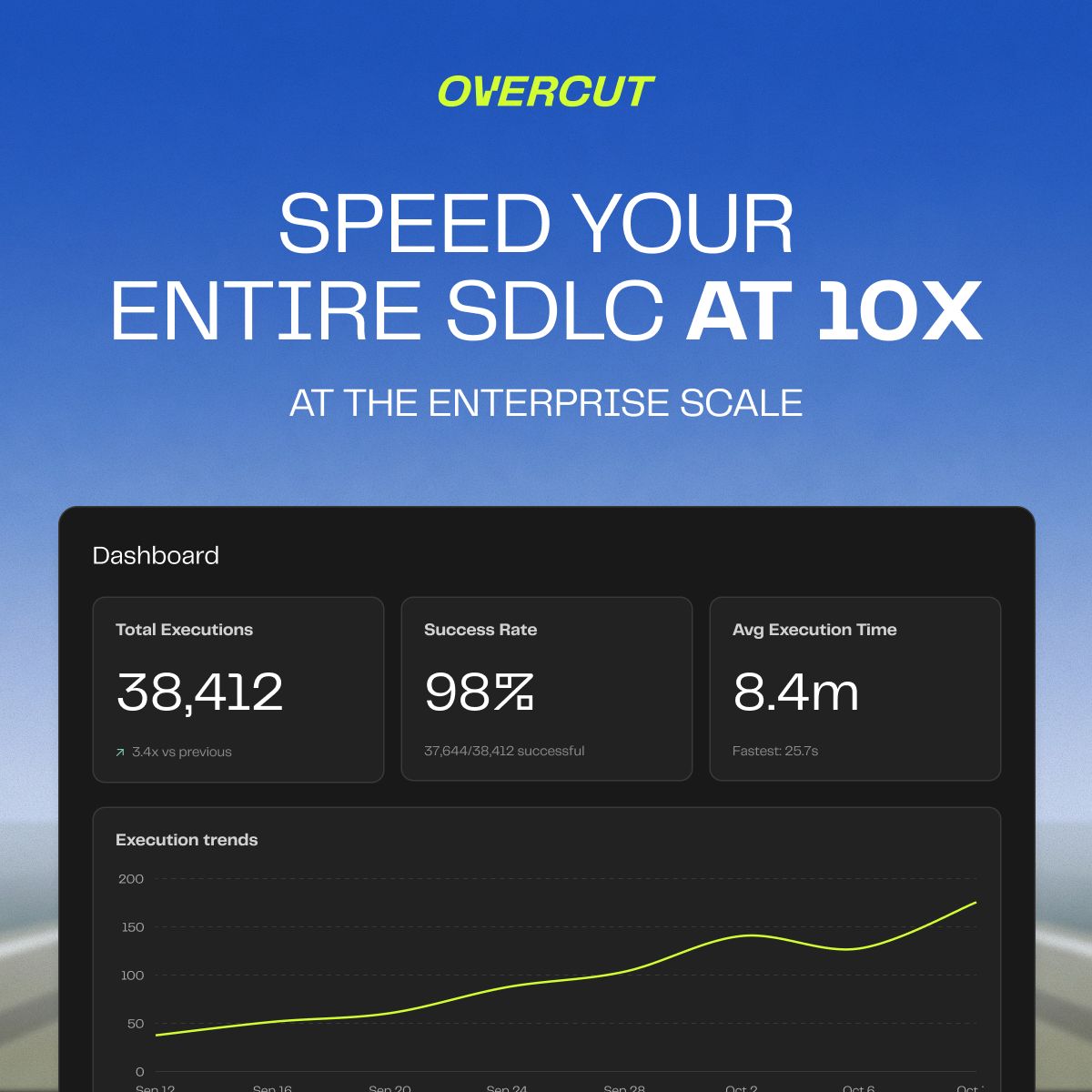
- LINKEDIN · IMAGERecorded 25 Oct 2026
Move tickets through planning, coding, testing, and review with Overcut’s AI software factory. Your team sets the direction and approves the work.
- LINKEDIN · IMAGERecorded 25 Oct 2026
Automate engineering workflows across your teams with permissions, checks, and a clear audit trail. Build your AI software factory with Overcut.
- Text-onlyEvery AI vendor is selling a software factory now. Read the proposal closely and most of them come with a team of engineers attached. They're called forward deployed engineers or FDE. It's the Palantir model, and it's spreading fast. Cursor is growing its FDE team tenfold. Consultancies are staffing hundreds of them. I understand why. Getting agents from a few developers in an IDE to an entire engineering org is hard. Someone has to wire tickets, repos, CI, permissions and approvals together, and that someone ends up being the vendor's engineers, sitting inside your org. But look at what you're actually buying. A project. Months of embedded engineers. A budget that reads like a services contract. A factory built by people who will eventually leave. And when they leave, who owns it? Who changes a workflow when your process changes, or when the next model ships next month? A factory that only works while the vendor's engineers are in the building is a services engagement with a product logo on it. I think enterprises should expect a product. Something your own platform team can stand up, with governance, audit trail, approval gates and deployment options already built in, and workflows owned by the people who use them. That's how we built Overcut. We're the only enterprise software factory that ships with zero FDEs. Our customers run it end to end themselves. See what Overcut ships with out of the box: https://lnkd.in/g-8Jt-EZLINKEDIN · TEXT-ONLYRecorded 27 Oct 2026
- Text-onlyIf you rolled out coding agents last year and don't see the gain in your delivery numbers, this is why. According to Bessemer's study on how AI changed engineering orgs, while engineers got roughly 10x faster at producing code, organizational throughput only went up 25-30%. Their wider data is worse. Across more than 400 companies, AI adoption rose 65%, median PR throughput rose 8%. So where does the 10x go? Into the handoffs. The agent finishes in minutes, and then the work waits for someone to pick up the ticket, for a reviewer, for an approval, for the next team. Coding agents sped up the part of the lifecycle that fits inside one agent session. Most of the elapsed time is between sessions, and people are still the ones moving the work along. The way to shrink that time is to take the coordination out of people's heads and put it into a system that starts the work, routes it, holds the gates, and keeps a record of every decision. That's the layer we're building at Overcut. Workflows that run the lifecycle from ticket to PR, with humans on the gates that actually need them. Read our take on the Bessemer report: https://lnkd.in/g898b8UqLINKEDIN · TEXT-ONLYRecorded 13 Oct 2026
- Text-onlyFor most of my career, software development happened in the IDE. You got a task, opened the codebase, understood the problem, wrote the code, ran it, debugged it, tested it, and eventually opened a PR. Coding agents changed how much of that we do ourselves, but the model is mostly the same. You get the task, open an agent next to your IDE, give it instructions, watch it work, answer its questions, fix what it got wrong, and eventually get to a PR. Same loop, and the developer is still the one operating it. I think autonomous development changes this much more fundamentally. The ticket becomes the input. It carries the intent, the requirements and the context. From there a workflow picks up the work and runs the development process on its own: investigate the codebase, plan, implement, test, validate, review, deal with failures along the way. The PR becomes the output. That's where a human sees what changed, why, what was tested, what the agents found, and decides whether it moves forward. Ticket in, PR out, and nobody driving in between. Developers will still open an IDE, at least not soon. There will always be work that needs exploration, debugging, or someone's hands on the keyboard. But the share of engineering work where a developer has to personally operate the process is going to keep shrinking. And if agents are doing more of the execution, the thing to optimize stops being how fast one developer can code. What matters is whether you have a system that can take intent, run the work across agents and tools, enforce the right controls, and bring a human back in when their judgment is actually needed. That system is what we're building at Overcut. A software factory that runs the work between the ticket and the PR, with the agents, tools, approval gates and verification needed to let it happen autonomously. Learn more about how you can build your software factory with Overcut: https://lnkd.in/ge4_PXE4LINKEDIN · TEXT-ONLYRecorded 9 Oct 2026
- Text-onlyMany conversations about AI in software development end up at the same question: how much faster are developers with AI? 20%? 30%? 50%? I'm increasingly convinced it's the wrong metric. If a developer takes a ticket, opens a coding agent, explains the task, watches it work, handles what goes wrong, reviews the result and opens a PR, we made that developer faster. That's valuable. But nothing about how software gets built has changed. A human is still operating the process from beginning to end. The more interesting metric is how much engineering work can go from intent to verified output without a developer driving the execution. Can a ticket trigger the work on its own? Can agents investigate, implement, test and review it, and recover when something fails? Does the system ask for a human when judgment is required, and produce enough evidence that someone can review the result with confidence? That measures something very different from developer productivity. It measures how autonomous the engineering system itself is. And I think this distinction matters more as coding agents get better. If agents execute 10x faster but an engineer still has to initiate, supervise and manage every task, the human stays the scaling constraint. This is much closer to how we think about productivity at Overcut. Helping an engineer finish a task faster is good. Growing the share of the SDLC that runs autonomously, with humans kept at the decision points where they add value, is what we're building for. Learn more about how you can run more of your SDLC autonomously with Overcut: https://lnkd.in/gqaDEz_WLINKEDIN · TEXT-ONLYRecorded 9 Oct 2026
6 of 43 adsSign up to see every Overcut ad, filter by format and date, and get alerts on new ones.
See all 43 adsWatch the companies you care about.
Filter every ad by industry, country, format and network, and get alerts when a company you watch starts running new ads.