On air · 1 of 3 networks
Omni Lab
- omnilabconsulting.com
- Advertising Services
- US
- 21 employees
Omni Lab’s ads on LinkedIn, Meta and Google, recorded by adsrunning. Browse the latest here for free. Sign up free to see all 101. Watch Omni Lab on any plan to get each new one in your feed.
Watchlist included in every plan
| Network | Status | Live ads | Nov 2025LinkedIn activity · 52 weeksNov 2026 | Checked | Next step |
|---|---|---|---|---|---|
| None recorded | 0 | Checked 3 Nov 2026 | See all 101 ads → | ||
| Meta | Not checked | — | |||
| Running | 10 | Ads on the Google Ads Transparency Center | Checked 5 Nov 2026 | Collect them with the API → |
Omni Lab has no live LinkedIn ads. We recorded 10 Google ads on 5 Nov 2026.
Latest ads
- LINKEDIN · IMAGERecorded 27 Sept 2026
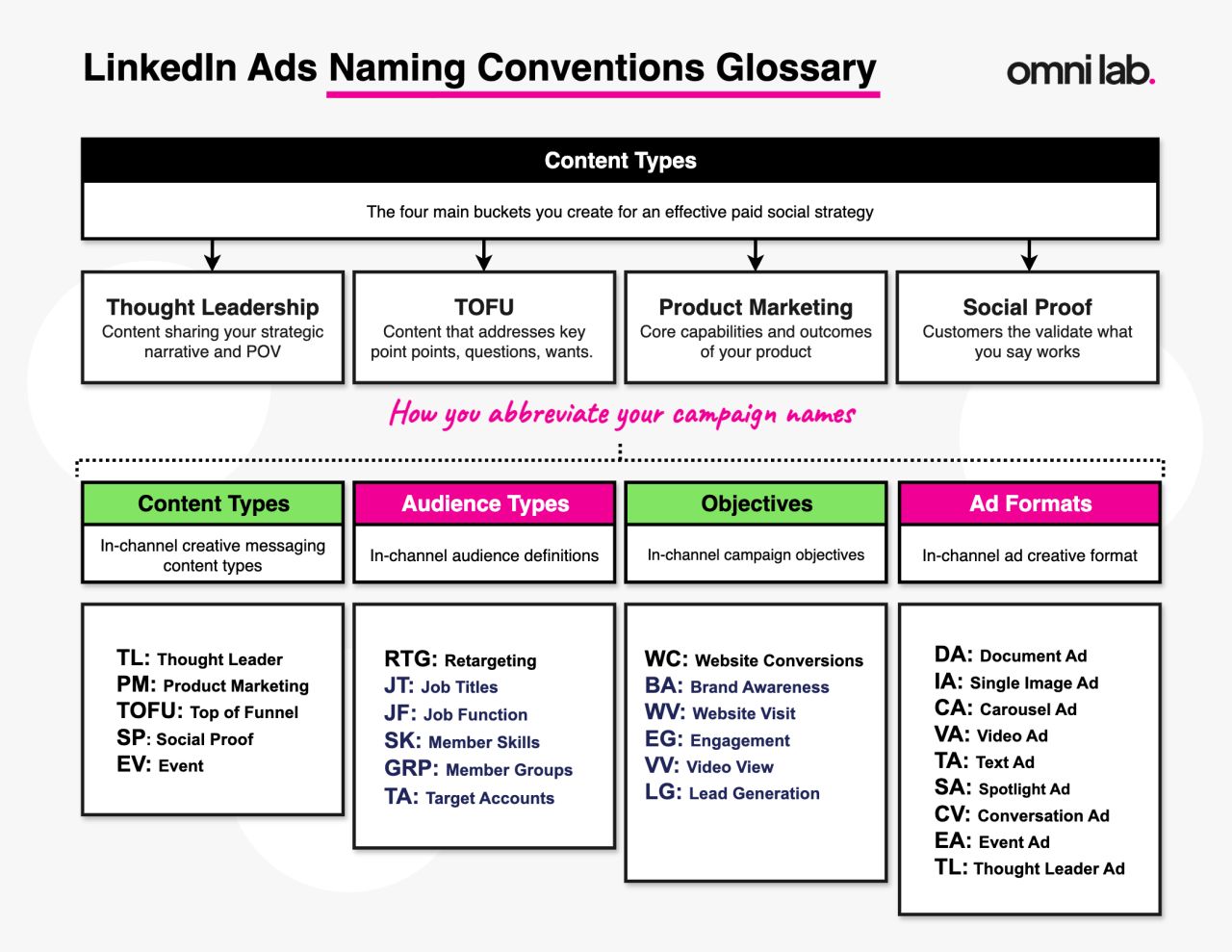
"Our campaign structure is a mess" said a VP of Marketing to me the other week. She went on to say... "I honestly don't have a good handle on what we are running or our strategy." I wish I could say this was an outlier, but I hear this ALL the time from marketing leaders at SaaS brands big and small. This happens when you: - Oversegment campaigns - Lack a clear strategic direction - Don’t document naming conventions - Have multiple people managing campaigns over time The result? - You can’t tell which campaigns are driving pipeline - It’s harder to sort by content type or objective - UTM parameters get messy in your CRM - Reporting becomes a nightmare It’s easy to think, “Who cares about naming conventions? I just want to hit pipeline.” But when you miss your pipeline target and start digging into campaign data, a clear and consistent naming structure becomes a lifesaver especially when you’re trying to spot what’s working and what’s not. Here’s how we approach it at Omni Lab 👇 Using LinkedIn Ads as an example, this is our internal naming conventions glossary that keeps everything organized across campaigns, audiences, and formats. Here are some examples: ✅ Campaign - Omni | Linkedin | WV | EV | FIRMO-CORP-MM | IA ✅ Ad Creative - Omni | PM | [Client] - Ad Set 30 - PM - Benefits - It's time to buy [Social] | 1x1 | IA - 10/06/25 ✅ Omni | LinkedIn | LG | Ad Set 145 - PM - Buy My Stuff - 10/06/25 You can then leverage tools like TextExpander to save the naming conventions so anytime your team needs to launch a new campaign the structure stays consistent. No need to "remember" it. Feel free to steal it or get inspiration from it.
- LINKEDIN · IMAGERecorded 27 Sept 2026
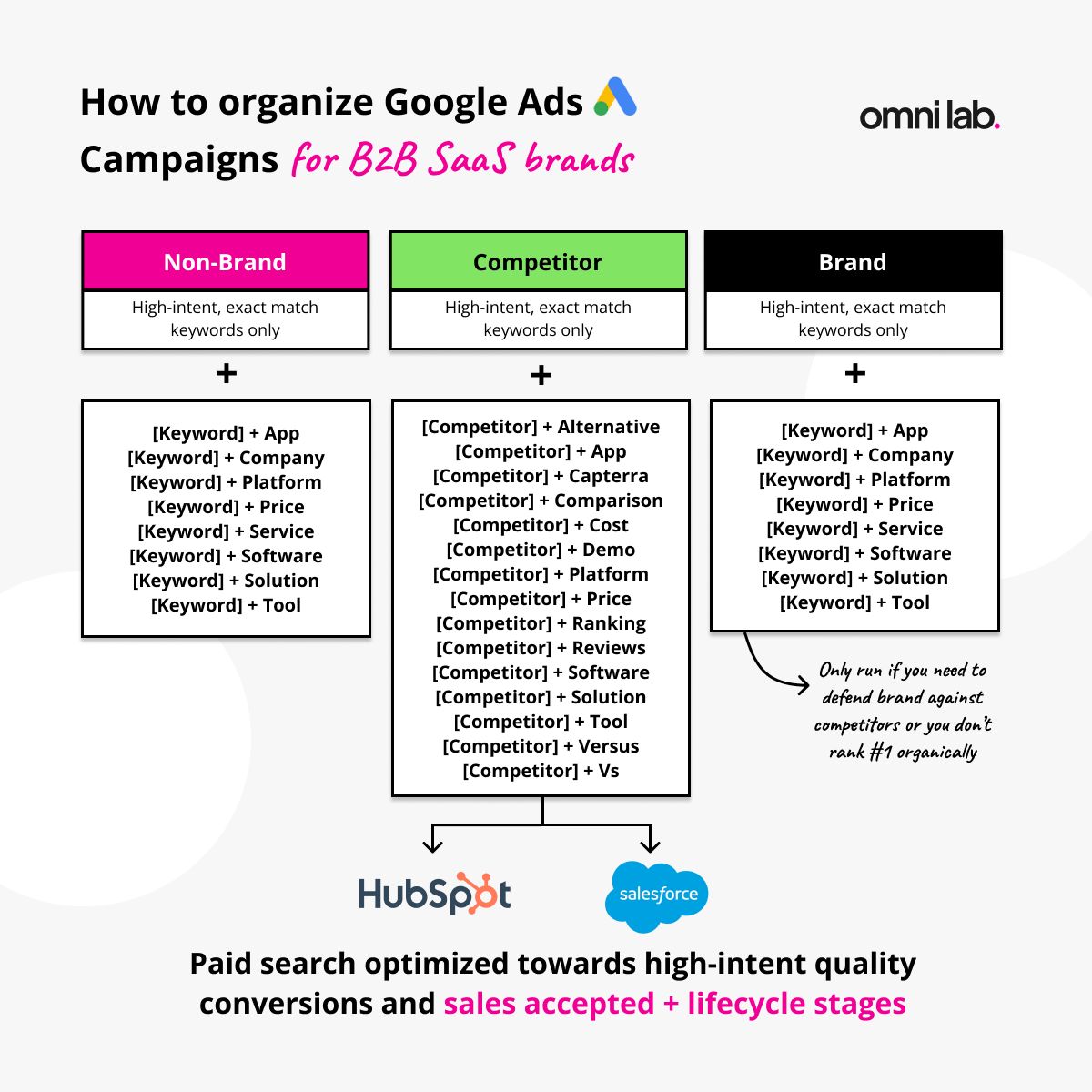
Most SaaS brands overcomplicate Google Ads. Here's how to simplify it. If you think about it, the only thing Google has control over is driving “quality" traffic to your website. After that, it's up to your website, product, sales team, and the rest of the org to bring it home. That means that, at the most basic level, you are buying search terms you want to appear for to align your brand with what a buyer is looking for. That's it. As for organization, here are some guidelines to follow: 1.) Types of campaigns: - Non-brand - Always focus on high-intent keywords - Brand - Only run if competitors are bidding against you and/or you don't rank #1 - Competitor - Focus on competitors you compete and win against 2.) Segmentation of Campaigns - Geo - Always split by geo (e.g. NA, EMEA, APAC) - Product - If you are a multi-product brand separate these - Theme - If there is enough volume split into theme 3.) Match Types: - Exact match - preferred starting point - Phrase match - only with tight control on search terms - Broad match - if you like wasting money Once you start spending, your weekly agenda will be simple. ✅ Review search terms report and consider negative keywords ✅ Review active experiments and idea backlog ✅ Review new product, capabilities, etc. that might change messaging or account structure ✅ Review performance charts Notice I didn't say: - Pause keywords - Change bid strategies - Launch new keywords - Or any other range of things you could be doing Why? Most people are WAY TOO reactive and prefer to spend their week panicking about demos being up, down, left, etc. This is how you drive an account to the ground. Stay patient and make incremental changes. When you start to convert, you can start looking at offline conversions like MQL, SQL, pipeline, and revenue. However, the reality is that the further down the funnel you go the less data you have. So instead, find the uppermost indicator that signifies a quality conversion that meets your ICP. You want to feed Google or any platform with as much data as possible and good quality conversions should ultimately translate into pipeline. TL;DR Complicated may look smart, but simple always wins.
- LINKEDIN · IMAGERecorded 27 Sept 2026
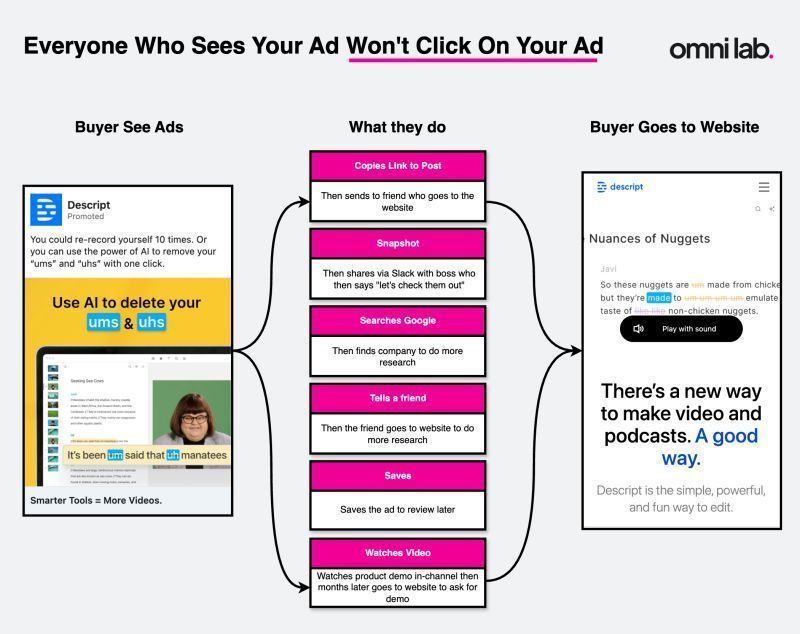
9/10 when I see an ad, I go to Google to look up the brand. However, most people get caught thinking people will: 1.) Click on Ad👇 2.) Go to landing page jail👇 3.) Convert 💰 The psychological bias that leads down this line of thinking is called the attribution bias. It's where humans have a tendency to simplify how they attribute actions to causes. However, not all advertising should promote an immediate response, or is that simple. Take Descript, for example. If I saw this ad and I happened to be interested in how to delete my ums and uh's I might: 1.) Type in the company name in the URL bar 2.) Take a screenshot 3.) Consume message in-channel 4.) Watch video in-channel 5.) Save ad 6.) Share ad in Slack group 7.) After hearing about your company, a friend tells another friend, and they go directly to your website. 8.) Mention it on the phone with a friend Zero-clicks... It means you need to shift your mindset and consider the broader influence your advertising has on the people you are targeting. TL;DR Reporting on platform metrics is great, but in most cases, you'll need to dig a bit deeper to understand the performance of your paid campaigns.
- LINKEDIN · IMAGERecorded 27 Sept 2026
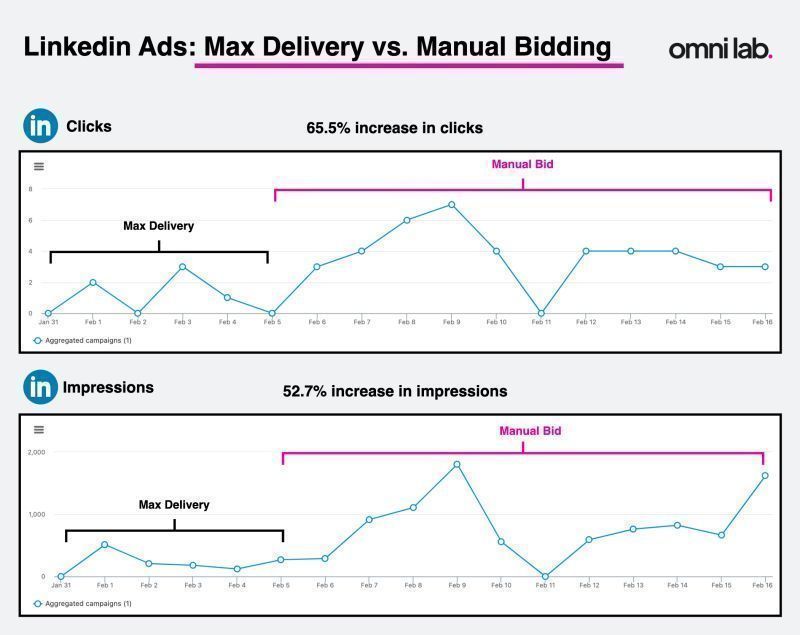
Max delivery vs. manual bidding on LinkedIn Ads. Here's what I've witnessed time and time again. 👇 - 65.5% increase in clicks after making the switch - 52.7% increase in impressions after making the switch This translates into the same budget reaching more in-market and out-of-market buyers. Why is this important? The double jeopardy law shows that smaller brands suffer not only because they have fewer customers, but also because those customers tend to be less loyal. Consequently, meaningful brand growth comes from reaching new (non‑buying) customers, not just attempting to squeeze more from existing customers or in-market buyers. We also reviewed the audience demographics to ensure we were still reaching all titles and company sizes in the audience. We saw: - A slight decrease (2%) in impressions served to Senior roles, but an increase of 4% to Director titles. - An increase in impressions served to bigger companies, 10,000+ and 1,000-5,000k, by about ~5%. While there was a slight impact, it was negligible. Always test, but often you are overpaying for traffic and impressions, ultimately decreasing reach, by setting your bidding strategy to maximum delivery. TL;DR In most cases, manual bidding will allow you to get more out of your current budget, but keep in mind that driving for the cheapest CPC/CPM can affect reach with more expensive audiences. You should always be after quality first. If you are interested in us managing your paid media strategy, check us out here > https://lnkd.in/e74x3b_E
- LINKEDIN · VIDEORecorded 27 Sept 2026
“Revolution and drive revenue with our all-in-one AI platform”. Come again? Do your ad headlines look like this? Buzzwords may make your brand appear impressive, but if buyers can't figure out what you do, then you are throwing your money away. It’s time to switch to an agency that understands that being clear is better than being vague.
- LINKEDIN · VIDEORecorded 27 Sept 2026
Targeting is the foundation of effective advertising. Get it wrong, and you burn budget and flood your CRM with leads that never close. Or worse, lose credibility with sales. While it may seem you are missing an opportunity by not chasing everyone, focusing is what’s going to drive better returns from your paid campaigns. At Omni Lab, we conduct in-depth historical analysis on the segments most likely to convert, ensuring your ad spend targets buyers most likely to come inbound.
6 of 101 adsSign up to see every Omni Lab ad, filter by format and date, and get alerts on new ones.
See all 101 adsWatch the companies you care about.
Filter every ad by industry, country, format and network, and get alerts when a company you watch starts running new ads.