On air · 1 of 3 networks
Nudge AI
- getnudgeai.com
- US
- 7 employees
Nudge AI’s ads on LinkedIn, Meta and Google, recorded by adsrunning. Browse the latest here for free. Sign up free to see all 38. Watch Nudge AI with Starter to get each new one in your feed.
Watchlist with Starter · $49/mo
| Network | Status | Live ads | Nov 2025LinkedIn activity · 52 weeksOct 2026 | Checked | Next step |
|---|---|---|---|---|---|
| Running | 38 | Checked 9 Oct 2026 | See all 38 ads → | ||
| Meta | Not checked | — | |||
| Recently | 100+ | Ads on the Google Ads Transparency Center | Checked 6 Oct 2026 | Collect them with the API → |
Nudge AI has 38 live LinkedIn ads. We recorded 100+ Google ads on 6 Oct 2026.
Latest ads
- LINKEDIN · IMAGERecorded 27 Sept 2026
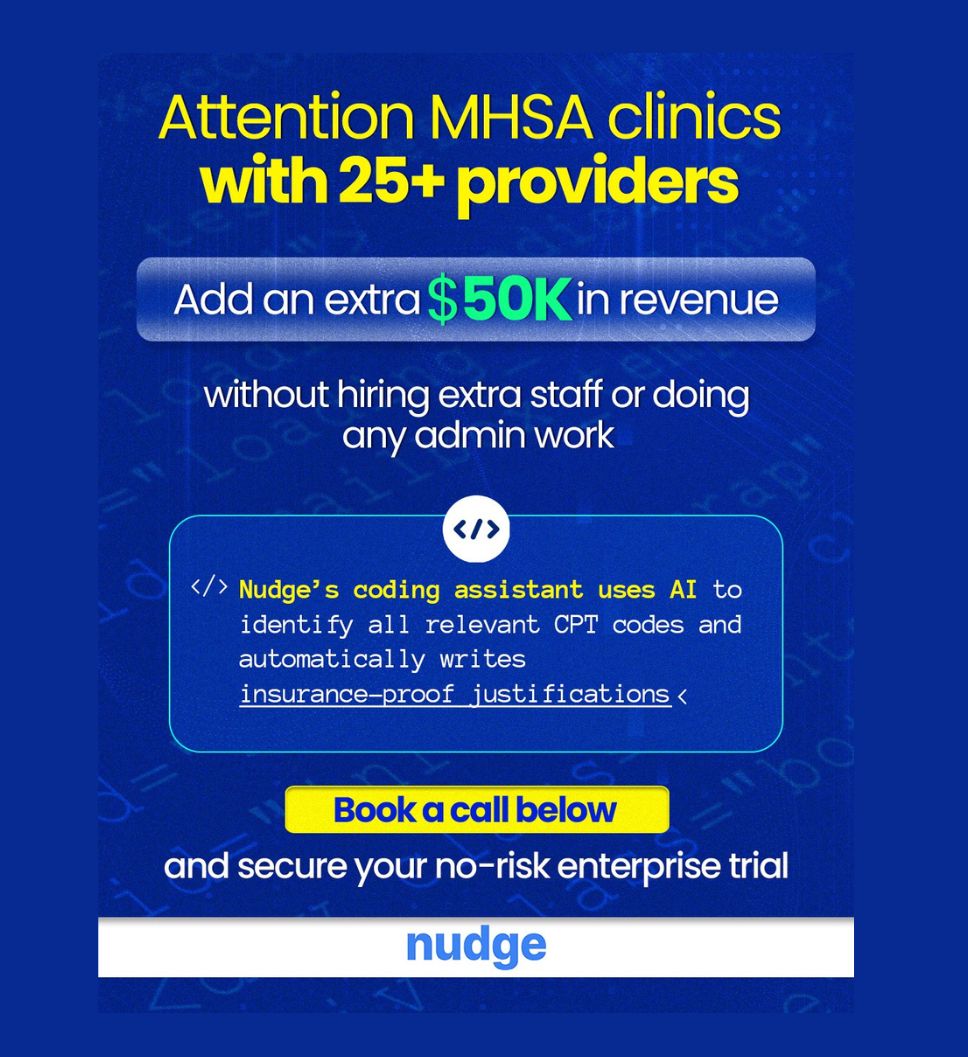
All MHSA clinic owners, listen up! Is your clinic stuck in paperwork overload? Nudge AI is here to rescue you! ✅ How? Nudge AI helps auto-generate HIPAA compliant notes for you, save hours, improve care and grow revenue - without changing how you work. ✅ Results? +30% revenue, 8+ hours/week saved per clinician, so they can focus more on actual work than admin duties. 👉 Find out how by booking a free demo with us today!
- LINKEDIN · IMAGERecorded 27 Sept 2026
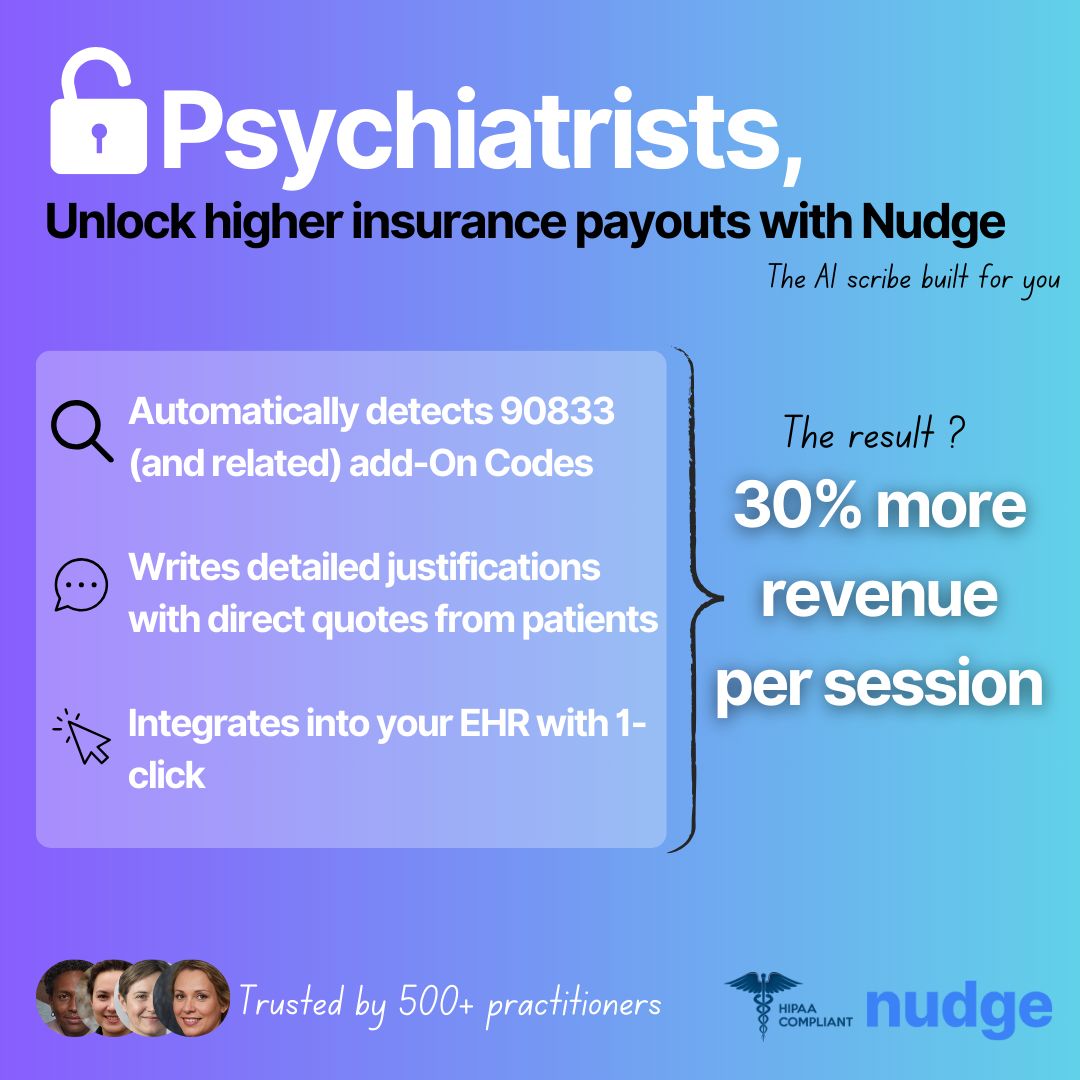
Behavioral health clinic owners, listen up! Is your clinic stuck in paperwork overload? Nudge AI is here to rescue you! ✅ How? Nudge AI helps auto-generate HIPAA compliant notes for you, save hours, improve care and grow revenue - without changing how you work. ✅ Results? +30% revenue, 8+ hours/week saved per clinician, so they can focus more on actual work than admin duties. 👉 Find out how by booking a free demo with us today!
- LINKEDIN · IMAGERecorded 27 Sept 2026
Behavioral health clinic owners, listen up! Is your clinic stuck in paperwork overload? Nudge AI is here to rescue you! ✅ How? Nudge AI helps save hours, improve care and grow revenue - without changing how you work. ✅ Results? +30% revenue, 8+ hours/week saved per clinician, so they can focus more on actual work than admin duties. 👉 Find out how by booking a free demo with us today!
- LINKEDIN · IMAGERecorded 27 Sept 2026
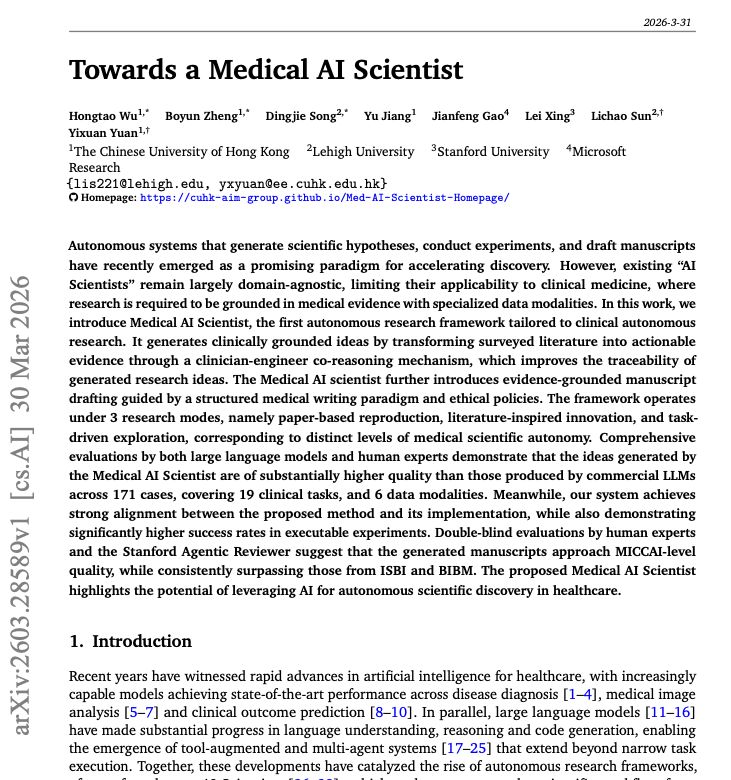
Stanford and Microsoft recently introduced a system they call a “Medical AI Scientist.” Here's everything you need to know. According to the publication, the system transforms surveyed literature into actionable evidence, executes experimental code, and drafts full manuscripts that adhere to medical ethical guidelines. The framework was rigorously evaluated across 171 clinical cases and 19 distinct research tasks. In testing, the system successfully completed experiments 91 to 93 percent of the time, significantly outperforming generalized models like GPT-5 and Gemini 2.5 Pro. Blinded expert evaluations found the AI-generated manuscripts comparable in quality to papers accepted at top medical imaging conferences. Furthermore, one of the system's manuscripts was formally accepted after a full peer review process. The internet is currently reacting to the headline that an AI can now write peer-reviewed papers completely on its own, the underlying utility of this technology mirrors the core application of clinical AI: serving as an embedded cognitive layer. Medical research and daily clinical practice share a similar operational bottleneck. The constraint is frequently the sheer volume of mechanical preparation required to validate a hypothesis or document an encounter. What a system like this actually does is compress the friction layer: • Synthesizing decades of fragmented medical literature • Setting up and debugging experimental code environments • Formatting data and citations into rigid manuscript structures The human remains entirely in the loop to interpret the nuances of patient variability, navigate ethical edge cases, and determine what is actually clinically actionable versus what is just statistically interesting. By reducing the mechanical friction between a hypothesis and its validation, we can dramatically shorten the time patients wait for clinical breakthroughs. Link to the study: https://lnkd.in/g3JKGPnx ♻️ Repost for your network ➡️ Follow Saureen Shah for more content like this.
- LINKEDIN · IMAGERecorded 27 Sept 2026
Radiology Business recently reported that the CEO of America’s largest public hospital system told a Crain’s New York panel he is ready to start replacing radiologists with AI to cut costs. His proposal: let AI handle the first reads of mammograms and X-rays, and only bring in a human if the system flags an abnormality. On a slide, that looks like cost savings. Inside a hospital, that looks like risk and some clinical leaders pushed back fast. We saw why in the recent Lancet trial on AI for mammography. The strongest results did not come from “AI instead of radiologists.” They came from AI inside the workflow: • Always paired with human oversight • Supporting decisions, not making them alone • Integrated with real clinical operations AI works best as an embedded cognitive layer. Not the final voice. Its job in radiology should be to absorb the “shadow work” that slows clinicians down: • Pull prior images and old reports • Reconcile fragmented EHR data • Draft structured findings for review Deploying AI to handle the preparation and documentation layer allows clinicians to operate with significantly greater capacity. They can spend more time on direct care, and health systems can safely absorb rising patient demand without accelerating burnout. The goal of healthcare AI is not to build a cheaper "doctor in a box." It is to build the operational spine that allows our current providers to practice at the absolute top of their license.
- LINKEDIN · IMAGERecorded 27 Sept 2026
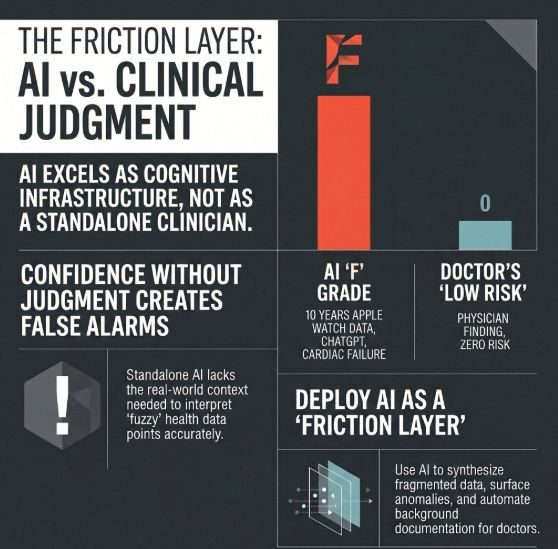
OpenAI wants ChatGPT to be your doctor. The Washington Post just showed why we're still far off from that being a reality. A technology columnist fed a decade of Apple Watch data into ChatGPT Health. Millions of heartbeats. Activity logs. Sleep data. The model crunched everything and gave his cardiac health an “F.” His actual physician reviewed the same data and confirmed he was at such a low risk for a heart attack that further testing wasn't even warranted. This is exactly why we need to stop treating AI as a standalone clinician. Generalized models are notorious for misreading fuzzy data points when they lack real-world clinical context. When a system generates conclusions with high confidence but lacks clinical judgment, it can create false alarms and unnecessary patient anxiety. In healthcare, AI demonstrates consistent, measurable value when deployed as an embedded cognitive layer. The technology is highly effective at managing the friction layer of clinical operations: • Synthesizing a decade of fragmented patient data into a clean, scannable timeline • Surfacing subtle anomalies for the physician to review • Handling the complex documentation and coding in the background When we ask AI to replace the physician, it fails. When we use it as bespoke infrastructure to remove cognitive friction, the human clinician can stay fully in clinical mode. I am curious how you see this inside your own practice: are patients already walking in with AI‑generated “diagnoses” on their phones? Link to the article here: https://lnkd.in/giXqWyD3


6 of 38 adsSign up to see every Nudge AI ad, filter by format and date, and get alerts on new ones.
See all 38 adsWatch the companies you care about.
Filter every ad by industry, country, format and network, and get alerts when a company you watch starts running new ads.