Not on air · 2 of 3 networks checked
Norilsk Nickel
- nornickel.com
- CH
- 839 employees
Norilsk Nickel’s ads on LinkedIn, Meta and Google, recorded by adsrunning. Browse the latest here for free. Sign up free to see all 26. Watch Norilsk Nickel with Starter to get each new one in your feed.
Watchlist with Starter · $49/mo
| Network | Status | Live ads | Nov 2025LinkedIn activity · 52 weeksOct 2026 | Checked | Next step |
|---|---|---|---|---|---|
| None recorded | 0 | Checked 29 Oct 2026 | See all 26 ads → | ||
| Meta | Not checked | — | |||
| None recorded | 0 | No ads found on the Google Ads Transparency Center | Checked 5 Oct 2026 | Collect them with the API → |
Norilsk Nickel has no live LinkedIn ads. We recorded no Google ads on 5 Oct 2026.
Latest ads
- LINKEDIN · IMAGESince 22 Oct 2026
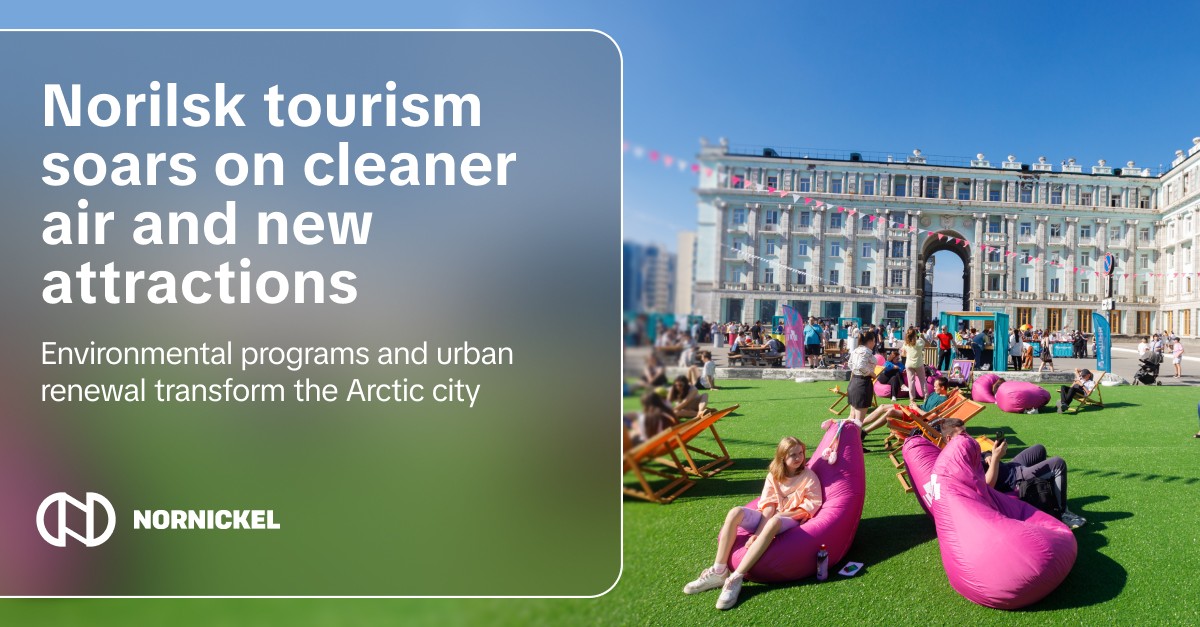
Demand for leisure trips to Norilsk in the first half of 2025 rose by 93% — the highest growth rate of any northern destination in Russia. Visitors come for the breathtaking nature of the Putorana Plateau and the northern lights, but also for industrial tours that include a working mine training facility, a 450-metre open pit, and a smelter where molten metal is poured before their eyes. Beyond the industrial sites, the city offers neoclassical architecture from the early Soviet era, the world’s northernmost drama theatre, ethnocultural routes, and Arctic cuisine. For a city long defined by its image as an unwelcome, remote industrial site, this surge in tourist interest shows how dramatically Norilsk has transformed. The biggest change is the better environment. Industrial emissions fell by 39% between 2020 and 2025, and in 2023 Russia’s federal meteorological service removed Norilsk from its list of settlements with critically high atmospheric pollution — a list it had been on for decades. The main driver is our Sulphur Programme, launched in October 2023, which processes flue gases from smelting furnaces to capture and treat sulphur dioxide. Capture efficiency exceeds 99%. When all installations reach full capacity in 2028, total pollutant volumes are expected to fall to roughly 10% of pre-programme levels. A parallel $1.5 billion urban renewal programme running until 2035 is already delivering results: new residential buildings and the Bashnya (Tower) cultural centre have opened, a medical centre in Talnakh is under construction, and a 1,100-place school is planned. The city’s Arctic university is being renovated and now runs permafrost research schools jointly with Moscow State University. A structural monitoring system tracks 1,500 buildings across the city for permafrost-related ground movement, measuring deformations to within 1–2 millimetres. #nature #travel #Arctic #ESG
- LINKEDIN · VIDEOSince 21 Oct 2026
We released fifty thousand juvenile Siberian sturgeon into the lower Yenisei near the port of Dudinka. This year's fish weigh 10–11 grams, roughly ten times heavier than the one-gram fry typically stocked in such programmes. The survival rate for the larger fish is much better: juveniles we released are the biological equivalent of 850,000 smaller fish. At 10–11 grams, sturgeon have already developed hardened bony plates along their bodies, leaving them with virtually no natural predators in the river. They also carry enough nutrient reserves to survive their first winter, overcoming the critical period that kills most smaller fry before they can establish themselves and eventually reproduce. The Yenisei releases are part of a restocking programme running until 2034, under which more than 20 million sturgeon juveniles are planned for the local water system. Once the ecosystem stabilises after 2035, the focus will expand to the Norilsk-Pyasina water system — a separate and ecologically significant basin on Taimyr. Read more: https://esg.nornickel.com/ #nature #Arctic #ESG
- LINKEDIN · IMAGESince 23 Jul 2026
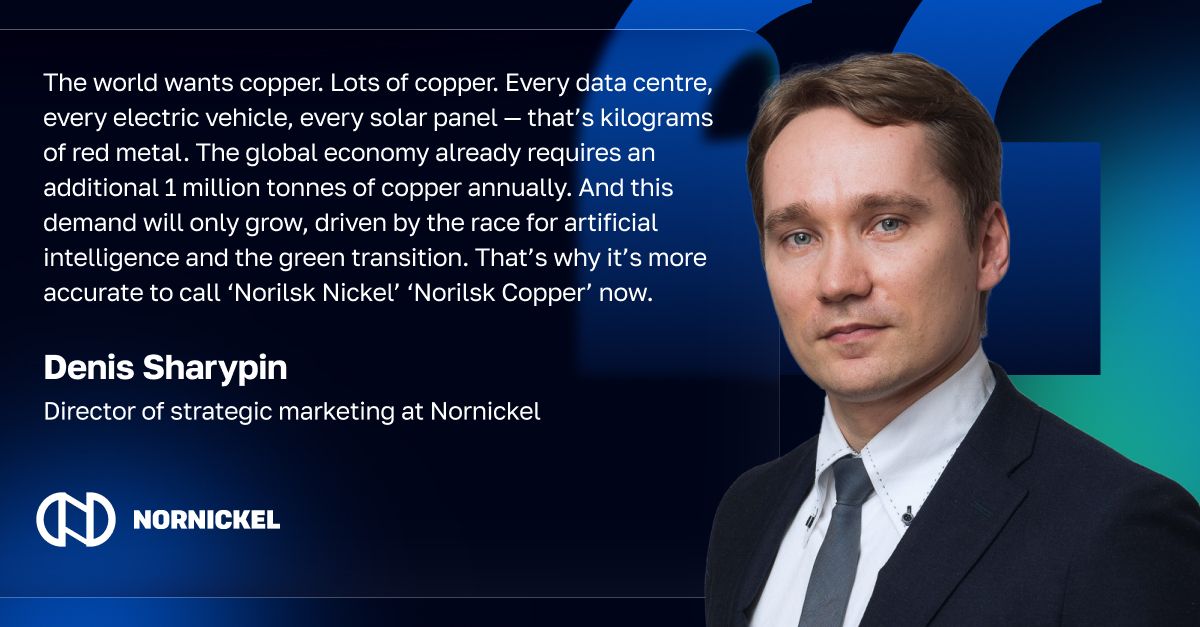
For the first time in Nornickel’s history, copper has overtaken nickel as the company’s largest revenue contributor, accounting for more than 30% of sales. This shift reflects copper's price strength through H1 2026 and is poised to become a long-term trend, despite current market turbulence. The metals market behaved oddly during the first half of 2026. Copper prices ranged from $10,000 to $14,000 per tonne — not due to a global shortage (exchange inventories actually rose by nearly 1 million tonnes) — but because traders rushed to import physical metal into the United States ahead of anticipated tariffs. When the Fed declined to cut rates on 19 June, prices consolidated sharply. Nickel hit $19,000, gold broke $5,000. Then the momentum faded. However, this noise obscures a real supply story. The global economy needs roughly 1 million additional tonnes of copper each year to wire data centres, electric vehicles, and solar installations. New mines take years to permit and build, and elevated interest rates since 2022 have suppressed upstream investment. Around 9 million tonnes of new capacity is pencilled in for 2028–2035. If even part of that is delayed, the market will shift into a structural deficit. Nickel faces its own pressures. Indonesia, which rose from minor player to dominant global producer within a decade, has tightened extraction quotas and changed its ore pricing formula. The closure of the Strait of Hormuz sent sulphur prices from $250 to over $1,400 per tonne, squeezing the economics of Indonesian nickel processing. Global nickel output is set to fall in 2026 for the first time in ten years, eroding the surpluses that have weighed on prices. Our Director of strategic marketing, Denis Sharypin, jokingly suggested we rename ourselves Norilsk Copper. But we're not picking winners. We produce metals the world needs right now: copper for digital infrastructure, nickel for next-generation batteries, and palladium and platinum for the automotive and chemical industries. Market fluctuations do not change the fundamental truth: demand for these metals is structural, long-term, and here to stay. #copper #nickel #PGM #market
- LINKEDIN · VIDEOSince 17 Apr 2026
Nornickel's Sulphur Programme is nearing completion. We've commissioned the third production line and fourth acid neutralisation line at the Nadezhda Smelter. All lines are operational and the system is at full design capacity. Once performance stabilises, sulphur dioxide emissions in Norilsk will be 90% lower than 2020 levels. Sulphur dioxide captured during ore smelting converts into sulphuric acid, which is then neutralised with limestone to produce gypsum — a stable, inert material. The four-line setup runs continuously, with one line held in reserve at any time. Since January 2026, the system has processed 160,000 tonnes of sulphur dioxide. The heavier load comes in the second half of the year as the new capacity ramps up fully. The programme cost nearly $4 billion. However, we are not stopping here and are already planning equipment upgrades. #ESG #Arctic
- LINKEDIN · IMAGESince 17 Mar 2026
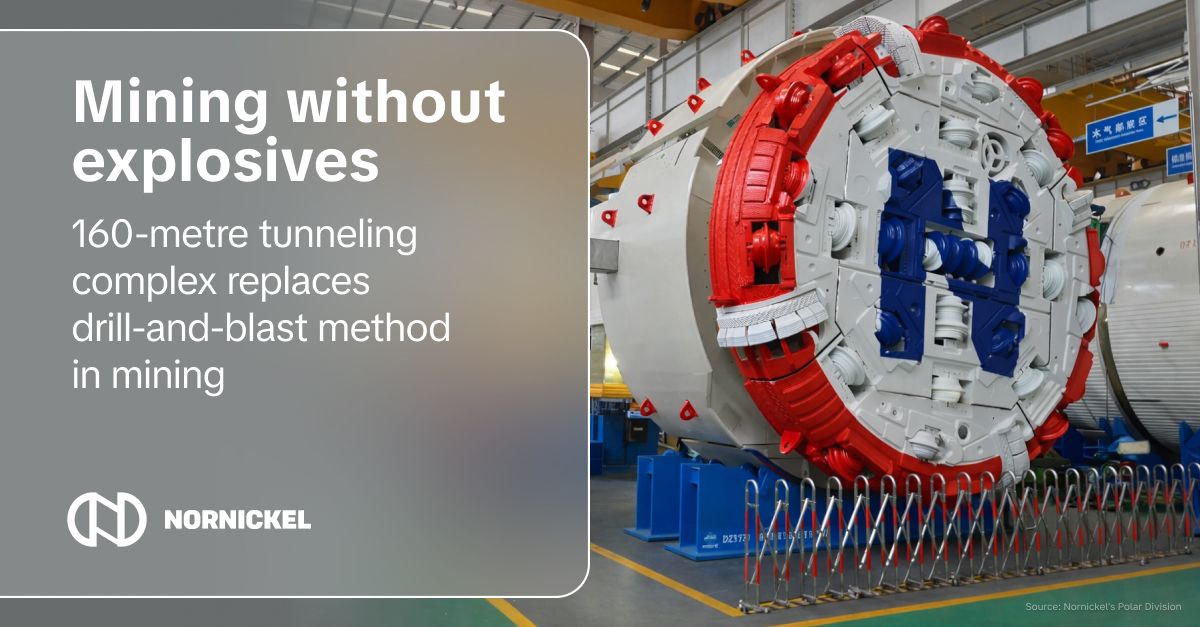
Nornickel is deploying a 160-metre mechanised tunnelling complex, Norda, to excavate hard rock ore without explosives — a first for metal mining at this scale. The technology, adapted from metro construction and coal mining, has been modified for much harder geology in nickel ore. Instead of drilling holes, packing them with explosives, and clearing the rubble in cycles, Norda’s cutterhead grinds through rock continuously. This shift changes the physics of underground work. Continuous cutting produces less vibration and shock to the surrounding rock mass, enabling faster advance rates, more stable tunnels, and significantly improved safety. The team estimates initial development speeds of around 500 metres per month. Industrial trials will determine whether this can be doubled once optimal ground-support patterns are established. For mine planning, we are already working with these higher scenarios. The initial target is 150,000 tonnes of ore this year, scaling up to 500,000 tonnes. #mining #technology #innovation
- LINKEDIN · IMAGESince 6 Feb 2026
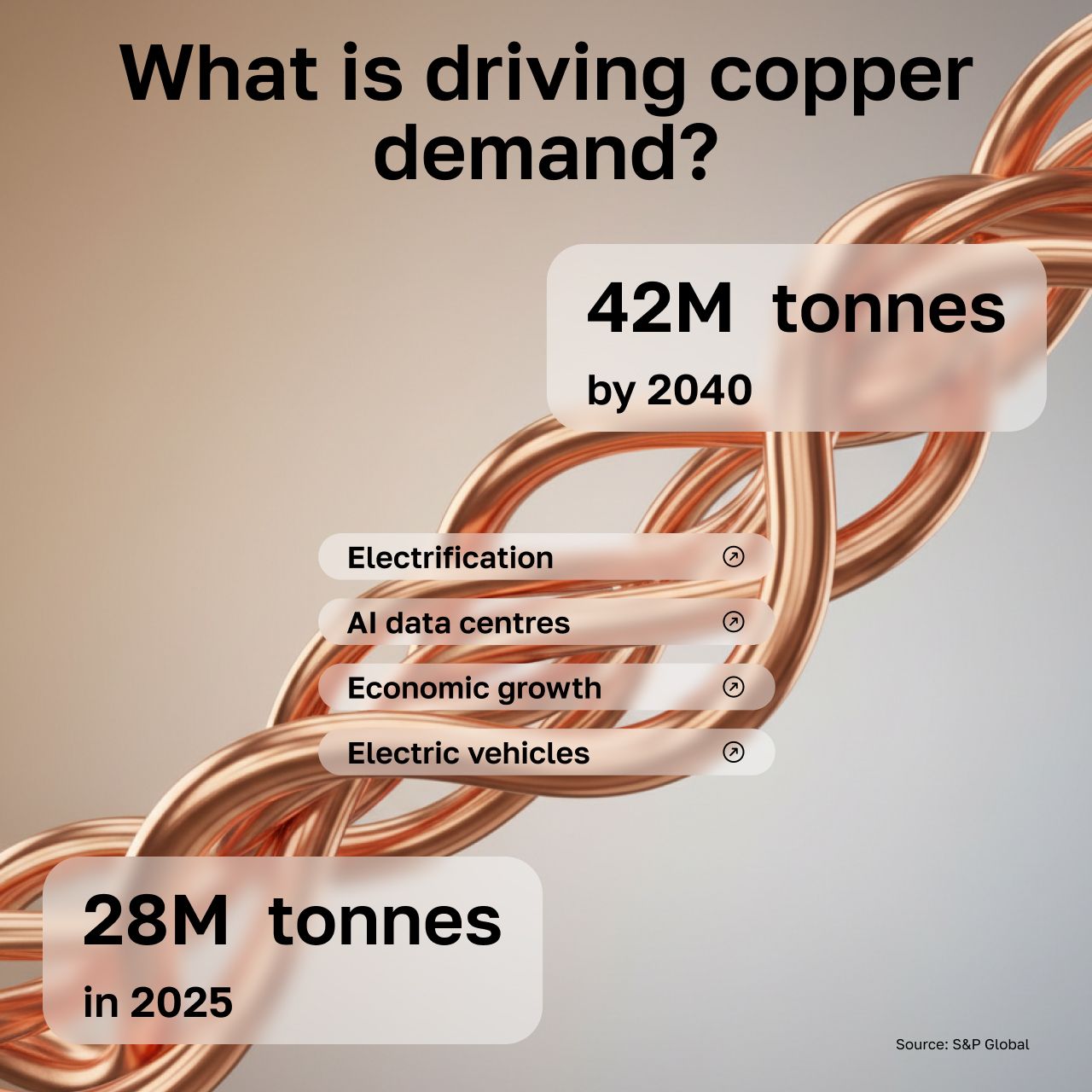
⚠️S&P Global sees massive copper shortage by 2040 Global copper demand could outstrip supply by 10 million tonnes by 2040, according to S&P Global Energy & Market Intelligence report (https://lnkd.in/eWcE5hGj). Analysts attribute the rising demand to several factors: ◼️ expansion of all types of traditional electrical equipment production ◼️ construction of electrical infrastructure ◼️ proliferation of AI technologies ◼️ demand for electric vehicles ◼️ growth of the renewable energy sector S&P Global forecasts global copper consumption to rise 50% from 28 million tonnes in 2025 to 42 million tonnes by 2040. The market is expected to remain balanced until the early 2030s. After 2033, without significant investment in new projects, copper shortages will accelerate rapidly, analysts warn. Supply will continue to face objective constraints: depletion of existing mines, declining ore grades, rising capital expenditures, complex regulatory processes, and logistical risks, the report says. This aligns with the forecast made by Nornickel’s research team in December (https://lnkd.in/e_vWKTb5). In this context, stable copper supplies become critically important. In 2025, Nornickel produced 425,000 tonnes of copper — about 1.5% of the global volume. #metals #copper
6 of 26 adsSign up to see every Norilsk Nickel ad, filter by format and date, and get alerts on new ones.
See all 26 adsWatch the companies you care about.
Filter every ad by industry, country, format and network, and get alerts when a company you watch starts running new ads.