On air · 1 of 3 networks
Neo4j
- neo4j.com
- US
- 1,112 employees
Neo4j’s ads on LinkedIn, Meta and Google, recorded by adsrunning. Browse the latest here for free. Sign up free to see all 685. Watch Neo4j with Starter to get each new one in your feed.
Watchlist with Starter · $49/mo
| Network | Status | Live ads | Nov 2025LinkedIn activity · 52 weeksOct 2026 | Checked | Next step |
|---|---|---|---|---|---|
| Running | 405 | Checked 29 Oct 2026 | See all 685 ads → | ||
| Meta | Recently | 6 | Active ads on the Meta Ad Library, all countries | Checked 23 Oct 2026 | Collect them with the API → |
| Recently | 400+ | Ads on the Google Ads Transparency Center | Checked 5 Oct 2026 | Collect them with the API → |
Neo4j has 405 live LinkedIn ads. Its Facebook page had 6 active ads on 23 Oct 2026, and we recorded 400+ Google ads on 5 Oct 2026.
Latest ads
- LINKEDIN · IMAGESince 23 Oct 2026
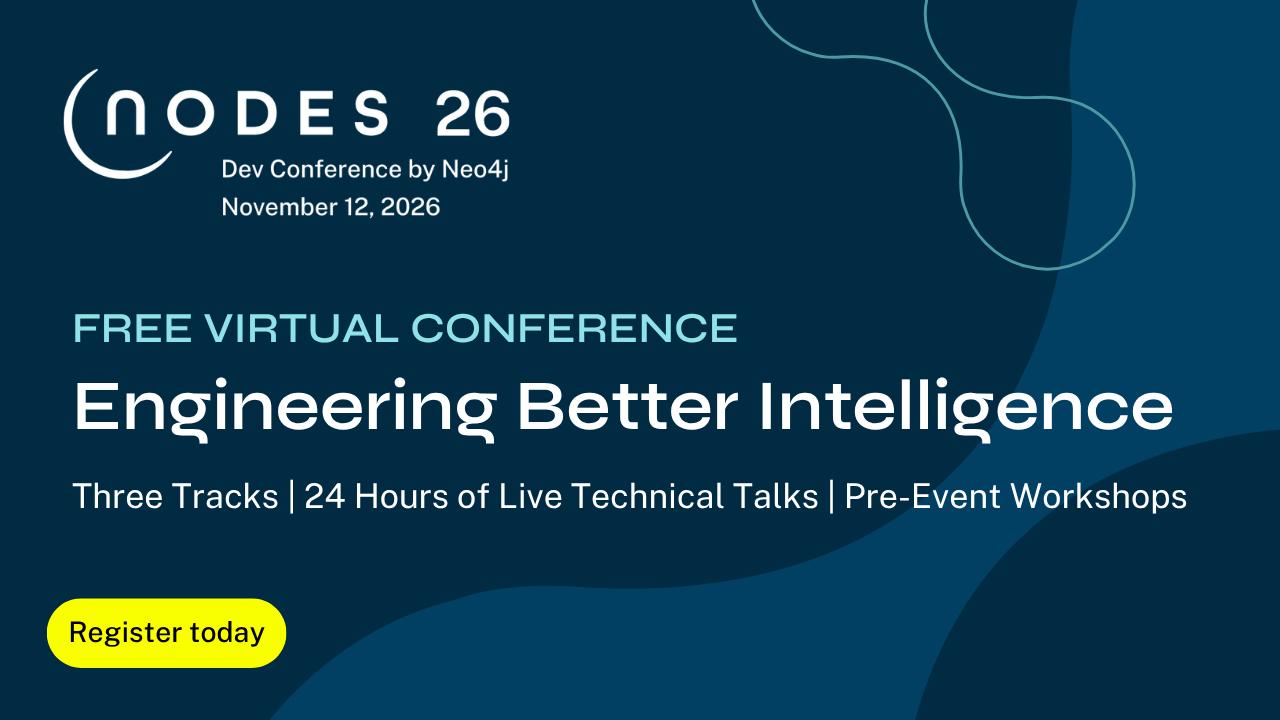
I am super excited that Dr. Andrew Ng will join Emil Eifrem for a Keynote Fireside Chat at our Neo4j #NODES developer conference this year! They will explore what's next for #AIEngineering and how we can design and build better agentic systems. 📅 NODES is a free, 24-hour global virtual conference dedicated to engineering better intelligence. 👉 Reserve your spot here: https://neo4j.com/nodes When it comes to understanding where AI engineering is heading, Andrew is deeply in the know - through deeplearning.ai, his AI fund investments, conferences, and the consulting he does for companies and governments. Recently, he and his team analyzed jobs, hiring needs, surveys and pain points to create the AI Engineering Skills Map (https://lnkd.in/eRiqE3br). Production grade AI engineering it requires four skills: * Building AI Systems: evals, model capabilities, data grounding, context management, and agentic architectures. * Software Fundamentals: system design principles, maintainable software architecture, security, integrations, and scalability * Coding Agents: applying strong SDLC practices to agentic development * Shaping what to build: product sense, business context and user empathy Why this matters for you: Building complex, production-ready agentic systems needs more than just stringing models, prompts and tools together—it requires strong data intelligence, context management, and precise knowledge grounding.
- LINKEDIN · VIDEOSince 13 Oct 2026
A claim I'll defend: over the next few years, the application layer gets more interesting than the model layer. I talked with SiliconANGLE & theCUBE for their AI Luminaries series about AI and graphs. The core argument: Every gain in base model intelligence raises the bar for the context architecture around it, not the reverse. A smarter model with amnesia is still a model with amnesia. It wakes up, ingests documents, reasons well, and forgets, including the reasoning, which is usually the part worth keeping. The human mind processes knowledge incrementally, over time, in a way that stays traceable. Rebuilding that in software is a data structure problem before it's a model problem. Graphs with the right ontology are the substrate. That's the bet I'm making. Clip below.
- LINKEDIN · VIDEOSince 13 Oct 2026
I spoke with my friend Philip Rathle, CTO at Neo4j, at Dreamforce by Salesforce ON The Ravit Show. Context, knowledge, semantics, ontology, memory. Every one of these enterprise AI ideas leans on graph technology. That was Philips core point. Here are the takeaways:- - Enterprise Knowledge Layer: built on 3 pillars. Ontology and semantics, integrated enterprise data, and long-term memory with reasoning graphs.- Virtual Graph: run graph queries through Neo4j directly on Snowflake, Databricks, and BigQuery. No need to migrate all your data first. - Financial services solutions: after acquiring GraphAware, Neo4j took its police and government tools and built a version to fight financial crime. - Multi-tenant Aura: multi-tenant database capabilities, once limited to self-managed products, now come to the fully managed cloud platform. Built for B2B AI startups.The big CXO problem Philip is solving: AI agents need real-time access to connected intelligence across data silos, not information locked inside a lakehouse.Some of these features are live today and others are coming soon. Full details are on the Neo4j website, and you can connect with Philip on LinkedIn.Full interview in the video below. #neo4j #graphdatabase #knowledgegraph #dreamforce #enterpriseai #aiagents #dataandai #theravitshow
- LINKEDIN · IMAGESince 9 Oct 2026
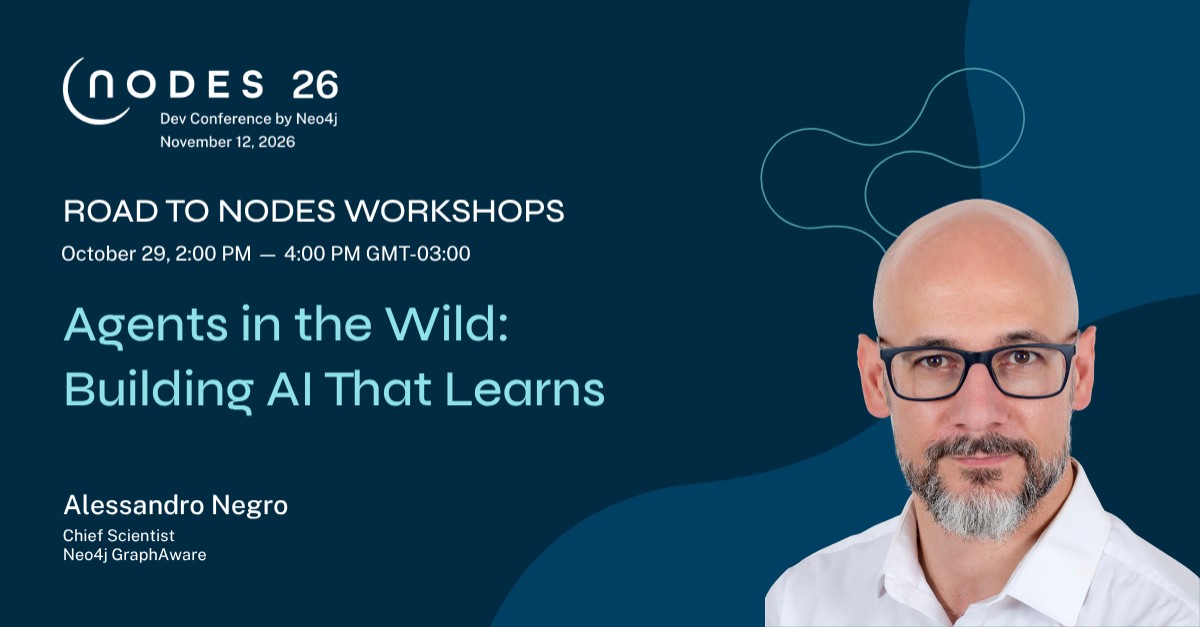
Build a memory stack that lets your agent learn from its own execution traces. In this free, two-hour online workshop, you'll design a Neo4j schema that captures agentic execution traces, compose playbooks dynamically at query time, and build a Reflector→Curator loop that improves from both human corrections and real outcomes. 💡 The test case is value investing, with live demos and real code throughout. You also see where graph-based memory pays off, and where the trade-offs in latency and complexity start to matter. Build intelligent, graph-powered applications! https://bit.ly/4ywyP3U #NODES2026 #Neo4j #AI Alessandro Negro
- LINKEDIN · IMAGESince 6 Oct 2026
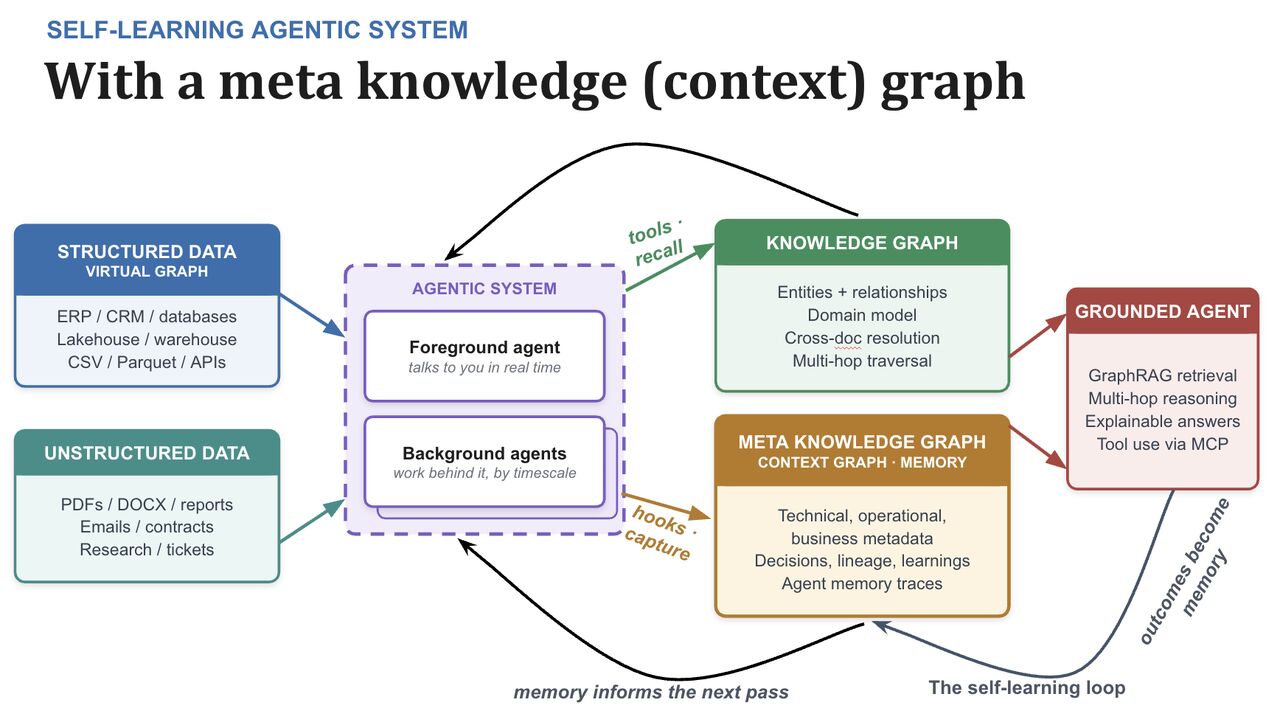
I am pleased to announce that we built a multi-agent system that learns and launched as a lab project (github link in the comments). Many AI agents stop at memory; this one is a real architecture on top of it: agents that read and write a shared context graph, a meta knowledge graph that holds its memory, with metadata drawn from both the graph and the lakehouse, a semantic layer over the data where it already lives, and self-learning through graph mining. We demonstrated it running in both #ClaudeCode and #Codex. Most AI agents are brilliant on day one and still on day one tomorrow. They restart from zero, because the industry ships memory and skips the harder half: what an agent does with that memory once it has it. So we built the other half. Not one agent with a longer memory, but one foreground agent talking to you in real time with a pool of background agents working behind it, split by timescale, all writing back to the same graph. The data stays in the lakehouse. The metadata, technical, operational, and business, comes from the lakehouse and the graph together, with unstructured data turned into a knowledge graph. That shared layer is what keeps a team of agents consistent instead of each one drifting alone. Self-learning is the part closest to my heart. The system learns two ways: it consolidates raw traces into durable learnings, and it mines the graph to surface patterns nobody recorded. I teamed up with the brilliant Tomaz Bratanic to making this lab project reality and write up exactly how. The detailed architecture, the implementation, and the code on GitHub are all in two blogs we just published. This is the first half of a four-part series: next, the semantic layer and how memory is captured, then end-to-end self learning and consolidation, then multi-agent systems in full. This started as the meta knowledge graph which attracted huge interest (original blog in the comments). Now it is proposed, built, and running. Both blogs in the comments. Would love your thoughts. Also thanks to many folks for endless discussions and contributions: Michael Hunger Jakub Marchwicki William Lyon Alexander Gilmore Eric Monk Brian Shi Kristof Neys Jesús Barrasa Niels de Jong #AgenticAI #AIAgents #AgentMemory #EnterpriseAI #Metadata #KnowledgeManagement #AIArchitecture #LLMOps #DataEngineering #MLOps #cloud #lakehouse #SelfLearningAI #GraphRAG #KnowledgeGraph #MultiAgentSystems #ContextEngineering #Neo4j #GenAI #RAG Neo4j
- LINKEDIN · IMAGESince 6 Oct 2026
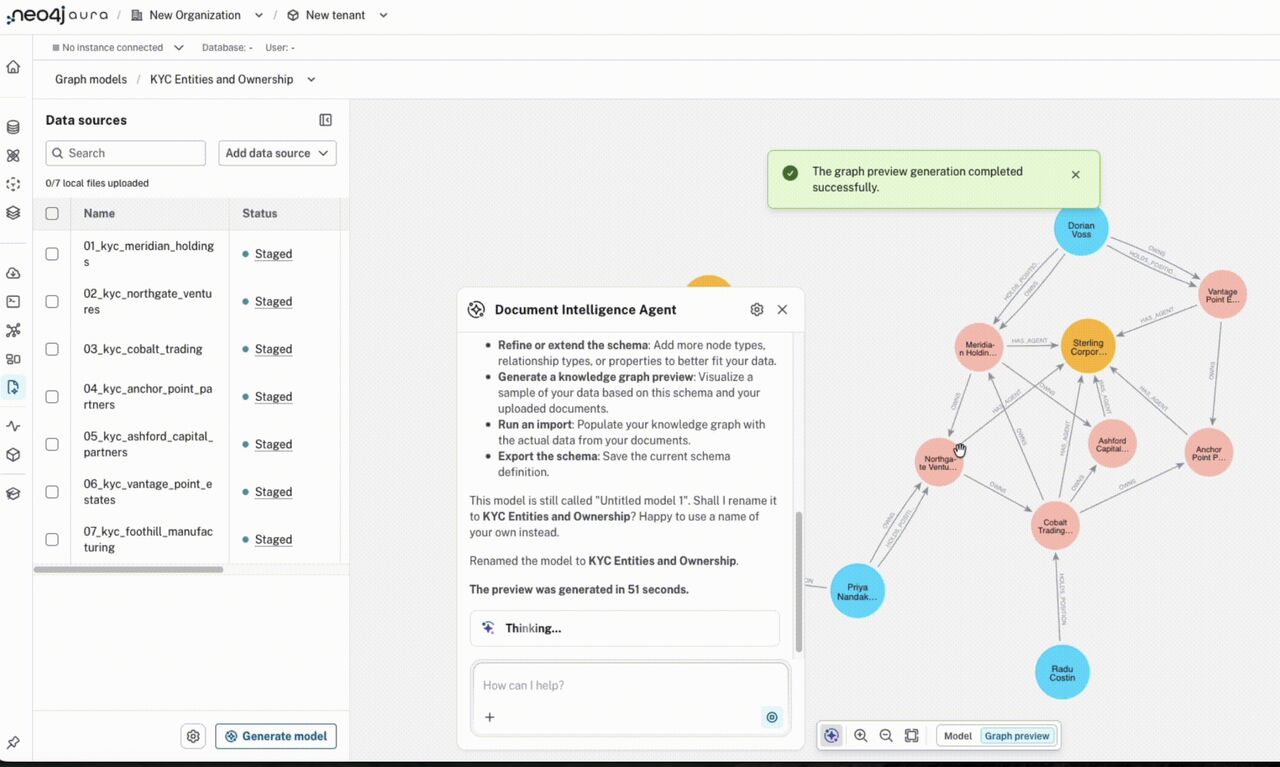
Back in the summer we launched the preview of Neo4j Document Intelligence, an agentic approach to building knowledge graphs from unstructured data. At the time we kept limits on document volume and complexity in place, on purpose, while we right-sized the experience for GA. We just announced at GraphSummit London that in a few weeks we are lifting all of those restrictions! Point it at your documents, describe what matters and the business context, and the Document Intelligence agent proposes the schema, extracts and resolves the entities, and builds the graph with you in control. Then chat with your graph in the same agent, or use it from Aura Agents, Claude, etc. Since preview we have had all sorts go through it. From UFO files to World Cup documents, and a lot in between... It takes a village to get something like this done. The engineering team has been working really hard since preview, with Estelle Scifo on the driving seat with great engineering team: Dave Russell Jonny Law, PhD Nathalie Charbel, Matteo Medioli, Amirhossein Layegh, Adam Schill Collberg, Jacob Sznajdman, Ali S. , Aleksey Dukhovniy Duytan (Zee) Hoang, William Doran André S. , Alongside Michael Hunger, Sudhir Hasbe, Florin Manole Oskar Hane, Wanhang Zhao Jessica Wright, Jean-Marc Guerin, Jesús Barrasa, Eric Monk, Nuno Pedro L. , Zaid Zaim, Benjamin Squire, Ben Lackey, Yoav Derazon, Osman Ishaq, Corydon Baylor, Terri Schlosser and many more across Neo4j. We are still making progress and a lot more is on the way :) Give it a spin and let us know what you think. Have a use case? Reach out to me directly and we can give you higher limits. Or fill out the form at the bottom of the blog in the comments. #Neo4j #GraphAI #KnowledgeGraphs #DocumentIntelligence #GraphRAG #RAG #AgenticAI #EnterpriseAI #AIAgents #GenAI #Ontology #UnstructuredData #DataEngineering #GraphDatabase #Aura #ContextEngineering #GraphSummit
6 of 685 adsSign up to see every Neo4j ad, filter by format and date, and get alerts on new ones.
See all 685 adsWatch the companies you care about.
Filter every ad by industry, country, format and network, and get alerts when a company you watch starts running new ads.