Not on air · 2 of 3 networks checked
NativeResearch drw GmbH
- native-research.com
- DE
- 14 employees
NativeResearch drw GmbH’s ads on LinkedIn, Meta and Google, recorded by adsrunning. Browse the latest here for free. Sign up free to see all 128. Watch NativeResearch drw GmbH with Starter to get each new one in your feed.
Watchlist with Starter · $49/mo
| Network | Status | Live ads | Nov 2025LinkedIn activity · 52 weeksNov 2026 | Checked | Next step |
|---|---|---|---|---|---|
| None recorded | 0 | Checked 29 Oct 2026 | See all 128 ads → | ||
| Meta | Not checked | — | |||
| None recorded | 0 | No ads found on the Google Ads Transparency Center | Checked 5 Oct 2026 | Collect them with the API → |
NativeResearch drw GmbH has no live LinkedIn ads. We recorded no Google ads on 5 Oct 2026.
Latest ads
- LINKEDIN · IMAGESince 29 Oct 2026
10 business cases where consultancies and corporates rely on us at Native Every one of them starts at the same point: where standard market research hits its limits. Frameworks and roadmaps are not the hard part. The hard part is a data foundation solid enough to carry the decision. These are the cases we get brought in for: Market entry strategies → Category sizing beyond industry reports. Opportunity estimates that are robust enough for investment decisions. Value based pricing for new products → Moving past cost plus logic. Quantifying what customers actually pay for and why. Revenue linked customer segmentation → Segmentations that show not only who customers are, but where the money sits. Large scale global surveys → Complex routing, long brand lists and multi category designs that require methodological rigor. Thought leadership with business relevance → Content designed to shape executive discussions, not marketing noise with a short shelf life. Strategic brand tracking → Connecting brand metrics to commercial outcomes across all 4Ps, not just communication. Hard to reach target groups → B2B decision makers and niche B2C audiences in difficult markets. Pricing strategy foundations → Willingness to pay data that supports real pricing decisions, not directional comfort. High performing loyalty programmes → Designs that create differentiation and economic return, not just points. Brand portfolio optimisation → Maximising reach while maintaining clear fences between brands and products. The pattern is consistent. Whoever owns the strategy, it only becomes executable when the evidence underneath it holds. Because without a reliable data foundation, even the strongest framework breaks down in execution. As former consultants, we understand these business cases from the inside. _____ PS: One of those ten on your desk right now? Let's talk. Just message me.
- LINKEDIN · IMAGESince 29 Oct 2026
Market research has an identity problem. Researchers see themselves as neutral truth-deliverers. Objective. Rigorous. Impartial. In the boardroom, that makes them invisible. Executives don't want more data. They want someone who says: Do this. For this reason. Now. Classic research firms don't do that ...and most can't. Their business model, incentives, and talent were built around delivery, not decisions. As a result, they are all fighting for the same shrinking budgets. We built Native to play exactly in this whitespace. Not a research agency that added consulting. Not a consultancy that bolted on fieldwork. A team with strong research expertise and genuine consulting DNA. One that stays in the room when decisions get made. My prediction: In five years, there won't be a single pure-play research agency in the top tier. The winners will look like strategic advisors who happen to have better evidence than any consultancy. Prove me wrong. _______ PS: Want research that stays in the room when the decision gets made? Let’s talk. Just message me.
- LINKEDIN · IMAGESince 29 Oct 2026
Remember when you could charge your Nokia and forget where the charger was? 😅 Then smartphones arrived. More features. More possibilities. And a much closer relationship with your charger. We complained about the battery. And bought them anyway. That’s what makes customer needs tricky. Something can matter enormously and still be worth sacrificing for something better. Battery life didn’t stop mattering. But what people expected from a phone changed. And that’s where research can give businesses false confidence. Ask customers to rate existing features, and you learn what matters in the world they already know. You don’t necessarily learn what they would sacrifice for an experience they haven’t had yet. “Battery life is important” can remain true, even as it becomes less decisive. For anyone developing a product, that creates two expensive mistakes: Sacrificing something customers won’t compromise on. Or protecting something they would happily trade for a benefit you haven’t offered yet. “Is battery life important to you?” won’t tell you the difference. “Would you accept charging every night to have all this in your pocket?” gets closer. Asking customers what matters gives you a list. Understanding their trade-offs helps you make a decision. That’s what a Conjoint or MaxDiff gives you. _____________ PS: Always happy to talk trade-offs. Just message me. Which feature are you protecting because customers won’t compromise on it?
- LINKEDIN · IMAGESince 29 Oct 2026
AI research tools are brilliant until the real project starts. I have tested a lot of them over the years, always hoping the next one would finally keep its promise. I genuinely want them to work. Most follow the same script. The demo is impressive, the pitch is ambitious and the insight appears in seconds. Then you use the tool on a live project and spend hours checking, correcting and working around it. After enough tests, I started to understand why. Too many tools are built by technology teams and reviewed by researchers only afterwards. By then, the important product decisions have already been made and the methodology has to fit whatever was built. That is the wrong way round. Market research cannot be reduced to a list of tasks that software completes faster. We still need to know whether the evidence supports the conclusion. → Who are we hearing from? → What are we actually measuring? → Where could bias enter? → What can we reasonably conclude? A polished answer can still be wrong. Founders from outside the industry are not the problem. Fresh perspectives help, and market researchers are certainly not automatically AI experts. Yet both sides need to build the product together. “Instant insights” makes a great pitch. Knowing which results are actually reliable takes extensive research expertise. AI can deliver 80 percent of the work faster than any team. But that final 20 percent decide whether the research results are turned into impactful business decisions. When the findings fall apart, the researcher carries the blame. Even people who wanted AI to succeed stop believing the next promise after enough disappointments. I still believe AI can improve market research enormously. I am simply waiting for a tool whose research I would put my own name behind. Insights Leads, where do AI research tools still fall short for you? ____ PS: Always happy to talk AI and research. Just message me.
- LINKEDIN · IMAGESince 29 Oct 2026
For decades, market research was designed for human decision-makers. Now we need to start designing it for machines. Traditionally, research addressed a specific business problem through a specific project. The findings were then interpreted by experienced researchers. And that interpretation mattered. A skilled researcher knew which answers could be taken at face value; and which could not. They recognised when respondents: - Had understood the question clearly - Were forced to guess - Interpreted an ambiguous question differently - Gave a socially desirable response - Claimed they would do something they were unlikely to do In other words, researchers learned to detect the Say-Do-Gap. This judgement was never a minor part of the job. It was one of the main reasons Consumer Insights teams existed: to translate what people said into what the business should actually believe. But now, companies are feeding decades of historical research into AI systems and expecting reliable answers in real time. The problem? Those archives contain excellent studies and poor ones. Observed behaviour and hypothetical intentions. Current insights and outdated assumptions. Clear questions and ambiguous ones. Yet without the right context and metadata, AI cannot reliably determine which evidence deserves more weight. More data does not automatically create more intelligence. Sometimes it simply creates more noise. The quality, context and reliability of training data fundamentally shape the quality of AI outputs. We then try to solve the problem downstream. Using better prompts, additional guardrails and more model tuning. Perhaps we are starting at the wrong end. The real challenge is not just teaching AI to interpret existing research. It is creating research that AI can interpret reliably in the first place. That means: - Designing methods with minimal interpretive ambiguity - Reducing the Say–Do Gap wherever possible - Connecting stated attitudes with observed behaviour - Recording methodology, context, recency and limitations - Separating robust evidence from directional signals - Validating research predictions against real outcomes This does not eliminate the need for research expertise. It moves that expertise upstream. The Consumer Insights professional of the future may be less of a translator between data and executives – and more of a teacher and curator of organisational intelligence. Decision-makers will increasingly interact with AI more often than they interact with researchers or agencies. Our role will therefore be to ensure that the AI understands the market better than they do while also knowing what it does not know. I am convinced that, in the long run, the primary audience for market research may no longer be human. _______ PS: Whether you run consulting cases or own the insights in-house: if research is the part of your project you’d rather not worry about, let’s talk. Just message me.
- LINKEDIN · IMAGESince 27 Oct 2026
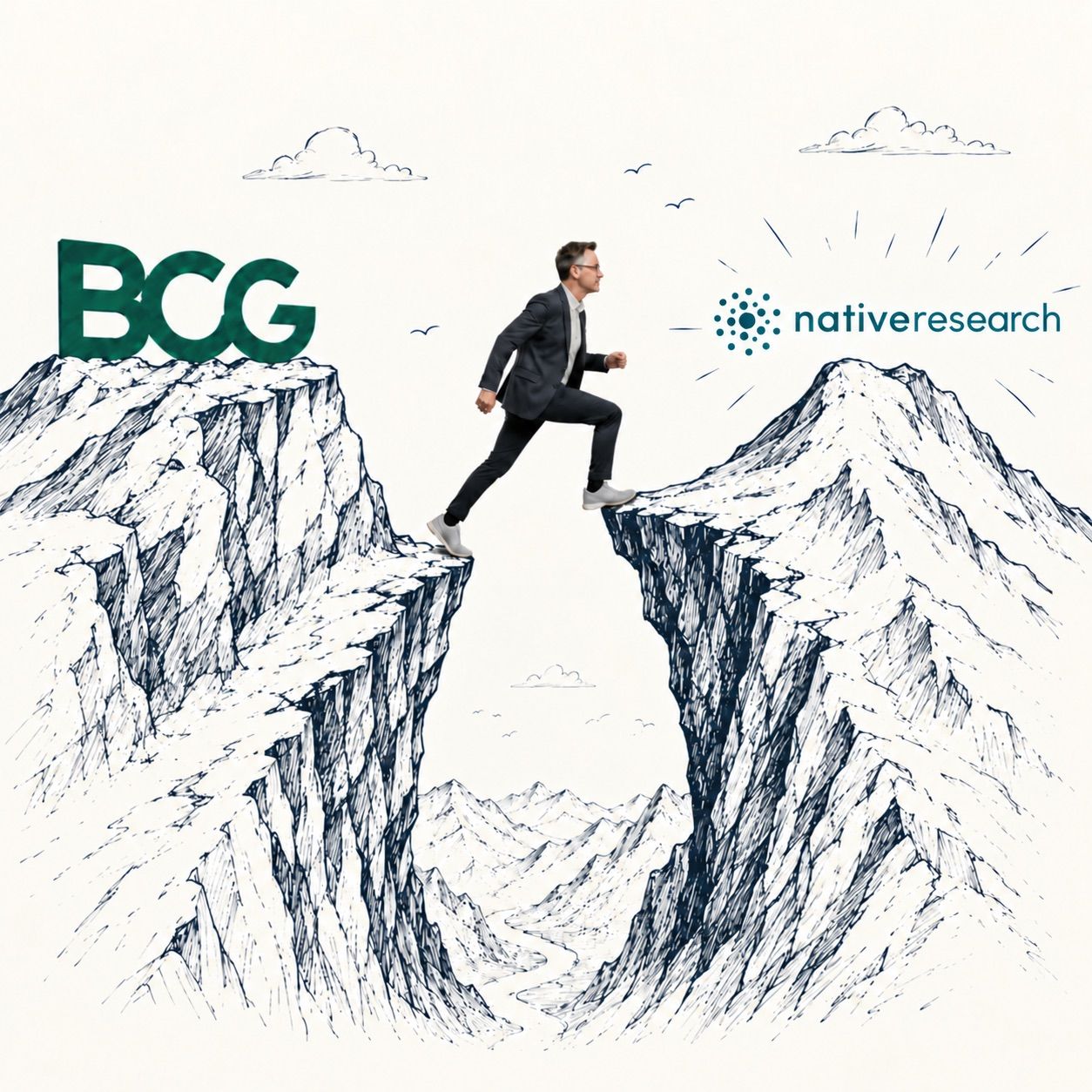
Two years. That’s how long it took me to stop approaching my new role like a project. When I left BCG, I assumed the challenge would be applying my consulting experience in a very different environment. It was not. BCG had given me an exceptional foundation: analytical rigour, structured thinking and the ability to navigate complex problems at speed. At NativeResearch, I have been learning what it means to take responsibility for a company over the long term. Three lessons stand out. 1. Take time to listen and learn. The colleagues closest to our clients, projects and processes often see things I cannot. I’ve learned to spend more time understanding their perspective before adding my own. My role is not simply to offer an answer. It is to create the conditions for the best answer to emerge. 2. Ideas matter. Follow-through creates impact. A strong idea can create momentum. Turning it into progress takes sustained attention. The true work happens when an idea is no longer new. Often, that is when it needs the most attention. 3. Focus is a leadership decision. There will always be more opportunities than we can pursue well. I’ve learned to choose fewer priorities, make the trade-offs explicit and give decisions enough time to deliver results. Sometimes, that means taking a small, deliberate step rather than opening another initiative. I look back on my time at BCG with enormous gratitude. The foundation I developed there continues to shape how I think and work. And I’m not the only one at NativeResearch who has made the transition from consulting to market research. Learning from both worlds has helped shape our DNA: combining a consultant’s perspective on business decisions with a market researcher’s depth of understanding and commitment to evidence. That combination is what our clients value. We understand the question they need answered and the decision they need to make. For me, that is what makes building NativeResearch so rewarding: continuing to learn from both disciplines, alongside colleagues who bring them together every day. ____ PS: Want a research partner who speaks consulting as fluently as research? Let’s talk. Just message me.



6 of 128 adsSign up to see every NativeResearch drw GmbH ad, filter by format and date, and get alerts on new ones.
See all 128 adsWatch the companies you care about.
Filter every ad by industry, country, format and network, and get alerts when a company you watch starts running new ads.