Not on air · 2 of 3 networks checked
Media Forty Two
- mediafortytwo.com
- Advertising Services
- GB
- 24 employees
Media Forty Two’s ads on LinkedIn, Meta and Google, recorded by adsrunning. Browse the latest here for free. Sign up free to see all 22. Watch Media Forty Two with Starter to get each new one in your feed.
Watchlist with Starter · $49/mo
| Network | Status | Live ads | Nov 2025LinkedIn activity · 52 weeksNov 2026 | Checked | Next step |
|---|---|---|---|---|---|
| None recorded | 0 | Checked 31 Oct 2026 | See all 22 ads → | ||
| Meta | Not checked | — | |||
| None recorded | 0 | No ads found on the Google Ads Transparency Center | Checked 4 Oct 2026 | Collect them with the API → |
Media Forty Two has no live LinkedIn ads. We recorded no Google ads on 4 Oct 2026.
Latest ads
- LINKEDIN · IMAGESince 14 Apr 2026
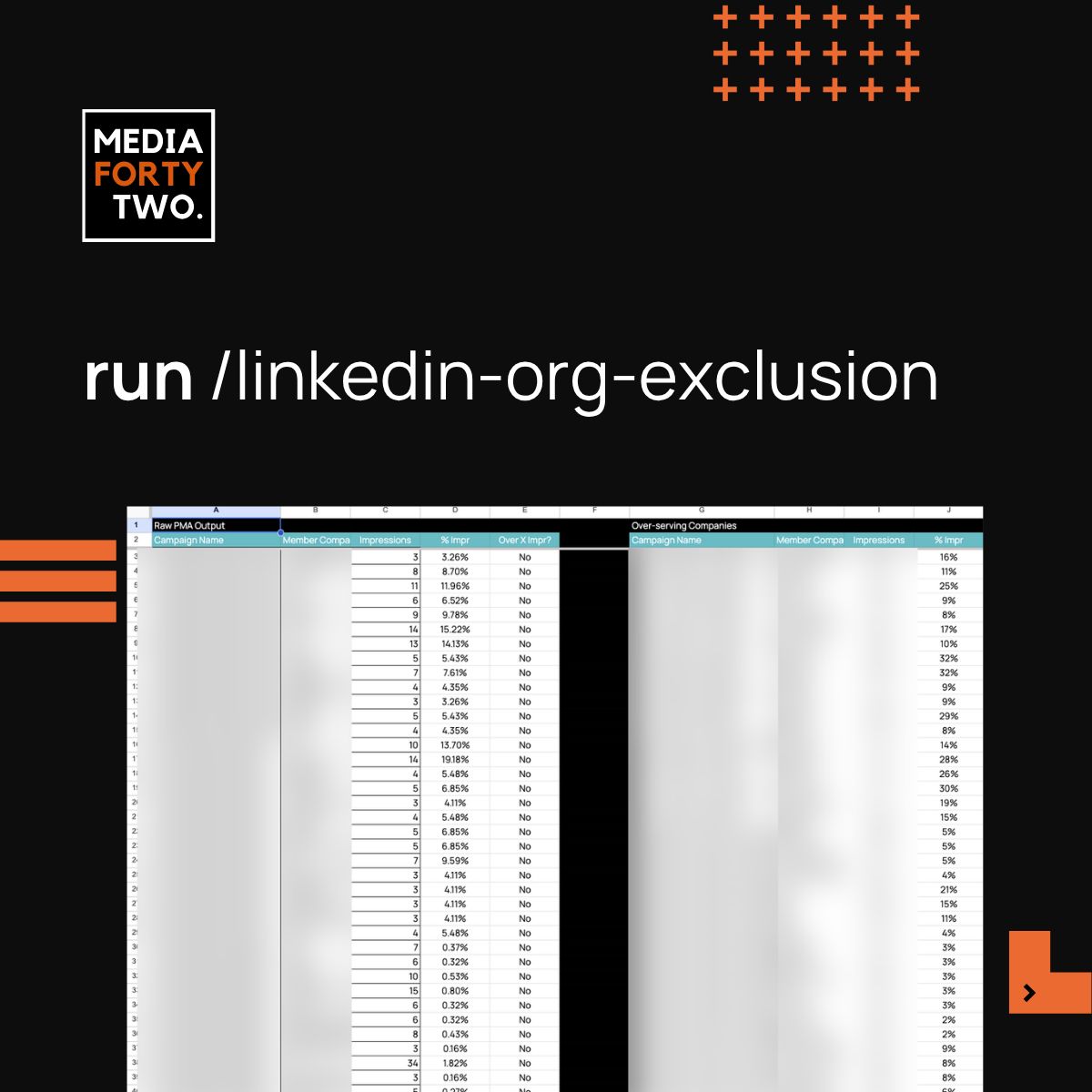
Paid Media managers: forget about those "comment claude" skill repos. Austin Lau (growth @ Anthropic) categorises AI work into "four dimensions". Dimension 3 "the one that most people overlook" is about AI unlocking tasks below the "ROI threshold". Work that would improve performance, but that nobody would staff or build because the cost never justified the outcome. It usually involves a narrow use-case that only has a meaningful impact at scale, but without AI is impossible to scale. It's not especially "sexy" For instance, some of our clients have 100+ LinkedIn campaigns live in any given month. Very often, in each of those campaigns, a handful of companies eat disproportionate impression share. Budget flows to companies that have seen your ads plenty while others haven't seen them at all. Annoying. There is a pre-existing fix: build dynamic exclusion lists per campaign. Doing that manually across dozens of accounts, across multiple campaigns, every week does not meet the "ROI threshold". This week Quinn McLeod (one of the best "systems thinkers" I have ever worked with) built a skill using Claude Code and the LinkedIn API that: → Pulls this week's campaign data from a Google Sheet and flags companies exceeding an impression threshold per campaign → Organises them into individual exclusion lists by campaign, creating new lists or updating existing ones → Pushes those lists to LinkedIn → Resets monthly so you're throttling delivery to rebalance spend, not permanently detargeting anyone An analyst would spend hours per week per account doing this. It now basically runs on its own now, and is more robust, and has more safeguards. Our clients' budgets now spread across their full target list, as much as possible, forever. Every week we are looking for more "dimension 3" use cases to add to our skillset. This is what moves the needle.
- LINKEDIN · IMAGESince 2 Apr 2026
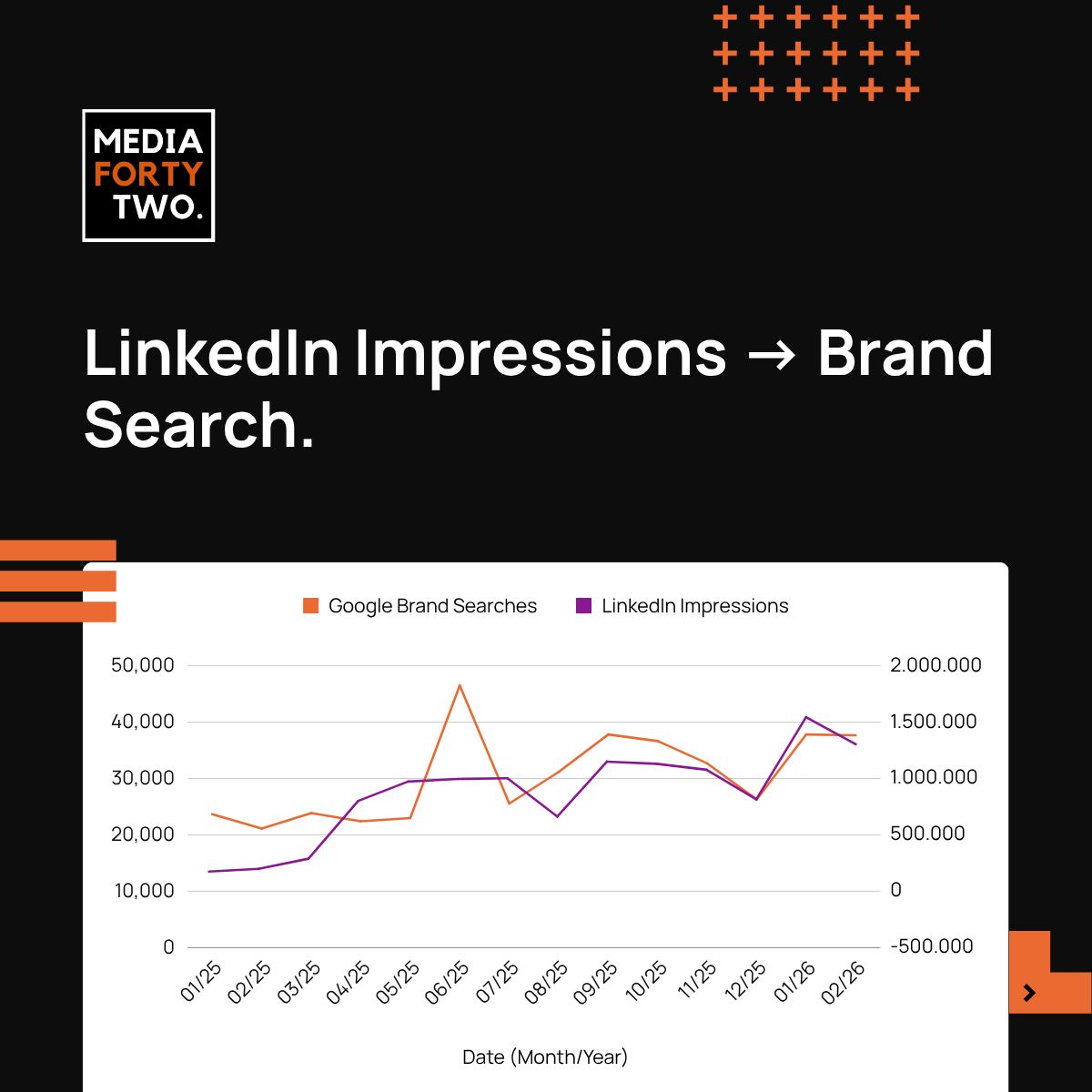
We ran this analysis for a B2B upper mid-market client over 14 months (Jan '25 to Feb '26). It compares monthly branded search clicks from Google Search Console with monthly LinkedIn impression data. - Pearson correlation: 0.67 - R² value: 0.45 In other words, nearly half of the movement in branded search can be explained by LinkedIn impressions alone. The rest comes from other channels, events, PR, and general noise. For a single paid channel in a multi-touch B2B journey, that's a strong signal. Important! The client had a major product announcement in June, and we left it in the data and the correlation held with the spike included. Media Forty Two took over the account from June/July and the first thing we did was introduce manual bids on awareness campaigns and enforced company list targeting to reduce waste. We also removed a legacy campaign from before our engagement that had an oversized audience generating poor-quality impressions at scale. Stripping that out gave us a cleaner read on the relationship between impressions and branded search. Obviously we can see correlation but haven't proven causation yet. The client is increasing LinkedIn spend by 50% in Q2 to test that. Previous spend increases have moved with corresponding branded search gains, but we haven't run a controlled test to confirm repeatability. By overlaying key page conversion rates from branded sessions, we can project handraiser impact too, not just traffic or impression volume. Run this yourself. Takes about 15 mins and gives you another way of showing LI's contribution to digital pipe. #demandgeneration #b2bmarketing
- LINKEDIN · IMAGESince 25 Mar 2026
Or at least, that's what it feels like when you can't see what it's doing. I know, I've been there. You're spending five, ten, twenty thousand a month and the best anyone can tell you is impressions went up and cost per click came down. So what? Visibility is the real issue here, not budget. Most LinkedIn accounts have no meaningful connection between what's being spent and what's *actually* making it to pipeline. What happens next is every budget conversation turns into a gut feel argument, and gut feel usually loses to the channel that can show a last-click number. When we take over an account, the first thing we build isn't a campaign. It's the measurement layer that tells you which spend is working and which isn't, by audience, by campaign, by stage of the funnel. Blind spending is what's costing you. The channel works, but only when you can see clearly enough to make it work. If your LinkedIn investment feels like an act of faith rather than a commercial decision, we should talk.
- LINKEDIN · IMAGESince 24 Mar 2026
The instinct when LinkedIn stops "performing" is to pull the budget and move it somewhere that shows up in the attribution report. A completely rational decision based on completely misleading data. Most B2B teams measure LinkedIn like it's Google: last-click, form fills, MQLs. LinkedIn doesn't behave like Google at all. Someone sees your ad. They scroll past. They see it again. Something sticks. Six weeks later they're in a buying conversation, your name comes up because it feels familiar, they Google you, they convert. Google gets the credit. LinkedIn gets nothing. So LinkedIn gets cut. And then over the following quarters, the pipeline that was being warmed in the background stops materialising and nobody connects the two. The data tells a different story when you go looking for it. Last week I pulled a quarterly cohort analysis for a Mid-Market SaaS client. It showed SQL conversion rates moved from 3.4% to 9.5% when LinkedIn engagement was present in the journey. Opportunity conv went from 1.1% to 3.2%. LinkedIn had zero last-click attribution across all of it. You don't need expensive tooling to see this. A CAPI integration, a cohort analysis comparing LinkedIn-touched versus untouched prospects, and a bit of patience is really all you need.
- LINKEDIN · IMAGESince 19 Mar 2026
You're reading this right now and you probably won't click it. That's great. You've just read one line of copy from someone you didn't know existed this morning. Something that possibly made you stop. And next time you hear about Media Forty Two, we'll feel vaguely familiar in a way you won't be able to explain (especially if you've read Hitchhiker's Guide). Which is exactly how this channel works for your business. The person who books a demo next month probably won't remember seeing an ad. They'll tell you they just "heard of you somewhere", then often they’ll Google you, find your site, fill out the form, at which point it will hand the credit to Google. When LinkedIn looks terrible in CRM, it is the first channel on the chopping block. And then, over the next two quarters, pipeline tails off. It’s not that the ads ever stopped working. The measurement was never built to understand how they were working. If you want to know LinkedIn's actual contribution, stop looking at who clicked before raising their hand. Look at what happens to pipeline when LinkedIn is in the journey. —------------------------------ Current reporting not showing LinkedIn’s real contribution? That’s one of the things we fix when we manage accounts. No expensive attribution platforms required.
- LINKEDIN · IMAGESince 18 Mar 2026
I know many of you that have been here: three hours in a room looking at the same slide and the same clicks-and-impressions dashboard. Same "we'll optimize next quarter" conclusion. A box ticking exercise that has taken up an extraordinary amount of talented people’s time but fails to achieve anything. Everyone in that room cares. But the reporting framework was never designed to answer the questions that actually matter to the business. When we onboard a new client, we spend disproportionate time upfront designing reporting that connects LinkedIn activity to real business outcomes. The stuff your CFO actually wants to talk about, like which campaigns are influencing deals that close, even when Hubspot gives Google all the credit. It’s harder to build, but it means every QBR compounds. Reach out if your paid LinkedIn reporting tells you what happened but never tells you what it meant.
6 of 22 adsSign up to see every Media Forty Two ad, filter by format and date, and get alerts on new ones.
See all 22 adsWatch the companies you care about.
Filter every ad by industry, country, format and network, and get alerts when a company you watch starts running new ads.