On air · 1 of 3 networks
Lookthrough
- lookthrough.com
- CH
- 26 employees
Lookthrough’s ads on LinkedIn, Meta and Google, recorded by adsrunning. Browse the latest here for free. Sign up free to see all 28. Watch Lookthrough with Starter to get each new one in your feed.
Watchlist with Starter · $49/mo
| Network | Status | Live ads | Nov 2025LinkedIn activity · 52 weeksOct 2026 | Checked | Next step |
|---|---|---|---|---|---|
| Running | 1 | Checked 29 Oct 2026 | See all 28 ads → | ||
| Meta | Not checked | — | |||
| None recorded | 0 | No ads found on the Google Ads Transparency Center | Checked 3 Oct 2026 | Collect them with the API → |
Lookthrough has 1 live LinkedIn ad. We recorded no Google ads on 3 Oct 2026.
Latest ads
- LINKEDIN · VIDEOSince 27 Oct 2026
Bauwerksbuch 2027 Gute Vorbereitung schafft Zeit. Bis zum 31. Dezember 2027 müssen Wiener Bestandsgebäude, die vor dem 1. Jänner 1919 errichtet wurden, grundsätzlich über ein elektronisch geführtes und registriertes Bauwerksbuch verfügen. Für Gebäude, die zwischen dem 1. Jänner 1919 und dem 1. Jänner 1945 errichtet wurden, endet die Frist am 31. Dezember 2030. Für bestimmte Gebäudekategorien bestehen Ausnahmen. Die Frist 2027 betrifft laut Stadt Wien rund 31.000 Gebäude. Entsprechend groß ist der organisatorische Aufwand: Die Stadt weist darauf hin, dass die erforderlichen Planeinsichten über einen ausreichend langen Zeitraum verteilt werden müssen. Wer fehlende Unterlagen aus dem Bauakt benötigt, sollte dafür genügend Vorlauf einplanen. Eine erste Sichtung lohnt sich deshalb schon jetzt. Pläne können bei der Hausverwaltung liegen, Bewilligungen beim Eigentümer und weitere Dokumente im Bauakt. Diese Unterlagen zusammenzuführen und ihre Vollständigkeit und Aktualität zu prüfen, ist ein wichtiger Schritt auf dem Weg zum Bauwerksbuch. Dabei unterstützt Lookthrough. Unsere Plattform bündelt die Gebäudeunterlagen, strukturiert sie und validiert die enthaltenen Daten. Eigentümer und Hausverwaltungen sehen auf einen Blick, was bereits vorliegt, welche Dokumente noch beschafft werden müssen und welche Informationen zu aktualisieren sind – für ein einzelnes Gebäude ebenso wie für einen ganzen Bestand. Mit dieser Übersicht lassen sich offene Punkte gezielt bearbeiten und Rückfragen schneller beantworten. Weniger Such- und Abstimmungsaufwand sowie weniger doppelte Arbeit können Zeit und Kosten sparen. Für die erforderliche Erstprüfung und die Erstellung des Bauwerksbuchs sind entsprechend befugte Fachpersonen zuständig. Ihnen steht dafür eine geordnete Datengrundlage zur Verfügung. So hilft Lookthrough, die Vorbereitung frühzeitig voranzubringen und mehr Zeit für die fristgerechte Fertigstellung zu gewinnen. Gerne zeigen wir Ihnen, wie das für Ihren Bestand aussehen kann. Gespräch mit unserem Wiener Team: https://lnkd.in/e9NSMe9U #Bauwerksbuch #Wien #Immobilienwirtschaft #Gebäudedaten Irakli Betanishvili
- LINKEDIN · IMAGESince 19 Oct 2026
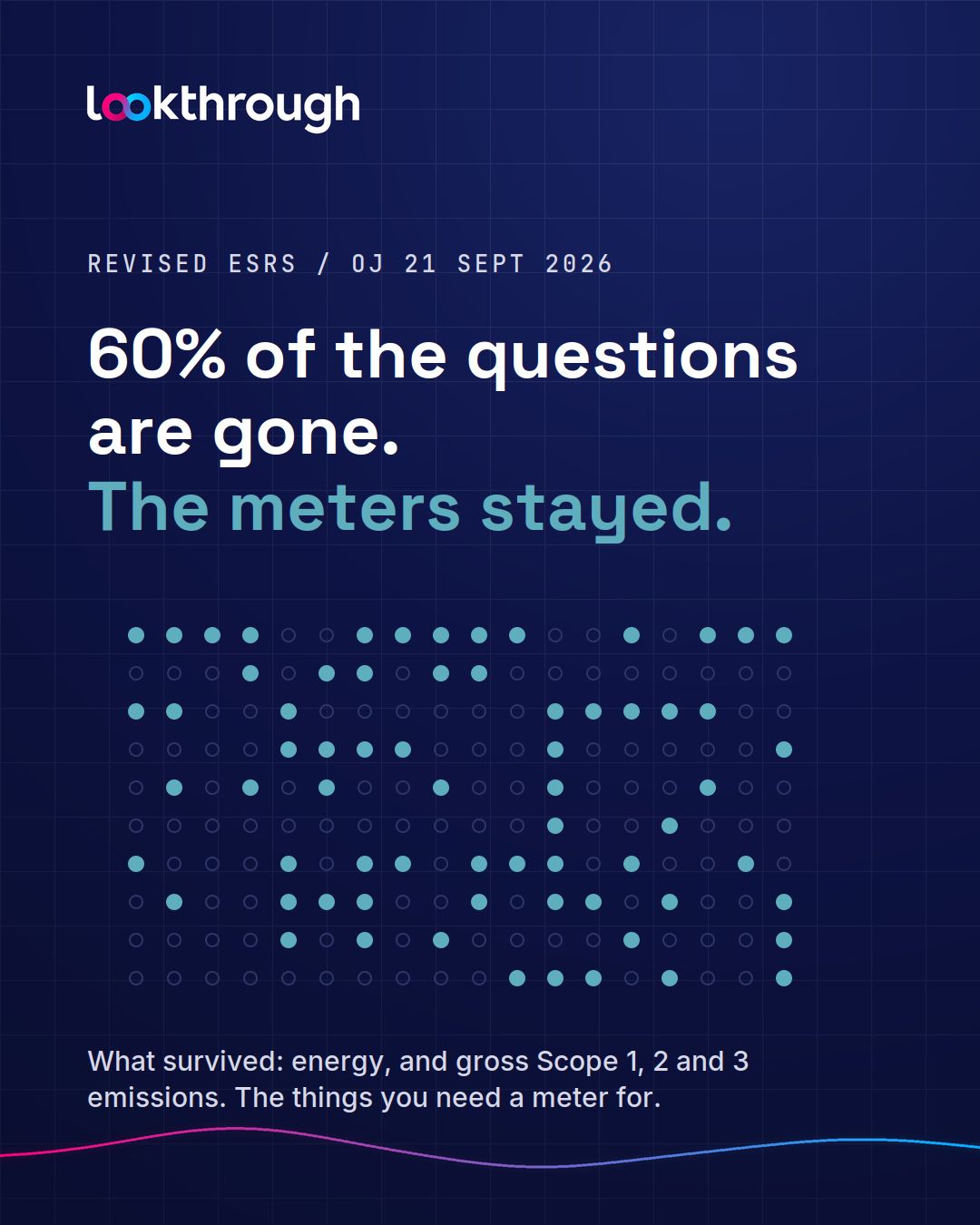
If you have someone who spent the last two years building a datapoint collection process, last month was a strange one for them. The revised ESRS landed in the Official Journal on 21 September, and more than 60% of the mandatory datapoints are simply gone, along with every voluntary one. Our first reaction was that this makes life easier. Having read it properly, we don't think it does, at least not for anyone who owns buildings. What survived is energy, and gross Scope 1, 2 and 3 emissions. The climate standard actually grew while shedding most of its datapoints, from nine disclosure requirements to eleven. And the parts that got pushed back are the modelled ones: anticipated financial effects of climate risk can wait until 2028, the numbers behind them until 2030. The metering starts immediately. Then there's the bit we had missed until we went into the text itself. There is a relief that lets you report on a partial scope where data is genuinely hard to obtain, which sounds generous until you notice what sits outside it. Gross Scope 1, 2 and 3 emissions are excluded by name. No partial credit on emissions. Which leaves a smaller job, made up mostly of the difficult part of the old one. Two practical notes. It bites for financial years from 1 January 2027, and for 2026 you choose one of three versions and have to say which you used. And from 2027 the scope narrows to companies above 1,000 employees and €450m turnover, so plenty of owners have dropped out of CSRD altogether. Their banks and larger tenants have not, so the questions tend to arrive from there instead. For a property portfolio the narrative was never the slow part. Getting consistent consumption data out of a few hundred buildings was. Of what's left, how much could you produce tomorrow?
- LINKEDIN · CAROUSELSince 6 Oct 2026
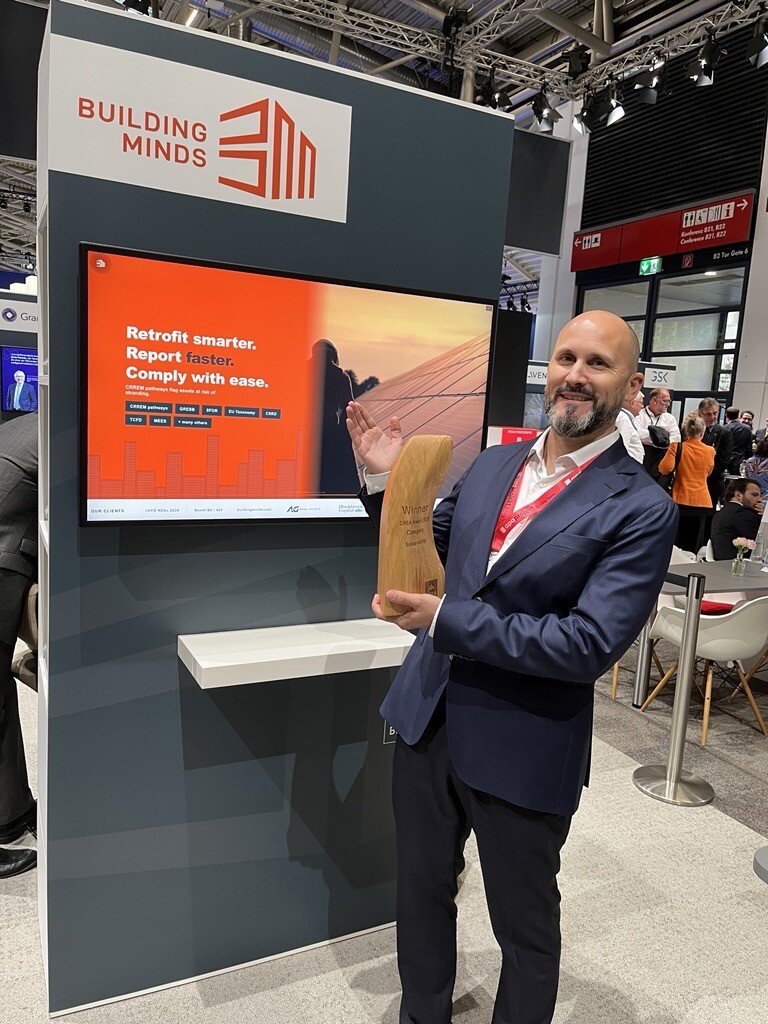
🏆 Lookthrough has won the DREA Award 2026 in the Sustainability category! The DREA Award recognises the most innovative technology in international real estate. In the Sustainability category, finalists pitched live to the jury at EXPO REAL for the prize honouring CleanTech and ClimateTech for the built world. 🌱 Thank you to Ferdinand Kumle for presenting our story, to the Digital Real Estate Association for a fantastic final, and congratulations to all the finalists. 👏 See what the jury saw 👇 #DREAAward #PropTech #Lookthrough #Sustainability
- LINKEDIN · IMAGESince 5 Oct 2026
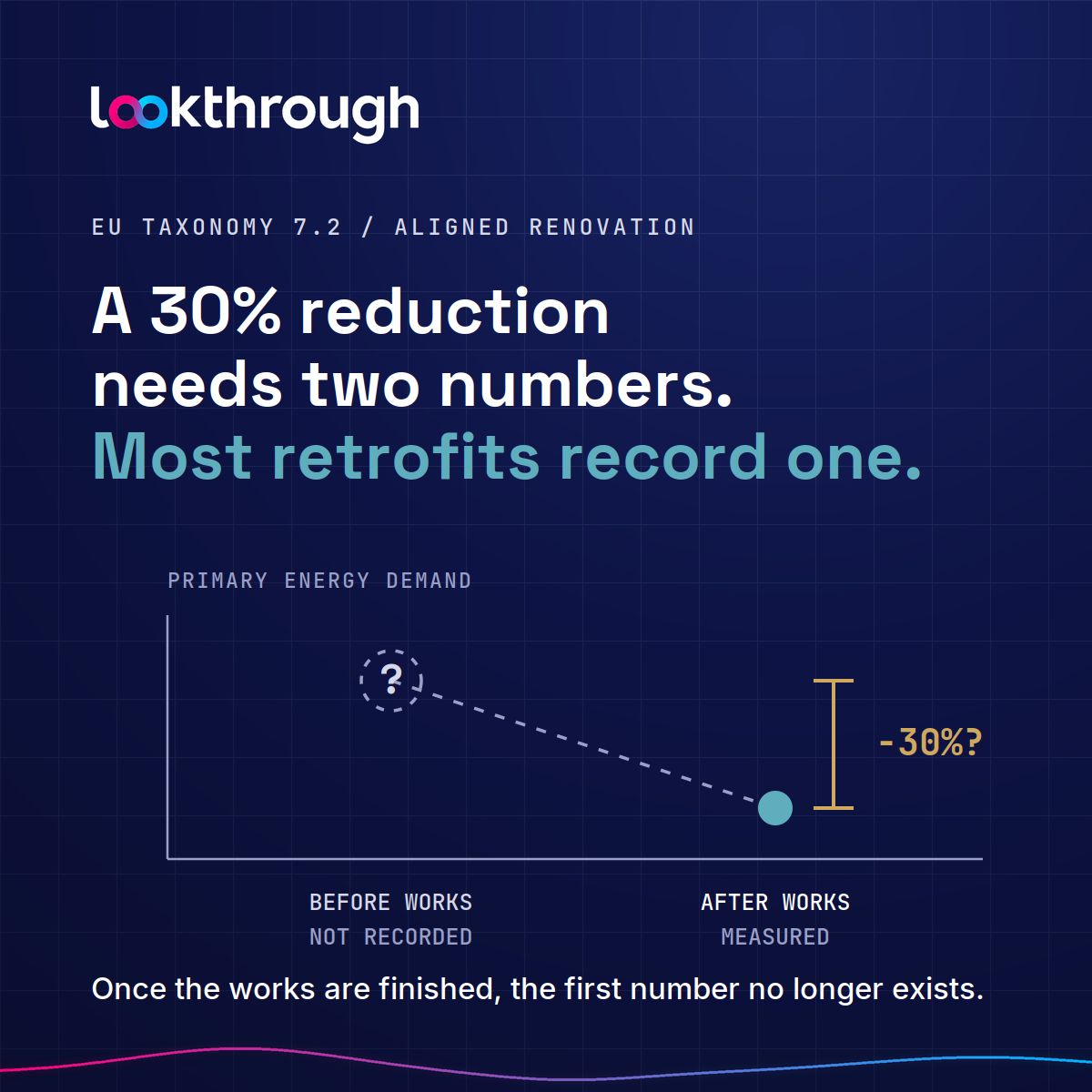
You can spend millions upgrading a building and still not be able to prove you upgraded it. The work isn't the problem. The problem is that nobody wrote down what the building was before the scaffolding went up. The mechanism is less obvious than it looks. Under taxonomy activity 7.2 a renovation can qualify two ways: it meets the national requirements for a major renovation, which usually means spending a quarter of the building's value or touching a quarter of the envelope, or it cuts primary energy demand by 30%. Staged work across a portfolio, a boiler here, controls there, rarely counts as a major renovation, so it ends up on the 30% route. And 30% is a comparison, not a reading. It needs the building's old position, which quietly stops existing the day the job finishes. Tempting to file that under paperwork. The money says otherwise. IEEFA went through Europe's 47 largest banks this month and found that green buildings take about 70% of the proceeds those banks allocate from their green bonds, and account for 3% of the avoided emissions they report. Renewables take a fifth of the money and deliver 90% of the reductions. That gap isn't hypocrisy, it's evidence. An efficient building can be proved with an EPC, in one document, today. An improvement can't be proved at all without a baseline, whatever method you use. The lenders aren't hiding from it either. The German Pfandbrief association has said outright that banks don't hold the historical data to compare a building before and after a renovation. And they can't collect it on your behalf. A survey or an accredited energy audit does the job where there's no EPC, but only while the old building is still standing there to be surveyed. So every programme running right now is making this call by omission, building by building. The same measurement also earns its keep for reasons that have nothing to do with Brussels. Which buildings give you the most for the least, which measure to do first in each one, what order to work through the portfolio: the same data, read forwards instead of backwards. The compliance evidence is a by-product. Either way it has to happen before the first works start. The portfolio ranked, then proper analysis of the buildings that come out on top. That is the work we do. If you have works starting this year, the baseline is the cheapest line on the programme and the only one with an expiry date. So: is it written into your standard works spec, or does it depend on who is running the job?
- LINKEDIN · IMAGESince 21 Sept 2026
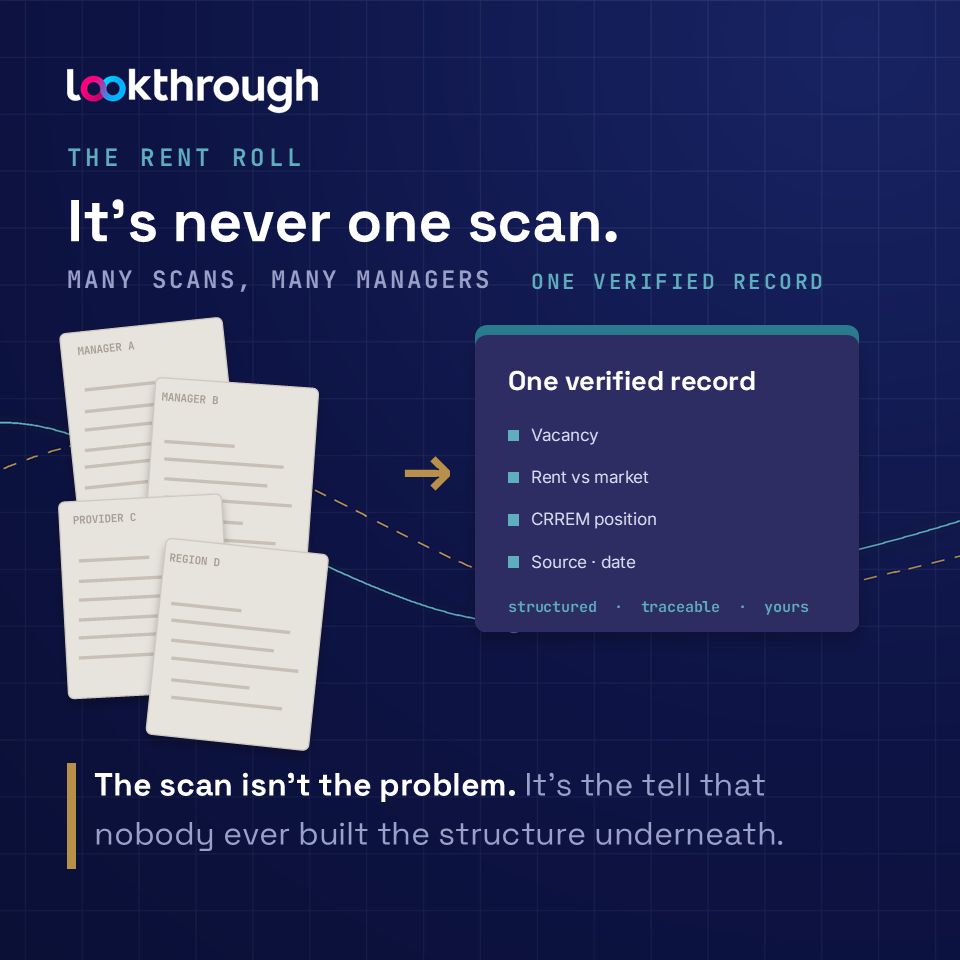
𝗬𝗼𝘂 𝗮𝘀𝗸𝗲𝗱 𝗳𝗼𝗿 𝘁𝗵𝗲 𝗿𝗲𝗻𝘁 𝗿𝗼𝗹𝗹. 𝗜𝘁 𝗰𝗮𝗺𝗲 𝗯𝗮𝗰𝗸 𝗮𝘀 𝗮 𝘀𝗰𝗮𝗻𝗻𝗲𝗱 𝗣𝗗𝗙. One scan is easy to deal with. The trouble is it's never one scan. It's dozens, a different manager for every region, each with its own layout and its own idea of what a rent roll even contains, and next quarter they all change again. Turning that into one consistent, verified record you can actually query, and keeping it current, is the work almost nobody has done. And numbers you can't trace to a source aren't numbers you can put in front of a bank or an LP. That is the layer Lookthrough builds: your data, from every source your portfolio runs on, consolidated, verified, and yours to query on your own terms. The scanned PDF isn't the problem. It's the tell that nobody ever built the structure underneath it. Want to see how we can help? Book a call: https://lnkd.in/dQJ6d8gS #RealEstateData #PropTech #AssetManagement
- LINKEDIN · IMAGESince 14 Sept 2026
Ihr Gebäude wird nicht in dem Jahr neu bewertet, in dem es die CRREM-Linie überschreitet. Sondern in dem Jahr, in dem Ihre Bank es bemerkt. Das sind zwei verschiedene Daten, und viele Eigentümer planen um das falsche herum. Das CRREM-Misalignment-Jahr ergibt sich aus Physik und Regulierung. Es ist das Jahr, in dem Ihr Gebäude sein 1,5-°C-Budget überschreitet, und es steht auf einer Kurve, die Sie heute schon lesen können. Die Neubewertung bestimmt, wer Sie finanziert. Sie tritt ein, wenn ein Kreditgeber das Risiko neu bepreist, die Laufzeit verkürzt, einen CapEx-Plan verlangt oder das Gebäude bei der Refinanzierung schlicht tiefer bewertet. In der Schweiz rückt dieses zweite Datum näher. Nicht, weil Mieter plötzlich auf CO₂ achten. Mit dem FINMA-Rundschreiben 2026/1 zu naturbezogenen Finanzrisiken müssen Banken Klima- und Transitionsrisiken systematisch in ihr Risikomanagement integrieren. Für die grossen Institute (Kategorie 1 und 2) gilt das seit dem 1. Januar 2026, für die übrigen gestaffelt bis 2028. Diese Pflicht tragen die Banken nicht allein. Sie geben sie weiter: als Fragen bei der Refinanzierung, als Datenanforderungen, als Auflagen. Die gebäudescharfe CO₂-Zahl, die Sie nie liefern mussten, wird zur Kreditgrösse. Der Zeitplan, der Ihr Objekt wirklich bestimmt, ist also nicht die CRREM-Kurve. Es ist das Datum, an dem Ihre Bank zu fragen beginnt, minus die zwölf bis achtzehn Monate, die eine ernsthafte Sanierung oder Repositionierung in Planung und Finanzierung braucht. Rechnet man von dort zurück, bleibt den meisten Schweizer Portfolios weniger Spielraum, als die Kurve vermuten lässt. Gut fahren werden hier nicht die Eigentümer mit den grünsten Gebäuden. Sondern die, die die Frage des Kreditgebers mit geprüften, gebäudescharfen Daten beantworten können, bevor sie gestellt wird, und aus Evidenz verhandeln statt hinterherzulaufen. Genau diese Ebene bauen wir bei Lookthrough, als CRREM-Partner: die objektscharfen Daten, die aus einem Refinanzierungsgespräch statt einer Notlage eine Position machen. Wenn Sie in den nächsten drei Jahren etwas refinanzieren, lautet die nützliche Frage nicht „Wann wird mein Gebäude neu bewertet". Sondern „Was wird meine Bank sehen können, und sehe ich es zuerst". #CRREM #Immobilien #Transitionsrisiko #FINMA #Refinanzierung

6 of 28 adsSign up to see every Lookthrough ad, filter by format and date, and get alerts on new ones.
See all 28 adsWatch the companies you care about.
Filter every ad by industry, country, format and network, and get alerts when a company you watch starts running new ads.