On air · 1 of 3 networks
LMC PRACTICE MANAGEMENT, LLC
- lmcpracticemanagement.com
- US
- 6 employees
LMC PRACTICE MANAGEMENT, LLC’s ads on LinkedIn, Meta and Google, recorded by adsrunning. Browse the latest here for free. Sign up free to see all 44. Watch LMC PRACTICE MANAGEMENT, LLC with Starter to get each new one in your feed.
Watchlist with Starter · $49/mo
| Network | Status | Live ads | Nov 2025LinkedIn activity · 52 weeksOct 2026 | Checked | Next step |
|---|---|---|---|---|---|
| Running | 44 | Checked 29 Oct 2026 | See all 44 ads → | ||
| Meta | Not checked | — | |||
| None recorded | 0 | No ads found on the Google Ads Transparency Center | Checked 3 Oct 2026 | Collect them with the API → |
LMC PRACTICE MANAGEMENT, LLC has 44 live LinkedIn ads. We recorded no Google ads on 3 Oct 2026.
Latest ads
- LINKEDIN · IMAGERecorded 31 Oct 2026
“Ophthalmology” on the specialty list. “Experts” in the headline. A very efficient marketing department. Now ask about the billing team. Who actually works your accounts? What ophthalmology-specific credentials and continuing education do they bring? Are they engaged with ASCRS/ASOA, AAO/AAOE, and the ASOA community? Can they explain how that knowledge changes their work? The questions apply to your software vendor’s RCM service, too. Selling the platform does not answer who is handling your revenue or how deeply they understand your specialty. At LMC Practice Management, ophthalmology is our entire focus. We investigate payer requirements, understand system workflows, and work with vendors on improvements intended to benefit the broader ophthalmology community. We can discuss the operational problem in detail because we do the work. If your prospective billing company handles ten specialties, ask how its ophthalmology expertise is staffed, maintained, and applied. The specialty dropdown has already given its presentation. You deserve to hear from the experts. Your patients see a specialist. Your revenue should too. #Ophthalmology #RevenueCycleManagement #LMCPracticeManagement
- LINKEDIN · IMAGERecorded 31 Oct 2026
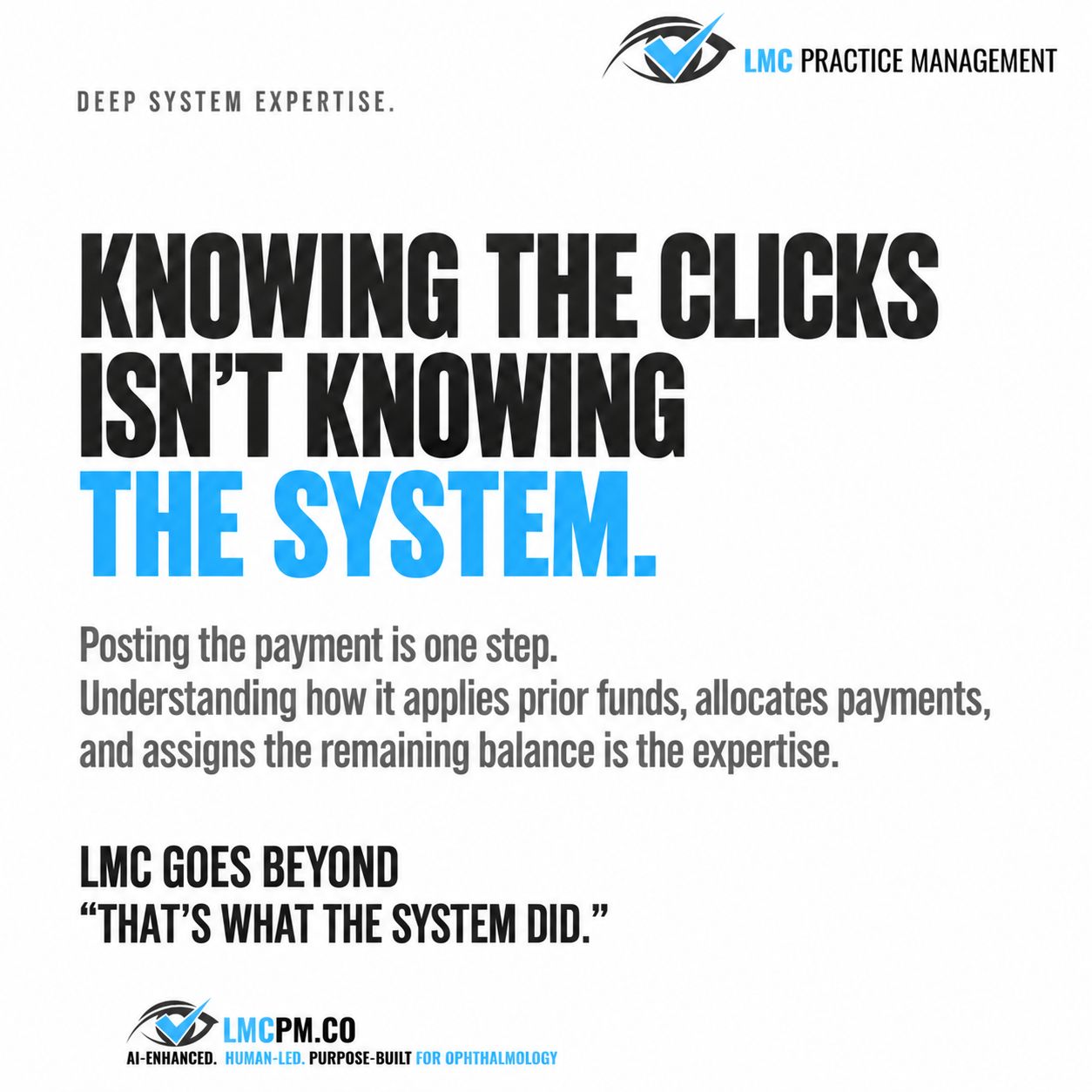
Using Nextech every day and understanding Nextech deeply are two different qualifications. One insurance payment for one patient’s claim can involve payment setup, coverage selection, charge allocation, prior payment sources, and a decision about the remaining balance. Knowing the sequence gets the entry saved. Understanding how those selections affect the account is Elite Power User territory. Does the allocation reflect the remittance? Were existing funds applied appropriately? Should the remaining balance move to another insurer or to the patient? “Because that’s what the screen showed” is a remarkably weak explanation for a patient statement. At LMC Practice Management, Elite Power Users describes the depth of system knowledge behind our ophthalmology billing. We understand how payments, adjustments, prior funds, and responsibility interact, and we investigate when the system’s result does not match the intended outcome. That expertise matters when the familiar sequence produces an unfamiliar problem. Your team should be able to explain what happened and what needs to change. Your practice deserves expertise beyond the Save button. #Ophthalmology #RevenueCycleManagement #LMCPracticeManagement
- LINKEDIN · IMAGERecorded 9 Oct 2026
After almost 30 years in medical billing and revenue cycle management, I’m convinced modifier 59 has become something of an urban legend. The billing boogeyman. Mention it, and somewhere in an ophthalmology practice, someone whispers: “But won’t that trigger an audit?” Somehow, the belief that using modifier 59 automatically invites an audit has survived longer than some practice management systems. And I understand why. When a provider has experienced an audit, recoupment, or costly billing dispute, the fear of going through it again is very real. But fear should never outweigh correct coding and documentation. Using modifier 59 does not automatically summon an auditor. Leaving it off doesn't magically protect a practice from one, either. The question should never be, “Will this modifier get us audited?” It should be, “Does the applicable coding guidance and documentation support its use?” Check the NCCI edit. Confirm that a modifier is permitted and the services qualify as distinct. Use a more specific modifier when appropriate. And no, we cannot simply slap modifier 59 on a claim because it denied. It's a modifier, not a crowbar. Now, here's where my perspective may differ from some. I actually welcome the opportunity to review an audit request. I want to know who's requesting the records, what they're asking for, whether the request is legitimate, and what authority supports it. At LMC, we've challenged third-party requests for hundreds of medical records and watched those requests shrink considerably. In some cases, we never heard from the requester again. When Medicare cataract surgery audits have proceeded, we've helped providers achieve 100% pass results. Those are historical outcomes, not guarantees. There are no guarantees in medical billing. But there is a difference between preparing for an audit after receiving a letter and operating with an audit-ready mindset every single day. At LMC, we don't wait for an audit to start auditing. We're continuously reviewing coding, documentation, medical necessity, and claim accuracy as part of the revenue cycle. We question things before claims go out. Because a green checkmark from a claim scrubber doesn't necessarily mean the coding is correct. When an audit request arrives, our work isn't just beginning. It's when the work we've been doing all along gets put to the test. Ultimately, the confidence I want every provider working with LMC to have is simple: “My billing is supported, and LMC is in my corner.” Medical billing already has enough horror stories. Most of them come with hold music. So, is modifier 59 still the billing boogeyman in your practice? Or have we finally reached the point where proper documentation can put that myth to rest? #Ophthalmology #MedicalBilling #RevenueCycleManagement #Modifier59
- LINKEDIN · IMAGERecorded 9 Oct 2026
BUSY DOESN’T ALWAYS MEAN PROFITABLE. Your practice can be incredibly busy and still be leaving a lot of money behind. A full schedule is not a revenue cycle metric. Neither is surgical volume. Neither is injection volume. Neither is how many patients walked through the door last month. You can perform 100 injections this week and still have a reimbursement problem. You can increase cataract volume while collections remain flat. You can have physicians booked solid while A/R quietly ages past 90 days. Production tells you what your practice did. Revenue cycle performance tells you how much of that work actually became revenue. And if you outsource your billing, there is another question worth asking: Who is responsible for noticing when those two numbers stop moving together? Your RCM company has access to the same trends. They see the claims. They see the payments. They see the denials, aging, adjustments and reimbursement patterns. So if production is climbing while collections aren't keeping pace, your first indication of a problem should not be a physician asking, "Why does it feel like we're busier than ever but collecting the same amount?" Your RCM partner should be questioning the numbers before you have to. Why did reimbursement fall? Which payer changed? Which procedures aren't paying correctly? Are injections being billed but not reimbursed? Are claims being rejected before adjudication? Are underpayments being identified? Are denials actually being corrected, or simply worked? Is A/R >90 days beginning to exceed 10% of total receivables? And perhaps most importantly, is anyone looking at the entire revenue cycle closely enough to recognize when something simply doesn't make sense? Processing claims is billing. Protecting the financial performance behind those claims requires considerably more. Being busy creates revenue opportunity. Capturing that opportunity is the job of the revenue cycle. And if your billing company can see that your collections aren't keeping pace with production but isn't asking why, you should probably start asking why they aren't. #Ophthalmology #OphthalmologyRCM #RevenueCycleManagement #MedicalBilling #PracticeManagement #HealthcareFinance
- LINKEDIN · IMAGERecorded 25 Sept 2026
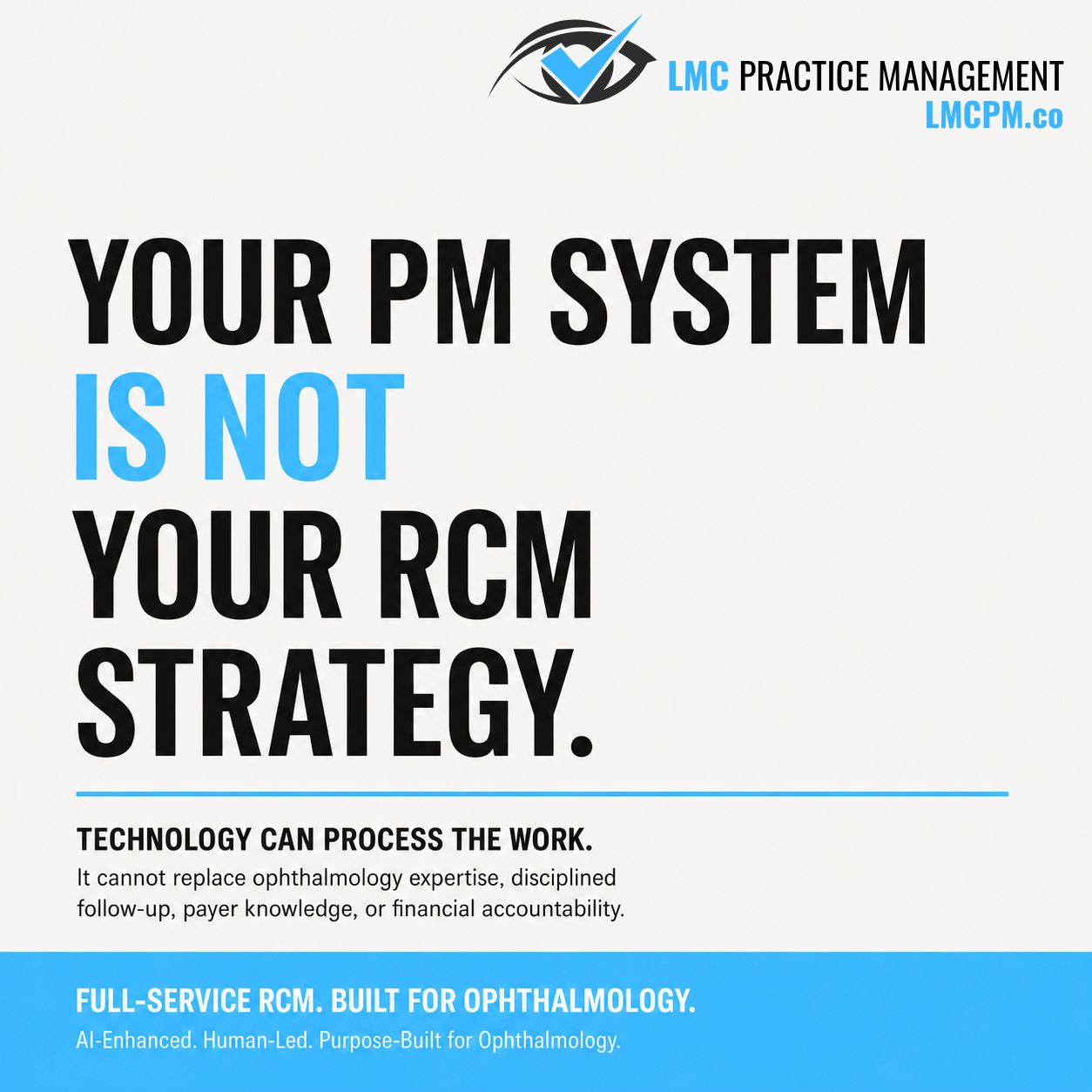
Your practice management system can move data. It cannot build your revenue cycle strategy. Technology can process claims, post payments, and organize workflows. But it cannot replace ophthalmology expertise, disciplined follow-up, payer knowledge, or financial accountability. That is where the real work begins. AI-Enhanced. Human-Led. Purpose-Built for Ophthalmology. #Ophthalmology #RevenueCycleManagement #MedicalBilling #PracticeManagement #HealthcareOperations #RCM
- LINKEDIN · IMAGERecorded 25 Sept 2026
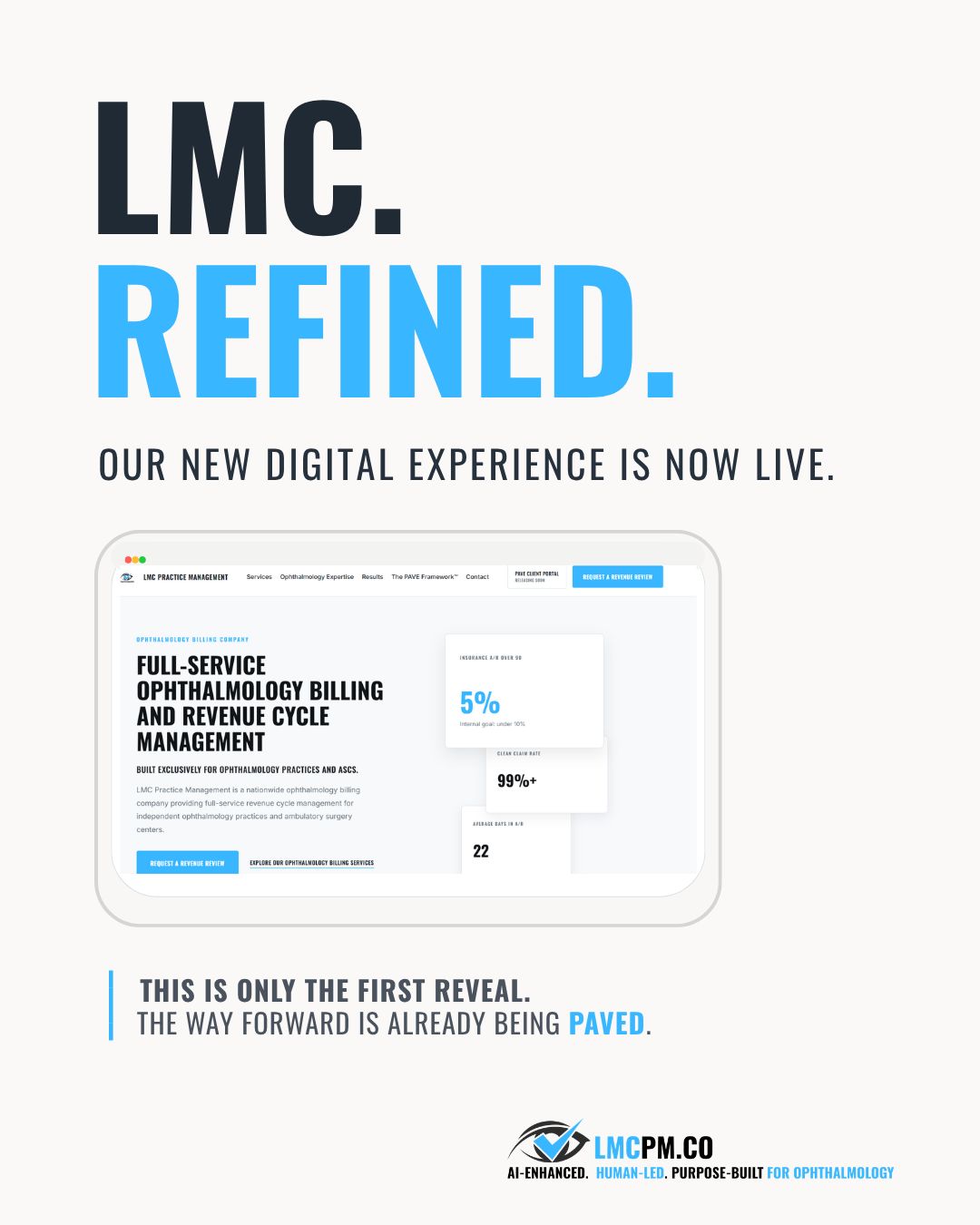
LMC, refined. For more than a decade, LMC Practice Management has built its reputation on deep ophthalmology expertise, operational precision and measurable performance. Over the past several months, we have been thoughtfully refining how that work is presented. Our updated website and visual identity now offer a clearer reflection of the established, specialized and forward-thinking company behind them. This is not a reinvention. It is the presentation catching up with the work. And consider this the first reveal. At LMC, we do not repackage what already exists, give it a new name and call it innovation. We build deliberately, test thoughtfully and introduce what is next when it is ready to deliver something meaningfully different. We are almost ready to show you what that means. The way forward is already being paved. Explore the refreshed LMC Practice Management: https://lnkd.in/ek2GfX6N AI-Enhanced. Human-Led. Purpose-Built for Ophthalmology. #LMCPracticeManagement #OphthalmologyRCM #RevenueCycleManagement #Ophthalmology



6 of 44 adsSign up to see every LMC PRACTICE MANAGEMENT, LLC ad, filter by format and date, and get alerts on new ones.
See all 44 adsWatch the companies you care about.
Filter every ad by industry, country, format and network, and get alerts when a company you watch starts running new ads.