Not on air · 2 of 3 networks checked
Lira.ltd
- lira.ltd
- IE
- 21 employees
Lira.ltd’s ads on LinkedIn, Meta and Google, recorded by adsrunning. Browse the latest here for free. Sign up free to see all 21. Watch Lira.ltd with Starter to get each new one in your feed.
Watchlist with Starter · $49/mo
| Network | Status | Live ads | Nov 2025LinkedIn activity · 52 weeksNov 2026 | Checked | Next step |
|---|---|---|---|---|---|
| None recorded | 0 | Checked 31 Oct 2026 | See all 21 ads → | ||
| Meta | Not checked | — | |||
| Recently | 6 | Ads on the Google Ads Transparency Center | Checked 3 Oct 2026 | Collect them with the API → |
Lira.ltd has no live LinkedIn ads. We recorded 6 Google ads on 3 Oct 2026.
Latest ads
- LINKEDIN · CAROUSELSince 26 Oct 2026
DTIF Call 8 is now open! A €40 million budget is available for collaborative projects developing disruptive technologies in Ireland. Applications close on 3 February 2027 and consortia must request at least €1.5 million in funding. Considering an application? A pre-eligibility check with the Enterprise Ireland DTIF team is mandatory before submission. Get in touch with Lira to discuss DTIF Call 8 and how we can support your organisation with its application.
- LINKEDIN · IMAGESince 16 Sept 2026
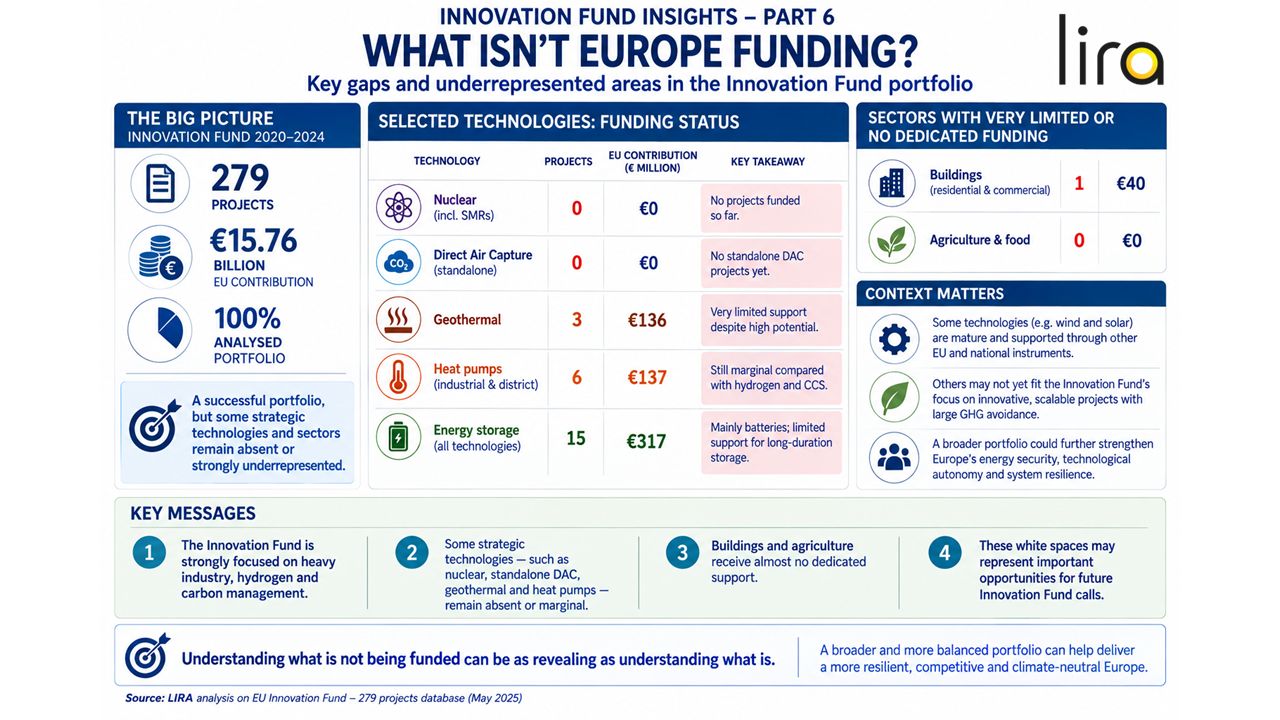
Innovation Fund Trends Part 6: What Isn’t Europe Funding? After analysing hydrogen, maritime, energy storage, CCUS and industrial decarbonisation, I looked at the 279 funded projects from the opposite perspective: what is still missing — or underrepresented — in the Innovation Fund portfolio? Some gaps are striking. -) Nuclear and Small Modular Reactors: 0 projects. -) Standalone Direct Air Capture: 0 projects. Europe is investing billions in capturing CO₂ from industrial sources, but not yet in large-scale capture directly from the atmosphere. -) Geothermal: 3 projects | €136M, a sector clearly underrepresented. -) Heat pumps: 6 projects | €137M. Despite their potential for industrial heat and district heating, their presence remains marginal compared with hydrogen and CCS. -) Energy storage: 15 projects | €317M. As discussed in third article of Innovation Fund Trends, energy storage funding remains concentrated on batteries and relatively mature solutions, with limited support for alternative long-duration storage technologies. The sectoral picture reveals further white spaces. Only one project (€40M) is explicitly classified under buildings, while agriculture does not appear as a dedicated sector in the portfolio. This does not mean that these technologies are unimportant. Some are mature and supported through other EU instruments, while others may not yet fit the Innovation Fund's focus on innovative, scalable projects with large GHG avoidance. But the portfolio reveals a clear strategic choice: Europe is concentrating its largest Innovation Fund bets on heavy industry, hydrogen and carbon management. The next opportunities may therefore emerge from today's white spaces: technologies that can complement these investments while strengthening energy security, technological autonomy and system resilience. Sometimes, understanding what is not being funded can be as revealing as understanding what is.
- LINKEDIN · IMAGESince 26 Aug 2026
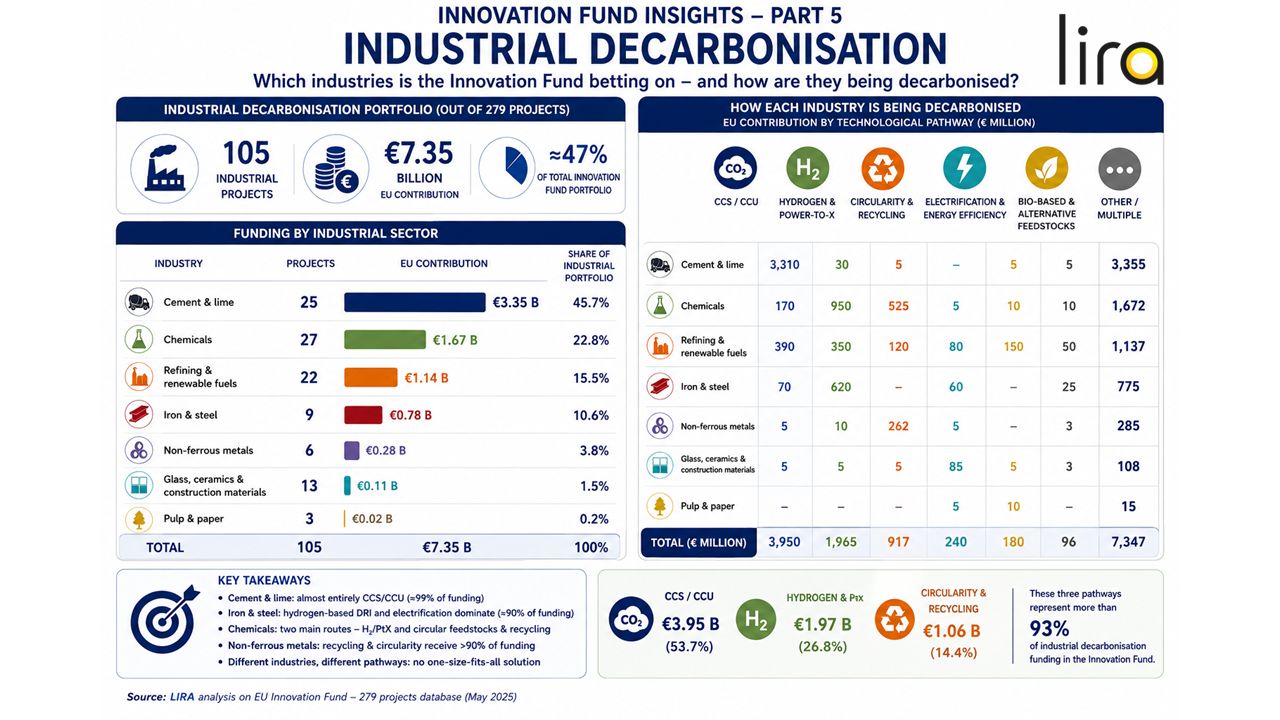
Innovation Fund Trends Part 5 – Industrial Decarbonisation Europe's transition to net zero is a crucial industrial challenge. But which industries are receiving the strongest support from the Innovation Fund — and, more importantly, how are they being decarbonised? I analysed the 279 projects in the Innovation Fund portfolio, focusing specifically on projects whose primary objective is the decarbonisation of energy-intensive industrial production. To avoid double counting, each project was assigned to its main industrial sector. Projects focused primarily on renewable generation, energy storage, transport or clean-tech manufacturing were excluded. The result is that 105 industrial projects received €7.35 billion, representing approximately 47% of the total Innovation Fund portfolio. The distribution is highly concentrated: -) Cement & lime - 25 projects | €3.35B -) Chemicals - 27 projects | €1.67B -) Refining & renewable fuels - 22 projects | €1.14B -) Iron & steel - 9 projects | €0.78B -) Non-ferrous metals - 6 projects | €0.28B -) Glass, ceramics & construction materials - 13 projects | €0.11B -) Pulp & paper - 3 projects | €0.02B But the most interesting finding is how differently these industries are being decarbonised. For cement and lime, the answer is carbon capture: almost the entire funding is associated with CCS/CCU, reflecting the need to address process emissions that cannot be eliminated simply through electrification or fuel switching. For iron and steel, the strategy is completely different. Investment is concentrated on hydrogen-based direct reduction and electrification, with projects such as HYBRIT and Stegra illustrating Europe's emerging pathway towards fossil-free steelmaking. The chemical industry shows perhaps the most diversified technological portfolio, combining renewable hydrogen and Power-to-X with circular feedstocks, chemical recycling and alternative raw materials. For non-ferrous metals, the direction is particularly clear: more than 90% of funding is associated with recycling and circularity, including the recovery of critical raw materials. In glass and ceramics, electrification, hybrid furnaces, heat recovery and process efficiency play a stronger role, while the limited portfolio in pulp and paper is mainly oriented towards replacing fossil fuels with biomass, biogas and bio-syngas. The message emerging from the Innovation Fund portfolio is clear: there is no single technology for industrial decarbonisation and Europe is effectively financing a different transition pathway for each industry.
- LINKEDIN · IMAGESince 29 Jul 2026
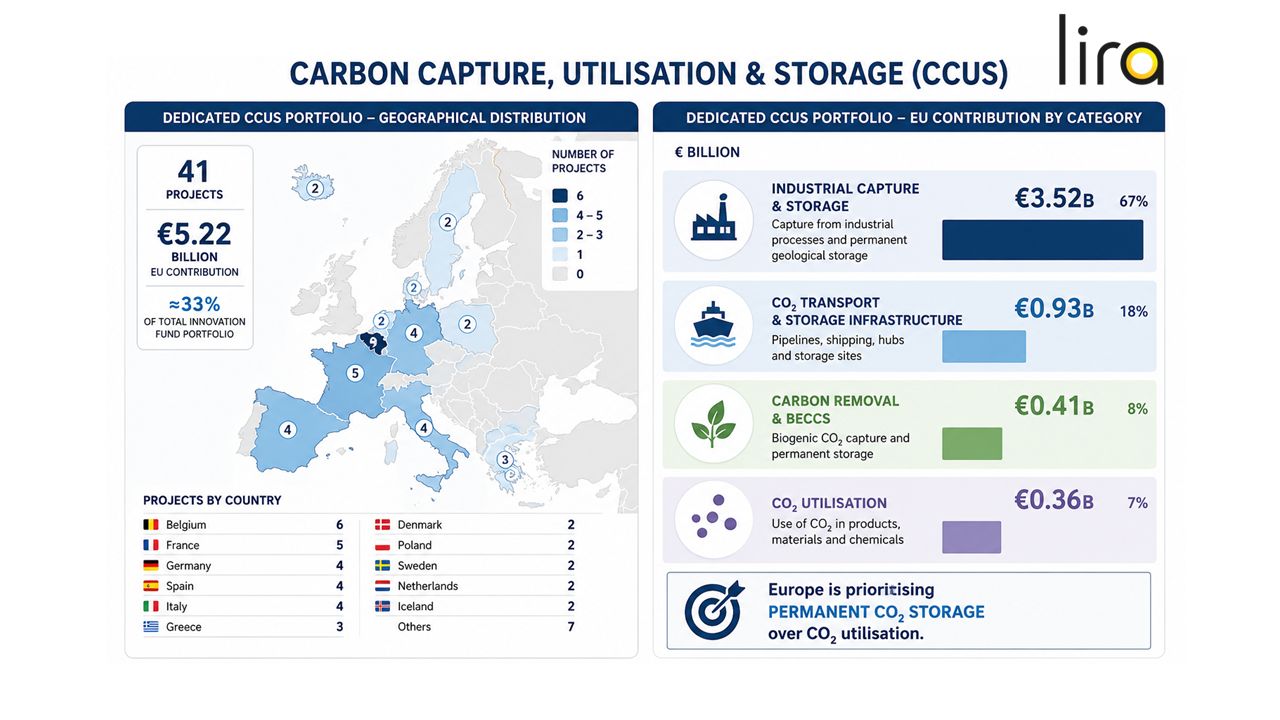
Innovation Fund Trends Part 4 – Carbon Capture, Utilisation and Storage Carbon management is becoming a central pillar of EU industrial policy. The European Industrial Carbon Management Strategy identifies CO₂ capture, transport, utilisation and permanent storage as essential tools for decarbonising hard-to-abate sectors. In parallel, the Net-Zero Industry Act establishes a target of at least 50 million tonnes per year of operational CO₂ injection capacity by 2030, supporting the broader European objective of climate neutrality by 2050. To understand how these policy objectives are translating into actual investments, I analysed the portfolio of 279 projects supported by the EU Innovation Fund. A strict methodological criterion was applied: I included only projects fully focused on CO₂ capture, transport, permanent storage or utilisation. Therefore, broader industrial projects in which carbon capture is only one component of another production process, such as hydrogen, steel, synthetic fuels or power generation, are excluded. The resulting portfolio includes 41 dedicated CCUS projects for a total EU contribution of €5.22 billion, that is approximately 33% of the total contribution in the entire Innovation Fund granted projects portfolio. Belgium hosts the largest number of dedicated projects, with 6 projects and approximately €970 million, followed by France with 5. Germany, Spain and Italy each host 4 projects. Funding is strongly concentrated on permanent emission reduction: -) Industrial capture and storage: €3.52 billion -) CO₂ transport and storage infrastructure: €929 million -) Carbon removals and BECCS: €410 million -) CO₂ utilisation: €360 million Industrial capture and permanent storage therefore account for 85% of the dedicated CCUS budget. In terms of application domain, cement and lime dominate the portfolio, reflecting the difficulty of eliminating their process emissions through electrification or fuel switching alone. The geographical distribution of CO2 storage sites is equally revealing. The North Sea is emerging as Europe’s main carbon-storage basin, supported by offshore storage sites, ports, pipelines and shipping routes. New hubs are also developing in the Mediterranean, Iceland and Central / Eastern Europe. CO₂ utilisation receives a smaller share of funding and is mainly directed towards mineralised construction materials, methanol and chemicals. The message emerging from the portfolio is clear: Europe is not simply financing individual carbon-capture plants, it is building integrated carbon-management value chains connecting industrial emitters, transport networks, storage hubs and selected CO₂ users. The Innovation Fund is therefore treating carbon management as a new strategic industrial infrastructure and, for now, prioritising permanent storage over carbon recycling and utilization.
- LINKEDIN · IMAGESince 11 Jul 2026
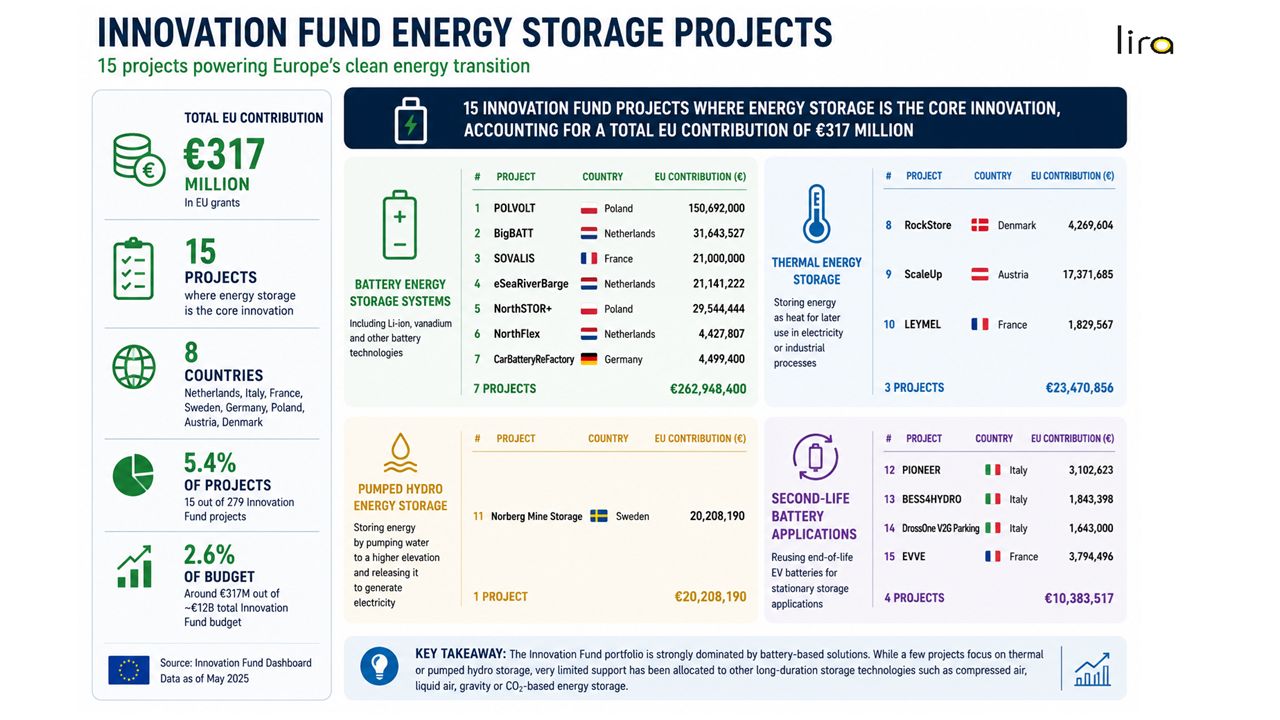
Innovation Fund Trends Part 3 – Energy Storage As Europe accelerates the deployment of renewable energy, energy storage is becoming one of the key enablers of the clean energy transition. It provides the flexibility needed to integrate variable renewable generation, enhance grid stability, reduce renewable curtailment and strengthen Europe's energy security. Recognising this strategic role, the European Union has placed energy storage at the heart of initiatives such as the Net-Zero Industry Act, REPowerEU, and the recent Electricity Market Design Reform, all aimed at building a more resilient and decarbonised energy system. To better understand Europe's priorities, I analysed the 279 projects funded by the Innovation Fund. I identified 15 projects where energy storage represents the core innovation, accounting for a total EU contribution of more than €317 million. These projects are mainly concentrated in the Netherlands, Italy, France, Sweden, Germany, Poland, Austria and Denmark, reflecting the presence of strong industrial ecosystems and ambitious energy transition strategies. The most interesting insight is not where Europe is investing, but which technologies are being prioritised. The Innovation Fund portfolio is clearly dominated by battery-based solutions, including lithium-ion systems, vanadium redox flow batteries and second-life battery applications. Only a limited number of projects focus on thermal energy storage or pumped hydro, while several initiatives explore how existing battery technologies can be integrated into the power system more efficiently. This suggests that the Innovation Fund is currently prioritising technologies that are already close to commercial deployment and capable of delivering immediate impact on grid flexibility and renewable integration, while more disruptive storage concepts (CAES, LAES, Power-to-X, Innovative LDES) have yet to receive significant support. As Europe moves towards a power system increasingly dominated by renewable energy, the need for long-duration storage will inevitably grow. It will therefore be interesting to see whether future Innovation Fund calls begin to broaden their portfolio towards these emerging technologies. The current Innovation Fund portfolio provides a clear snapshot of where Europe believes the energy storage market is ready to scale today. The next challenge will be ensuring that breakthrough long-duration storage technologies also have the opportunity to reach commercial maturity.
- LINKEDIN · IMAGESince 16 Jun 2026
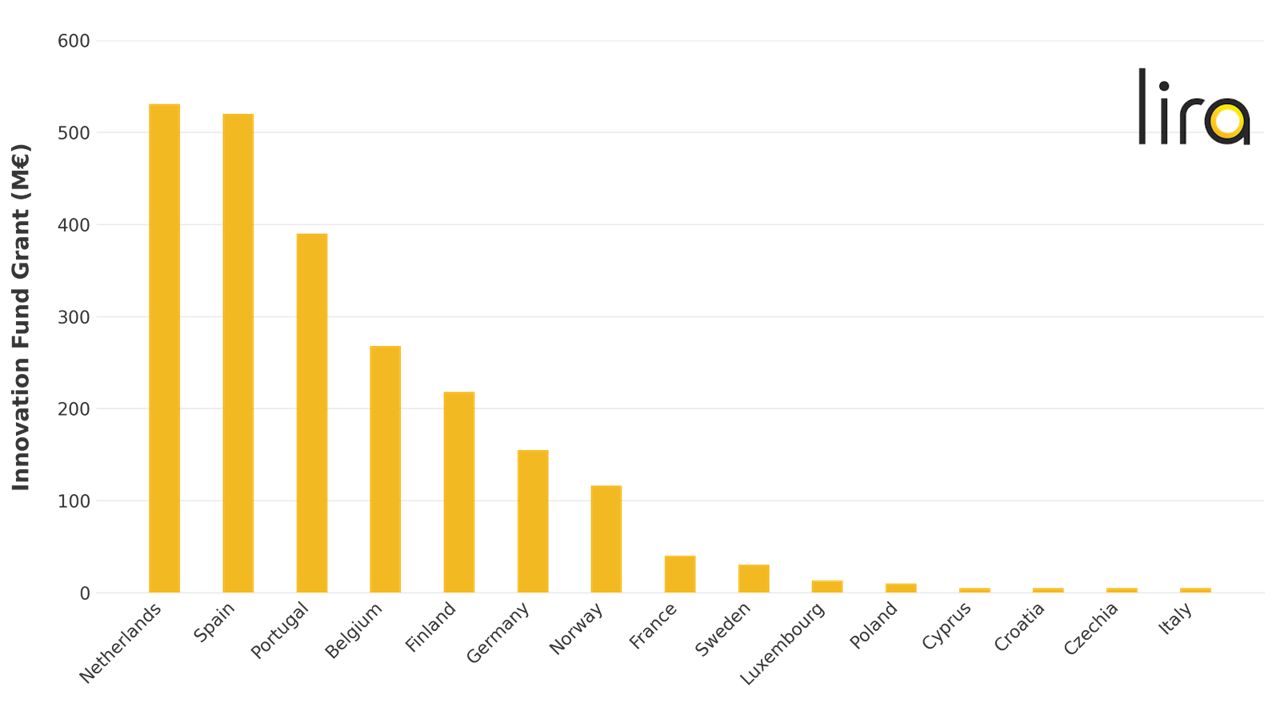
Innovation Fund Trends Part 1 - Hydrogen Since its launch, the Innovation Fund has allocated around €16 billion to 279 clean technology projects across Europe. Hydrogen alone accounts for approximately €2.3 billion distributed across 37 projects, representing 14.5% of the total funding awarded so far. I recently analysed the portfolio of hydrogen projects funded under the Innovation Fund, and the results reveal some interesting trends: -) Spain leads by number of projects, with 10 out of 37 funded initiatives (27% of the entire portfolio). -) The Netherlands ranks first in total funding received, attracting more than €530 million (23% of the total funds allocated) across just 5 projects. -) Northern Europe dominates the funding landscape. The Netherlands, Belgium, Germany, Norway, Finland, and Sweden together account for 16 projects and more than €1.3 billion in grants (57% of the total). The analysis also shows that the Innovation Fund is supporting projects that use hydrogen to decarbonize sectors that are difficult to electrify such as hard-to-abate industries (84% of projects) such as steel industry, chemicals, refineries, heavy transport. Moreover, Power-to-X and e-fuels account for 51% of the projects. The main messages to highlight are: 1- The vast majority of funded projects combine large-scale renewable hydrogen production with a specific industrial off-taker. Standalone hydrogen production projects are relatively rare. Instead, the Innovation Fund is prioritising integrated value chains where hydrogen directly replaces fossil fuels in steelmaking, refining, chemicals, ammonia production, heavy transport and e-fuels. 2- Another notable trend is the growing focus on Hydrogen Valleys and industrial clusters, being the Iberian Hydrogen Valley, the North Sea Hydrogen Valley and the Nordic Green Industry the three major hydrogen districts. 3- Finally, the strong presence of Power-to-X projects suggests that Europe increasingly views hydrogen not as a final product, but as a platform for producing strategic molecules such as green ammonia, synthetic fuels and sustainable aviation fuels. SME participation in the hydrogen subtopic remains relatively limited. Only 11 of the 90 hydrogen-related participants are listed as SMEs, equal to 12.2%, compared with 17.04% across the Innovation Fund portfolio as a whole. Hydrogen projects funded by the Innovation Fund are structurally different from the average project, being typically larger, more capital-intensive, and more dependent on infrastructure, industrial off-takers and complex permitting. Taken together, these projects reveal a clear trend: Europe is prioritising hydrogen where it can create the greatest industrial value, the largest emissions reductions, and the strongest long-term competitive advantage.

6 of 21 adsSign up to see every Lira.ltd ad, filter by format and date, and get alerts on new ones.
See all 21 adsWatch the companies you care about.
Filter every ad by industry, country, format and network, and get alerts when a company you watch starts running new ads.