On air · 1 of 3 networks
Leland
- joinleland.com
- US
- 324 employees
Leland’s ads on LinkedIn, Meta and Google, recorded by adsrunning. Browse the latest here for free. Sign up free to see all 27. Watch Leland with Starter to get each new one in your feed.
Watchlist with Starter · $49/mo
| Network | Status | Live ads | Nov 2025LinkedIn activity · 52 weeksNov 2026 | Checked | Next step |
|---|---|---|---|---|---|
| Running | 27 | Checked 31 Oct 2026 | See all 27 ads → | ||
| Meta | Not checked | — | |||
| Not checked | — |
Leland has 27 live LinkedIn ads. We recorded 82 Google ads on 2 Oct 2026.
Latest ads
- LINKEDIN · IMAGERecorded 31 Oct 2026
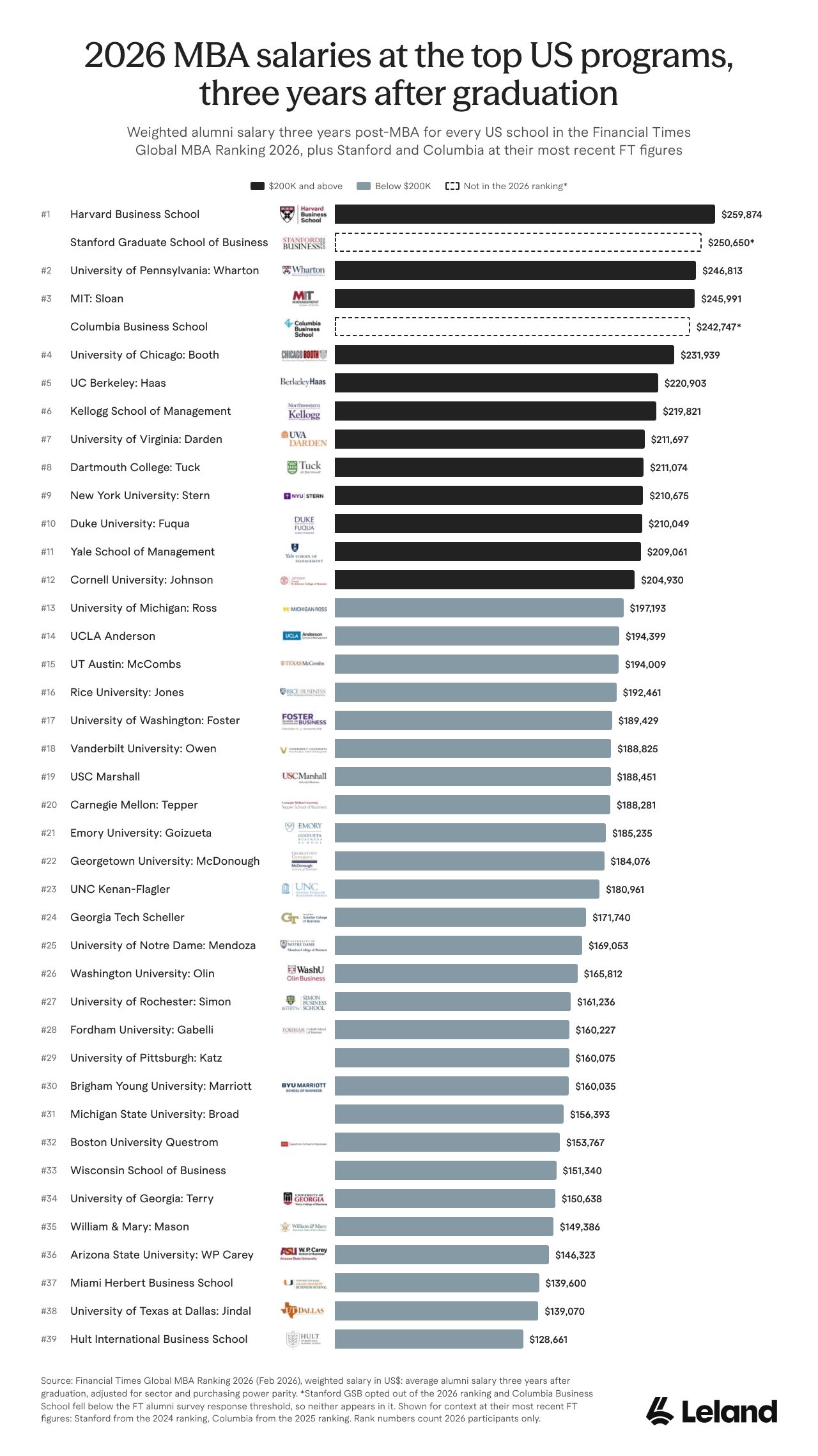
Narrative violation reminder: MBAs from top MBA programs are making $250K+ three years out of school. Last year I posted this data and it surprised a lot of people. "I thought MBAs were struggling to get jobs?" "Does anyone want to hire MBAs in 2026?" "Is HBS struggling?" I'm not here to tell you that you should get an MBA, but I just want to share the data with you so you can decide if it works for you. A few things stood out: - 12 US programs are over $200K. Harvard, Wharton, and MIT Sloan are all above $245K. - Every M7 school in the ranking clears $219K. - Ranks 13 to 23 are packed: Ross, UCLA, McCombs, Rice, Foster, Vanderbilt, USC, Tepper, Emory, Georgetown, and UNC all land between $180K and $197K. - Even programs ranked 30 to 39 on this list are pulling $128K to $160K. - Stanford and Columbia aren’t in the 2026 ranking. Stanford opted out and Columbia missed the FT’s alumni survey threshold, so I added both at their most recent FT numbers. The same two things are still true: 1. MBAs are not for everyone. 2. An MBA from a top school can be career-changing. And here’s the part most college students don’t know: you can lock in a spot at one of these schools before you graduate. HBS 2+2, Stanford GSB deferred enrollment, and a dozen other programs admit seniors who then work for 2 to 4 years before enrolling. Leland is hosting a FREE Deferred MBA Week, Nov 2-5 to help college students interested in deferred MBAs learn from former admissions officers, professional admissions consultants, and more. They'll be covering everything you need to know about deferred MBA programs and how to get in. Register free here: https://lnkd.in/gfhRHTSu
- LINKEDIN · IMAGERecorded 31 Oct 2026
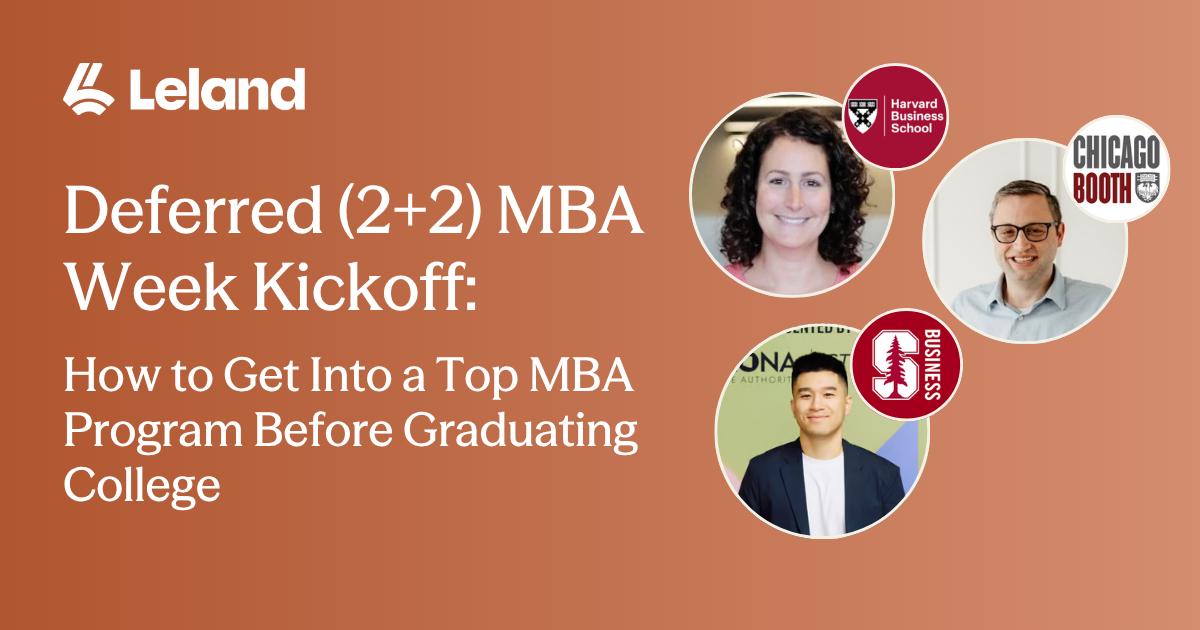
Ever since I was admitted to the deferred MBA program at Stanford University Graduate School of Business, dozens or maybe even hundreds of juniors and seniors in college (prospective applicants) have asked me what I think schools are looking for and what successful applicants do that makes them successful. There's a range of answers you'll hear to those questions. But what I haven't seen a lot of people discuss, and how I approach it, is the idea of the MBA application as a race to see who introspects the deepest. The best applicants aren't necessarily the ones that have the most illustrious internships or come from the most prestigious undergrads or have the highest-paying jobs lined up. Rather, the correlation I've noticed is that the best applications come from those who introspect the deepest, because they are more likely to authentically and therefore convincingly communicate who they are, what they're about, and where they're headed. And that's the battle. On Nov 2nd, I'm going to be taking part in a panel hosted by Leland to kickoff their FREE Deferred MBA Week from Nov 2-5! Join 6 live sessions with top admissions experts covering everything you need to know about deferred MBA programs and how to get in. Register for free here: https://lnkd.in/gCAeDYDZ And if you're applying to deferred MBA programs this year or simply curious about the process, I've been coaching on Leland for the past 1.5 year, helping applicants secure acceptances to M7 and HSW schools. With deferred MBA season just around the corner, book an intro call with me here: https://lnkd.in/g9tX9k4X
- LINKEDIN · IMAGERecorded 29 Oct 2026
There's been a lot of talk about the role of business schools going forward; But I think one of the most underrated aspects of MBA programs is the optionality they provide you as you're figuring out your direction, early in your career. Part of the value of that optionality is the ability right out of school to do something "riskier," knowing that you can always go back to the tried and true path if it is a better fit. And that psychological safety goes a long way in being able to really consider the full slate of options available early in your career. Thinking back, I really wish I had given deferred MBA programs a shot when in college: I was still in "academic mode," perfect for GMAT studying, I had the luxury of time that became harder with a challenging consulting career, and it would have opened me up to taking more unconventional directions with my early career. This realization really made me encourage my sister to pursue a deferred MBA, and she ended up getting into Booth, while starting her career in semiconductors. The MBA let her explore other options, which ultimately validated her decision to come back to the tech hardware space. I think there's great value in that optionality, and the great news is, Leland is helping prepare aspiring deferred MBA candidates for free! @Leland is hosting a FREE Deferred MBA Week, Nov 2-5! Join 6 live sessions with top admissions experts covering everything you need to know about deferred MBA programs and how to get in. Register for free here: https://lnkd.in/gc_hjUge
- LINKEDIN · IMAGERecorded 29 Oct 2026
Thinking about an MBA while you’re still in college? You may be able to secure your spot before you graduate. Having worked in MBA admissions at top business schools, I’ve seen how valuable the deferred route can be for students planning ahead. Many leading MBA programs typically admit applicants with several years of professional experience. Deferred MBA programs offer a different route: apply while you’re still in school, gain work experience, and enroll a few years later. This can be especially appealing if an MBA fits into your long-term career plans. You can spend those early years building experience, exploring industries, and clarifying your goals with a future business school seat already secured. Some employers also offer MBA sponsorship, which may come with a commitment to return to the firm after graduation. But you don’t need an employer-sponsored path to benefit from deferred admission. It can also give you room to explore before deciding your next move. If you are interested in this path, Leland is hosting a FREE Deferred MBA Week, November 2-5! Join six live sessions with top admissions experts covering deferred MBA programs, the application process, and how to build a competitive application. Register for free here: https://lnkd.in/gmbH6Scb Applying this round? Let’s connect and discuss how to make your application stand out.
- LINKEDIN · IMAGERecorded 24 Sept 2026
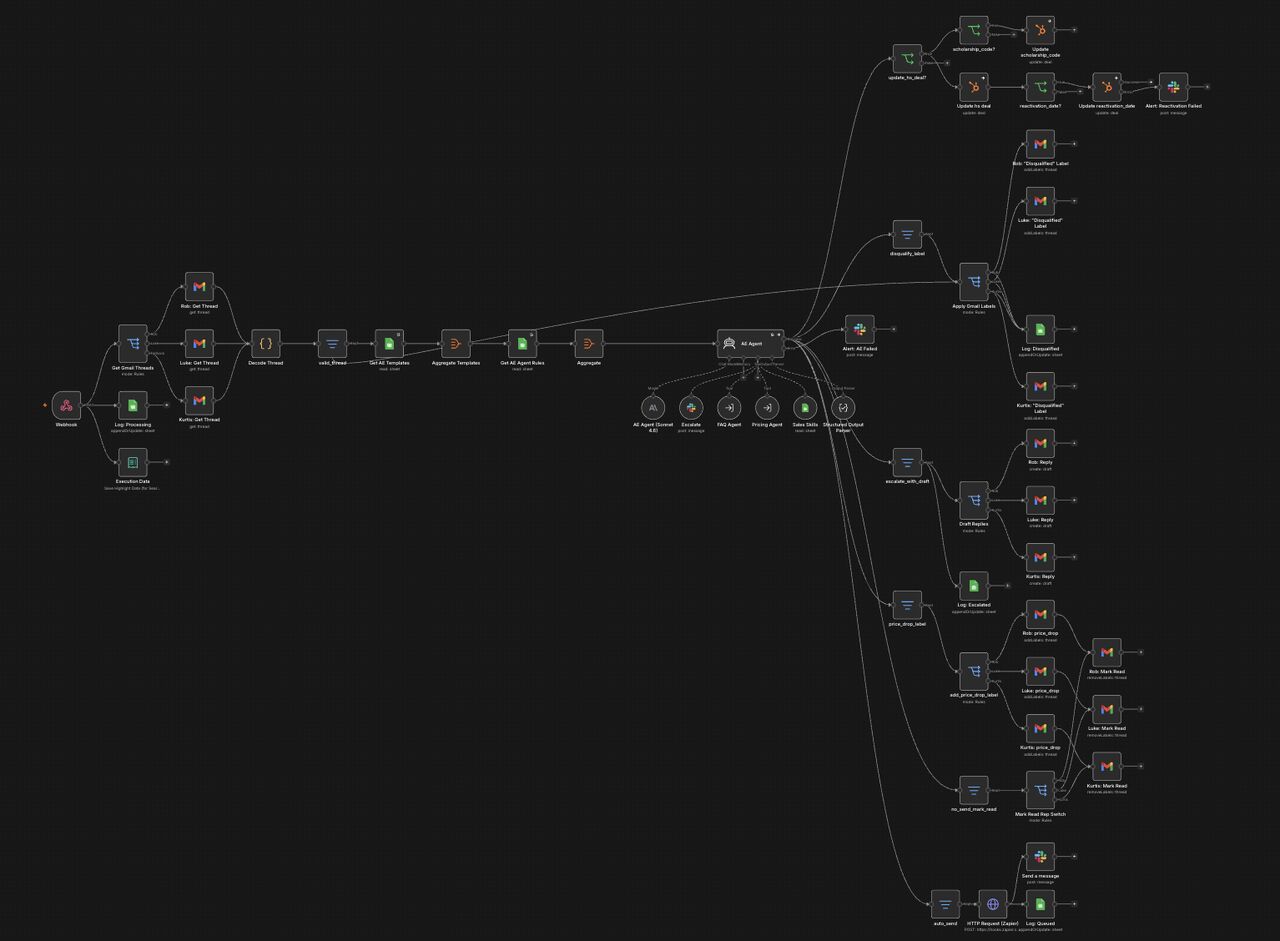
We just automated one full-time employee + two interns away with AI. Good news: we found other places for these people to be valuable at the company. But their original jobs are now run by a team of agents that interact with each other to price, communicate, and sell one of Leland's products. This agent team will deliver over $1M in value this year and much more in the future. It's scalable and able to process thousands of conversations at the same time, which was never possible without a large team before. It's an SDR agent, pricing agent, comms agent, closing agent, and more all baked into one. There are pass offs, escalations, and a growing context base to constantly improve itself. I'll be share more about this and the various other agents/agent teams we've been building at Leland in the coming weeks. If you want to build one of these for yourself, check out our AI Builder Program. If you want us to build one for you, shoot me a DM, we have an AI Services team that can build these for you, quickly.
- LINKEDIN · IMAGERecorded 24 Sept 2026
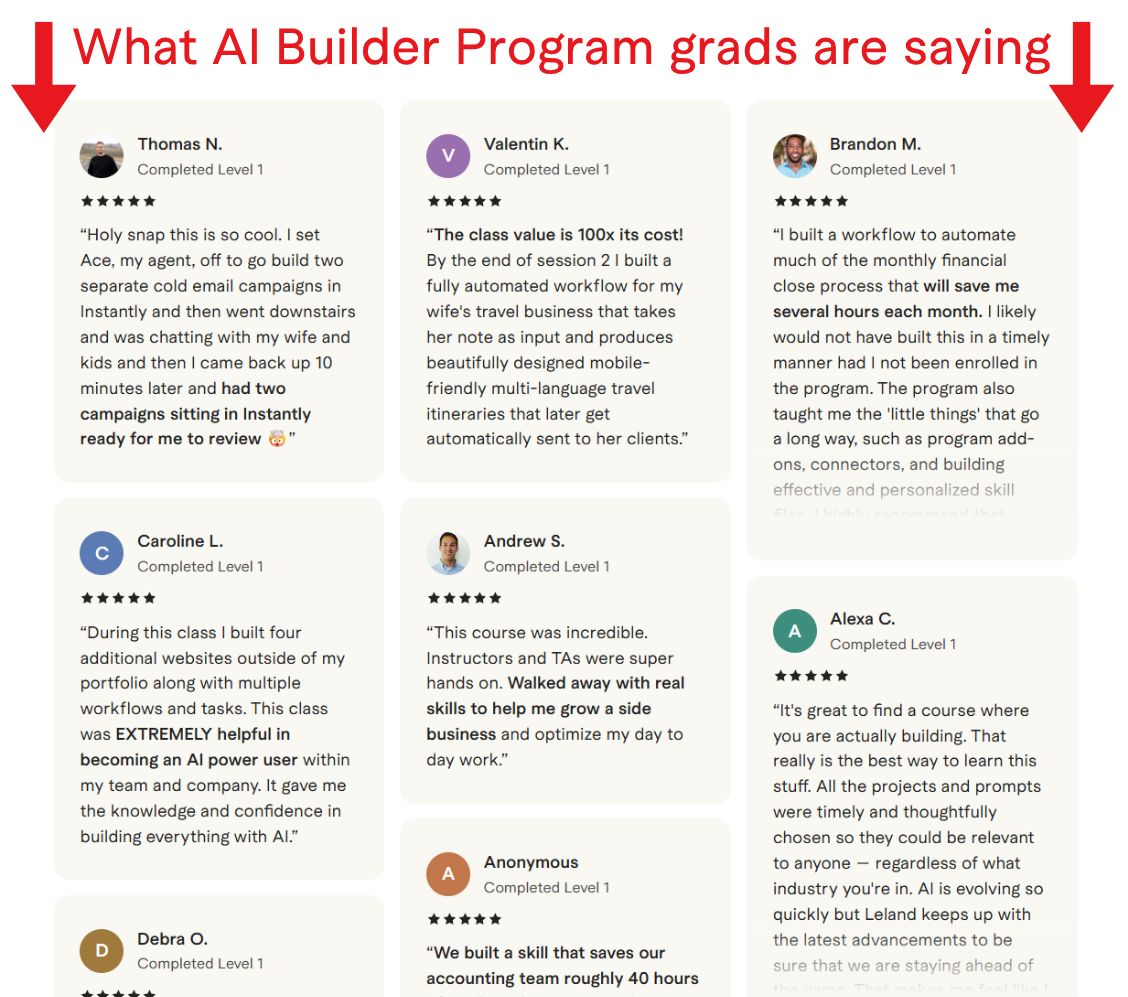
4 things I’m hearing from CEOs every day: "Our engineers are adopting it, but it's sporadic with everyone else." "AI is helping, but we aren't building enough agents yet." "How do I know what's actually valuable and what's just noise?" "I feel like we're getting there, but I want to get there faster." The data matches what they're feeling. When companies take our AI intake quiz, we find that at the high end, less than 5% of employees are actually getting the most out of AI. It's not a tooling problem or a talent problem. It's an enablement and infrastructure problem. Companies need: 1. Tools: access to the best models, plus connectors to their tools and data 2. Training: application-based learning focused on building for each employee's actual job Infrastructure: organized context and systems that compound agent-building Teams have to solve 1 on their own. We built the AI Builder Program to solve 2. We've now trained people at thousands of organizations and the program has a 4.8/5 rating (see below). It's incredible. And we've built out a team of AI Engineers to solve 3 for you. We'll help you set up your company brain and build your first agents to get you going. If any of those four quotes sound familiar, shoot me a DM and let's chat.
6 of 27 adsSign up to see every Leland ad, filter by format and date, and get alerts on new ones.
See all 27 adsWatch the companies you care about.
Filter every ad by industry, country, format and network, and get alerts when a company you watch starts running new ads.