On air · 1 of 3 networks
Kintsugi
- trykintsugi.com
- Technology, Information and Internet
- US
- 181 employees
Kintsugi’s ads on LinkedIn, Meta and Google, recorded by adsrunning. Browse the latest here for free. Sign up free to see all 678. Watch Kintsugi with Starter to get each new one in your feed.
Watchlist with Starter · $49/mo
| Network | Status | Live ads | Nov 2025LinkedIn activity · 52 weeksNov 2026 | Checked | Next step |
|---|---|---|---|---|---|
| None recorded | 0 | Checked 31 Oct 2026 | See all 678 ads → | ||
| Meta | Not checked | — | |||
| Running | 100+ | Ads on the Google Ads Transparency Center | Checked 1 Nov 2026 | Collect them with the API → |
Kintsugi has no live LinkedIn ads. We recorded 100+ Google ads on 1 Nov 2026.
Latest ads
- LINKEDIN · IMAGERecorded 24 Sept 2026
People know me as the co-founder & CEO of Kintsugi, building the compliance OS for the internet. But to get where I am today, there’s been a long detour of 20+ years, from growing up with $5 a month living in New Delhi to dropping out of Stanford and MIT before becoming a founder. Here’s my timeline: I was born and raised in New Delhi, and spent parts of my childhood in China and Dubai. We lived on five dollars a month, we didn’t have computers, and some days, we didn’t have food either. Math was the only thing that gave me a sense of order in that chaos. In early 2000s, I used to compete in International olympiads thanks to my school and my teachers and was at the right place, right time to get Gold and Silver medals in some of them which gave the exposure to world stage. In 2010, I got into both Harvard and Carnegie Mellon, but due to an issue in my visa application, my plans fell apart. I went to Georgia Tech instead, angry and determined to prove myself. I walked into the Dean’s office and said, “Let me take every final. If I pass them all, let me graduate.” He said yes. I finished my entire undergraduate degree. I moved to California, I needed to take the leap to the US, and I started sending money home. I was taking small software engineering gigs to survive. That’s how I got connected to Facebook. At the time, Facebook was trying to build a copy of Snapchat, what eventually became Instagram Stories, WhatsApp Stories, and Messenger Stories. I joined as a researcher through Stanford, building ranking algorithms for those products. When I joined, Facebook was already public, but 10% of users couldn’t load the News Feed, about 200 million people. That was the culture, perfection was irrelevant, and progress was everything. It taught me to move fast, but also to notice when speed starts hollowing out purpose. During that time, I also wrote two research papers, Intelligent Tutoring Systems and the Stanford Question Answering Dataset, which became part of the foundation for what the world now knows as ChatGPT. Back then, we were just trying to make machines understand context. In 2023, I decided to build Kintsugi with my co-founder Jeff. We were both engineers, and we wanted to solve one of the most boring, lucrative, and underserved problems on the internet, indirect tax compliance. We called it Kintsugi because building a company often feels like repairing something broken with gold. Over the next two years, we scaled from two founders to 140 people. We became SOC 2 Type II compliant faster than any company I know. We built infrastructure that can take a customer live in a single day. It’s not a sexy line of work, but compliance is the foundation that lets trust and scale exist for businesses. That’s the short detour that’s brought me here today and I wouldn’t trade any of it. Now I’m focused on dedicating the next decade to mending what’s broken in how the internet handles compliance, one line of code at a time.
- LINKEDIN · IMAGERecorded 24 Sept 2026
Every founder LOVES flexing their AOV, their MER, their LTV… But the second you ask them about sales tax compliance during BFCM, they suddenly regress into a toddler hiding behind the couch eating Goldfish. Here’s the uncomfortable truth no one wants to hear: Half these brands are scaling like crazy while their sales tax filings look like a middle school group project where everyone forgot to do their part. Rates change. Shipping rules change. Promo taxability changes. Your “we’ll figure it out later” vibe? That’s not strategy. That’s a slow, silent revenue leak dressed up as optimism. And the states? They don’t care that your TikTok Shop velocity is “unhinged” or that your new ad creative absolutely cooks. They care that you owe them money. Full stop. This is literally why Kintsugi exists. Real-time tax rates. Real-time promo logic. Real-time shipping accuracy. If you’re doing eight figures and still treating sales tax like it’s optional… you’re not a brand. You’re a pending audit. Clean your books up before the states do it for you. DM me if you want an intro 👊🏼
- LINKEDIN · IMAGERecorded 24 Sept 2026
Kintsugi has scaled from two founders to 140+ employees in just two years. But as you scale, things inevitably move fast and break along the way. Looking back, I can see a few bullets we dodged early on that have quietly saved us from disaster: 1. Compliance. We became SOC 2 Type II compliant faster than any company in the world at our stage. Most founders don’t think about this early on. They just want to get the product out, serve customers, collect money, raise more money. But then the audits come. Every year. And you have to untangle everything you did to get to market fast. We bet on compliance because I’ve seen what’s at stake when it’s ignored. 2. Infrastructure. We set up the right HR and payroll tools early. We got every employee to sign their IP and conduct policies from day one. This may sound obvious, but if it isn’t written down and signed, it can come back to bite you. People call these “cover your ass” moves. I see it as protecting your foundations to allow scaling to be possible. 3. Security. We put device management (MDM) in place when we were still small. It doesn’t drive revenue. But it only takes one stolen laptop with source code on it for everything to fall apart. That one decision could save your company. _ _ _ These aren’t glamorous topics, and they’re often ignored because they don’t feel urgent or tied directly to revenue, but neglecting them can kill your company later. It’s easy as a founder to be solely focused on moving faster. But the better question is how to lay the infrastructure in place so fast doesn’t break you. Momentum without structure eventually collapses under its own weight. The bullets you dodge early on that may seem boring when you’re small are the ones that keep you alive when you scale.
- LINKEDIN · IMAGERecorded 24 Sept 2026
Sales tax has quietly become the primary source of revenue for local governments in the United States. Not income tax, not property tax, but sales tax… It’s a strange truth that rarely makes headlines but explains so much about how the system actually works. The roads we drive on, the schools our kids attend, the community parks and pools that every city builds, all of them are funded by the same dollars businesses collect and remit each month. For years, states like Texas and Florida have positioned themselves as magnets for high-income residents and business owners. They keep income taxes low to attract migration and investment. They can’t lean too heavily on property taxes either, because property owners are the most active voting base in every jurisdiction. States like Texas now have dedicated compliance units that do monthly roll-ups of where you’ve registered payroll, hired W-2 or 1099 employees, and where you’re sending product. They cross-check that data against their sales-tax records. If you’re paying people in-state but not collecting or remitting tax there, it triggers a flag. So where does that leave them? They still need to pave roads, fund schools, and pay for local infrastructure. The only reliable lever left to pull is sales tax - consumption. The dollars flowing through your transactions are what keep those systems alive. Once you understand that dynamic, the rest starts to make sense. The sudden increase in audit notices. The cross-checking of payroll and registrations. The constant tightening of enforcement. States are following the money, and the money is in sales tax. For 65% of U.S. states, sales tax is now the single largest source of revenue, so of course enforcement is increasing. When states depend on that income, they’re not going to let it slip through the cracks. When they do come after you, the costs add up fast, penalties typically start at around 7% per month, and they compound. Then come the fines, the registrations, the audits, the lawyers. That’s why compliance can’t live at the bottom of the finance checklist anymore. Yes it’s imperative as a business to avoid penalties. But, you also need to look further and understand the incentives that drive the entire system you operate in. The sooner you see it that way, the more predictable, and less painful, it becomes. If you’re not sure where you stand, take five minutes and find out. Run a free exposure test check at trykintsugi.com - awareness is the simplest form of compliance.
- LINKEDIN · IMAGERecorded 24 Sept 2026
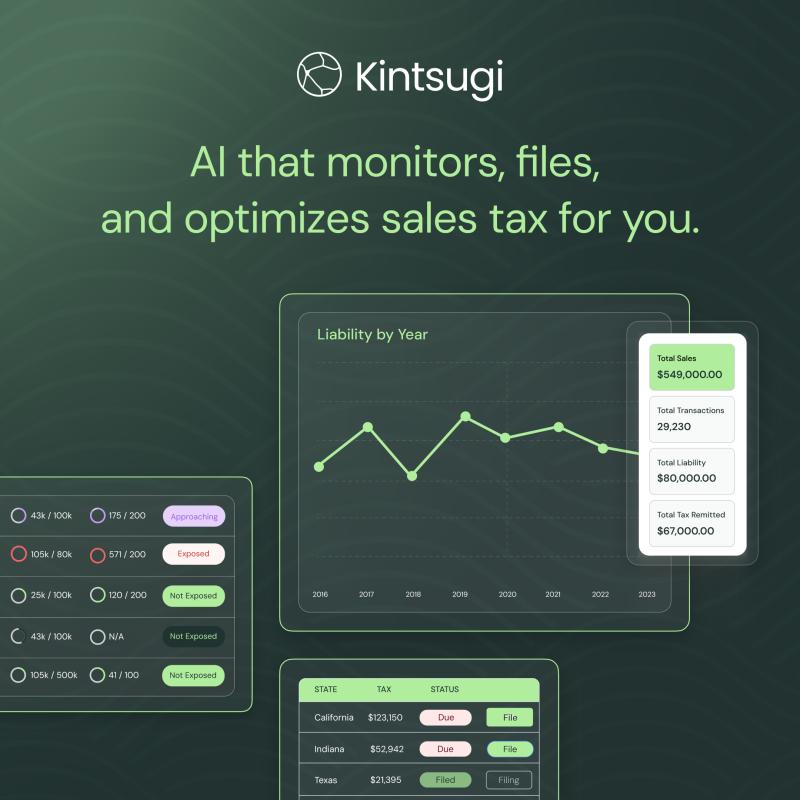
Don't let sales tax penalties and nexus thresholds ruin your holidays this year 🎁 Even if you're selling new products, into new countries at record sales volumes, Kintsugi works in the background to keep you compliant. Book a demo now to see why DTC brands are switching 🤝
- LINKEDIN · IMAGERecorded 24 Sept 2026
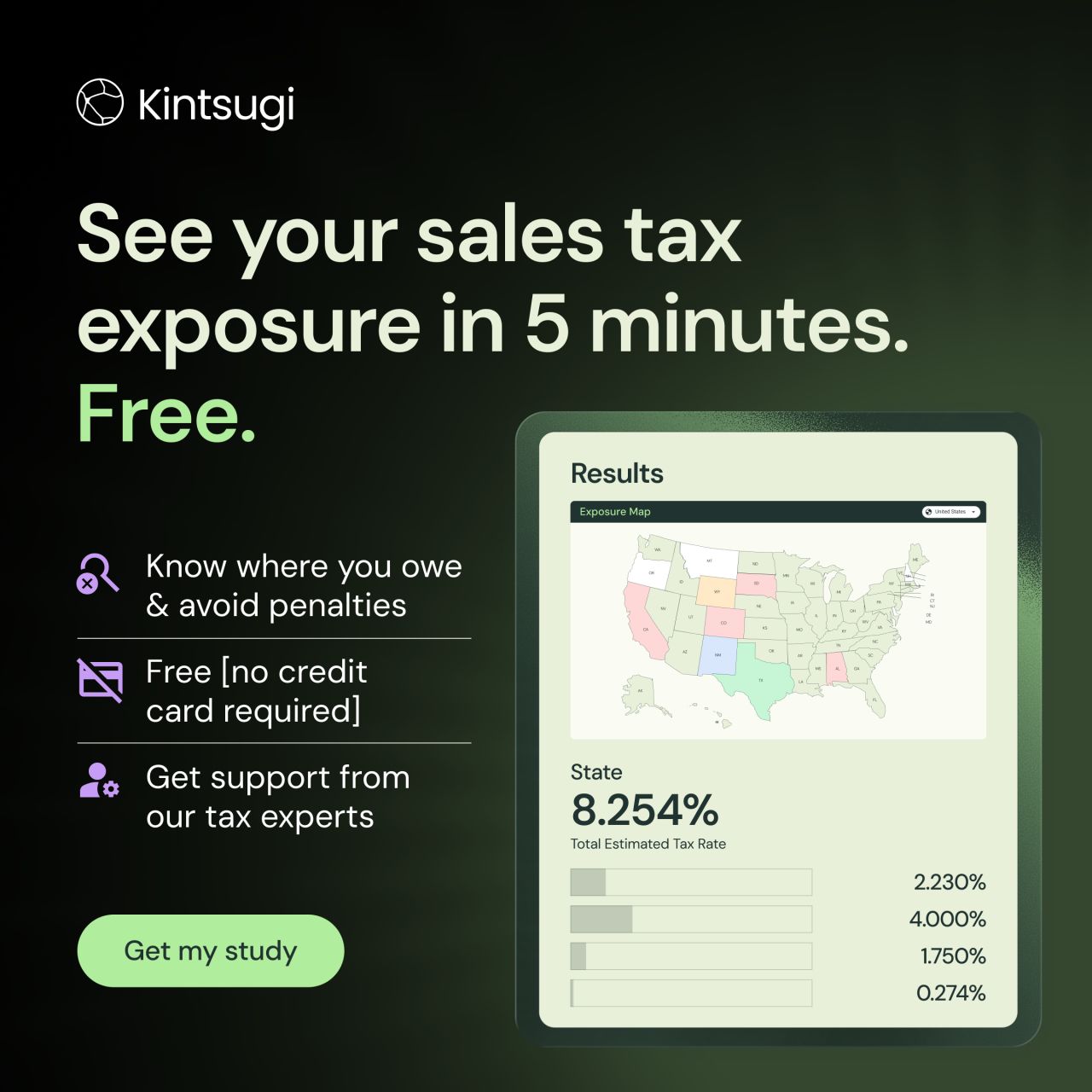
Stop guessing which states you owe sales tax in. Easily integrate your Shopify or Stripe account and start seeing US & International results in 5 minutes. See your sales tax exposure results, and start becoming more compliant today!



6 of 678 adsSign up to see every Kintsugi ad, filter by format and date, and get alerts on new ones.
See all 678 adsWatch the companies you care about.
Filter every ad by industry, country, format and network, and get alerts when a company you watch starts running new ads.