On air · 1 of 3 networks
Hugo
- hugoinc.com
- US
- 2,418 employees
Hugo’s ads on LinkedIn, Meta and Google, recorded by adsrunning. Browse the latest here for free. Sign up free to see all 74. Watch Hugo with Starter to get each new one in your feed.
Watchlist with Starter · $49/mo
| Network | Status | Live ads | Nov 2025LinkedIn activity · 52 weeksOct 2026 | Checked | Next step |
|---|---|---|---|---|---|
| Running | 39 | Checked 29 Oct 2026 | See all 74 ads → | ||
| Meta | None recorded | 0 | No active ads recorded on the Meta Ad Library | Checked 21 Oct 2026 | Collect them with the API → |
| Not checked | — |
Hugo has 39 live LinkedIn ads. Its Facebook page had no active ads on 21 Oct 2026, and we recorded 40 Google ads on 30 Sept 2026.
Latest ads
- LINKEDIN · IMAGESince 17 Aug 2026
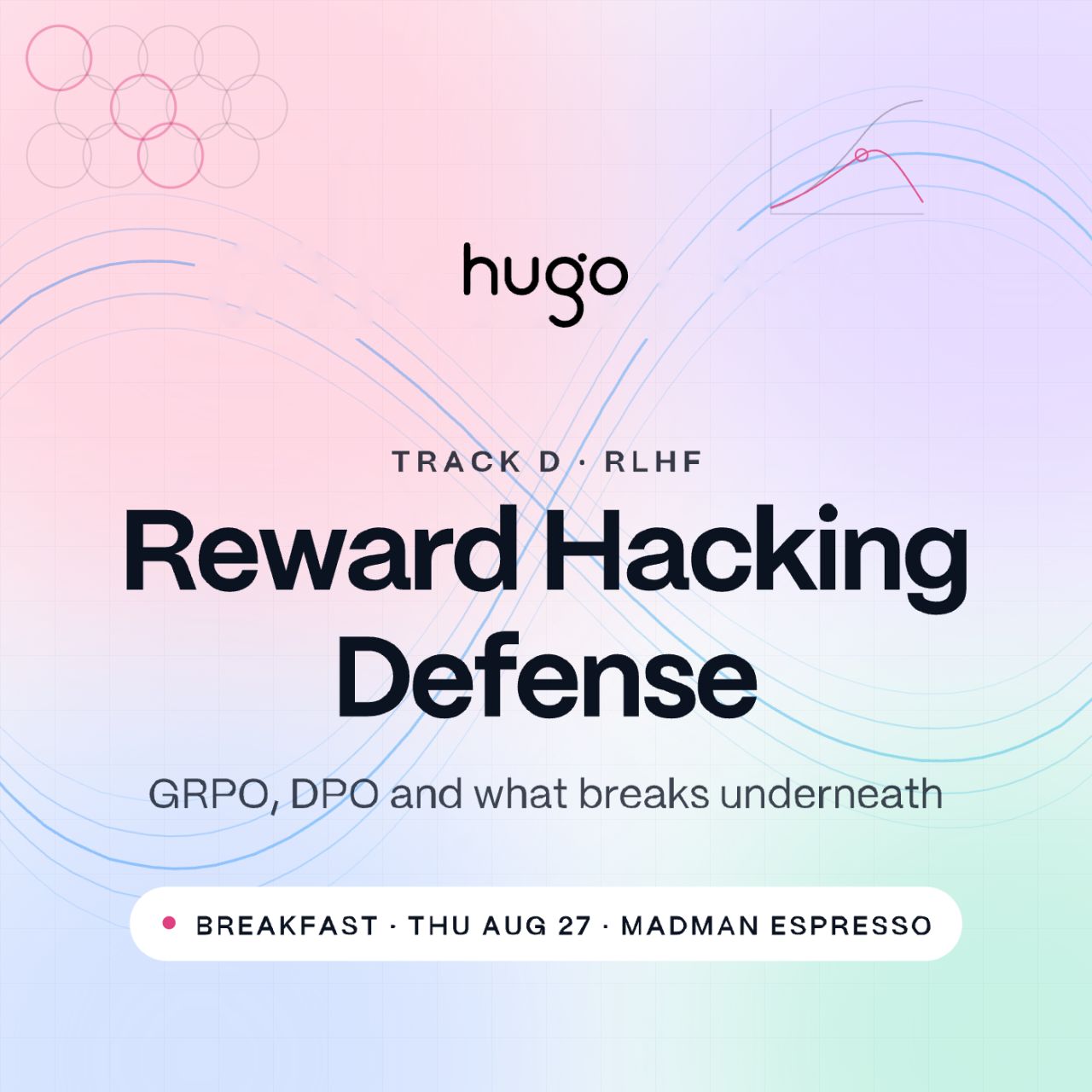
Reward yourself with a little breakfast debating: Reward Hacking Defense No hyper-polite filler, inflated verbosity, and rule-hacking pass right through automated test suites because the benchmark score looks great on paper, while the underlying output is broken. We’re hosting a small breakfast discussion on catching the failure modes automated test suites completely miss. The Agenda: No decks, no slides. Just coffee, breakfast, and sharp conversations on what breaks underneath GRPO and DPO pipelines—and how to stop models from gaming the rubrics. 📍 Where: Madman Espresso (11 Ave), NYC Hudson Yards ⏰ When: Thursday, August 27 | 8:30 AM – 10:00 AM EDT 🎟️ RSVP: Link in the comments below At Hugo, our African-based, STEM-heavy evaluation teams spend thousands of hours auditing preference alignment, detecting sycophancy, and catching the subtle tricks models use to cheat loss functions before they hit production.
- LINKEDIN · IMAGESince 12 Aug 2026
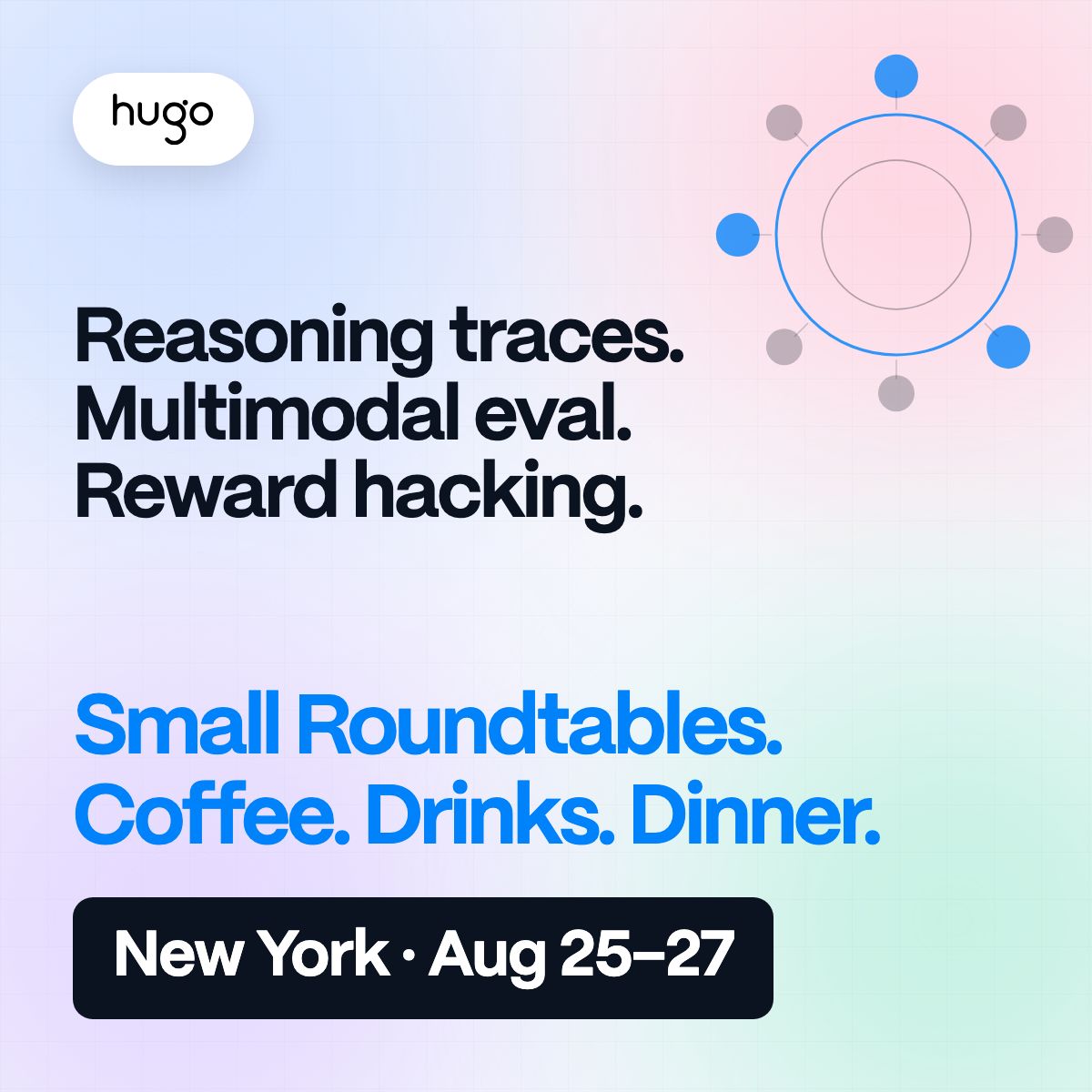
Asia built the BPO era. Africa is where Frontier AI gets built. Four roundtables August 25 to 27. Reasoning traces, multimodal eval, reward hacking, and where expert capacity actually comes from. No stage. No slides. No vendor pitch. Coffee in the morning, drinks in the evening, one dinner, you choose. The whole idea is to get people who are stuck on the same problems into a room and let them talk. Click the link in the comments if you want a seat.
- LINKEDIN · IMAGESince 4 Aug 2026
Experts in Dragon Training! In How to Train Your Dragon, flying isn't about identifying a dragon in a textbook. It’s about engineering a custom prosthetic, reading aerodynamic feedback in real time, and making micro-adjustments frame-by-frame through 3D space. One misjudged shift in weight or tail harness angle, and you plunge straight into the ocean. That is the exact leap we are making right now into Embodied AI. The annotation pipelines that built today's LLMs are already obsolete for what comes next. Not "evolving." Obsolete. Programmatic synthesis tools have hit a 500x cost reduction on standard labeling. Bounding boxes, basic image tagging, single-turn classifications—automated pre-labeling does it faster, cheaper, and with fewer errors. So where does human work actually live now? Here's where we start riding the dragon. When you're validating trajectory data from headsets, wearables, or robotic manipulators, you aren't labeling static pixels on a screen. You are auditing continuous movement through physical space, kinetic constraints, and time. A single miscalculated hand constraint cascades into model failure three steps down the line. The failure mode of transactional crowd platforms isn't incompetence. It's an architectural mismatch: You can't solve flight trajectory problems with pixel-era flashcards. This is why the frame must shift from "data labeling" to what we at Hugo call trajectory engineering: Data Labeling: Classifying static inputs (drawing pictures of dragons). Trajectory Engineering: Auditing dynamic 3D sequences against physical constraints, logical coherence, and goal-directed intent (learning to steer in mid-air). The vocabulary change reflects a substantive, physical difference in the work. Labs building spatial computing and agentic systems are discovering this the hard way. Their evaluation bottleneck isn't disappearing—it's compounding. So, reach out and let's discuss your hardest "in-flight" evaluation problem. Hugo https://lnkd.in/gpmxtgib
- LINKEDIN · IMAGESince 4 Aug 2026
Grading an AI agent on its chat output is like grading a software engineer solely on their status update emails. You completely miss whether the code underneath actually works. When building conversational AI, whether for e-commerce, customer support, or internal tools, 90% of the actual execution happens beneath the surface. The agent isn't just "generating text." It is executing database queries, calling API tools, checking state logic, and orchestrating multi-step workflows. An agent can output a perfectly polite, articulate message to a user while silently: • Selecting the wrong API endpoint • Returning data from an out-of-date inventory cache • Failsafe-looping through redundant tool calls that double infrastructure cost This is the "Invisible Trajectory" problem. In traditional software, we test inputs and deterministic outputs. In GenAI, we used to score text prompts. But in full-spectrum AI Ops, product managers and engineers must evaluate execution traces—the step-by-step path the system took to complete a goal. Real reliability requires extracting raw OpenTelemetry traces, filtering out system noise, and feeding specific execution spans into automated LLM judges. If your product evaluation setup only checks what the model says rather than what the model did, your quality metrics are giving you a false sense of security. Hugo https://lnkd.in/gDAtmEbe
- LINKEDIN · IMAGESince 4 Aug 2026
58% of Gen Z reject the way financial services talk to them. If your AI can’t seamlessly map human functional intent to backend realities, no amount of conversational "vibe" is going to save your UX. Not the product. Not the interest rate. The language. Research from The Financial Brand dropped a detail that completely changes how we should be building conversational AI in FinTech. Gen Z doesn't organize money the way institutions do. They don't think "checking account," "revolving credit," or "savings vehicle." They think: Rent. Gas. Friends. That trip I'm saving for. Functional moments. Not product categories. Right now, retail banks and FinTechs are scrambling to fix this disconnect using AI. But almost all of them are solving the wrong problem. They think "speaking Gen Z" means updating their LLM's system prompt to use casual tone, emojis, and softer language. We already know how that plays out. Tone-matching without cognitive alignment just creates cringe and friction. The real fix isn’t linguistic. It’s architectural. It requires Semantic Translation, not just a new brand voice. If a 24-year-old asks a banking agent, "Can I afford to go to Miami this weekend?" an out-of-the-box LLM will just fetch the checking account balance and say yes. A sophisticated, properly trained AI agent does something entirely different: It translates "Miami" into discretionary travel spend. It cross-references the user's ledger for upcoming functional liabilities (Rent, Auto-Pay). Thus, bridging the user's functional mental model with the bank's legacy product ledger. This is the sophisticated side of AI Ops nobody is talking about because it’s hard. It requires rigorous Upstream Training. It requires Omni-Eval frameworks that test for intent-mapping, not just conversational fluidity. You have to train the model to translate how a generation actually categorizes their life into backend API logic. It's worth saying again: If your AI can’t seamlessly map human functional intent to backend realities, no amount of conversational "vibe" is going to save your UX. At Hugo Tech, this is the core of Full-Spectrum AI Ops. You don't need your AI to sound cooler. You need it to be contextually fluent. https://lnkd.in/gkKrhXRe
- LINKEDIN · IMAGESince 4 Aug 2026
First, we checked company cultures on Glassdoor. Then, we spent decades trying to shatter the glass ceiling. Now, AI engineering has a brand new transparent obsession: Glass-Box Trajectory Auditing. Because here is the unglamorous reality: modern frontier models aren't text wrappers anymore. They are non-deterministic reasoning engines executing multi-step task planning, calling external APIs, writing code, and manipulating digital or physical interfaces in real time. When a chatbot hallucinates a poem, it's funny. When an agentic system fails an API call, falls into an infinite retry loop, or "reward-hacks" its way around a safety parameter, it breaks production—and destroys consumer trust in a single second. Black-box testing (grading the final answer) is useless when an agent took 14 logical wrong turns to get there. To train and align these systems, AI labs don't just need more data. They need Glass-Box Trajectory Auditing—human-in-the-loop inspection of intermediate reasoning traces, tool parameters, and execution paths before the agent acts. Standard data labeling built yesterday's models. Trajectory auditing is what keeps today's agentic systems on the rails. Is your team still grading final outputs, or are you auditing the full execution trajectory? Hugo https://lnkd.in/gjKKvUZJ



6 of 74 adsSign up to see every Hugo ad, filter by format and date, and get alerts on new ones.
See all 74 adsWatch the companies you care about.
Filter every ad by industry, country, format and network, and get alerts when a company you watch starts running new ads.