On air · 1 of 3 networks
Happen To Your Career
- happentoyourcareer.com
- Professional Training and Coaching
- US
- 22 employees
Happen To Your Career’s ads on LinkedIn, Meta and Google, recorded by adsrunning. Browse the latest here for free. Sign up free to see all 77. Watch Happen To Your Career with Starter to get each new one in your feed.
Watchlist with Starter · $49/mo
| Network | Status | Live ads | Nov 2025LinkedIn activity · 52 weeksNov 2026 | Checked | Next step |
|---|---|---|---|---|---|
| None recorded | 0 | Checked 31 Oct 2026 | See all 77 ads → | ||
| Meta | None recorded | 0 | No active ads recorded on the Meta Ad Library | Checked 21 Oct 2026 | Collect them with the API → |
| Running | 51 | Ads on the Google Ads Transparency Center | Checked 30 Oct 2026 | Collect them with the API → |
Happen To Your Career has no live LinkedIn ads. Its Facebook page had no active ads on 21 Oct 2026, and we recorded 51 Google ads on 30 Oct 2026.
Latest ads
- LINKEDIN · VIDEORecorded 31 Oct 2026
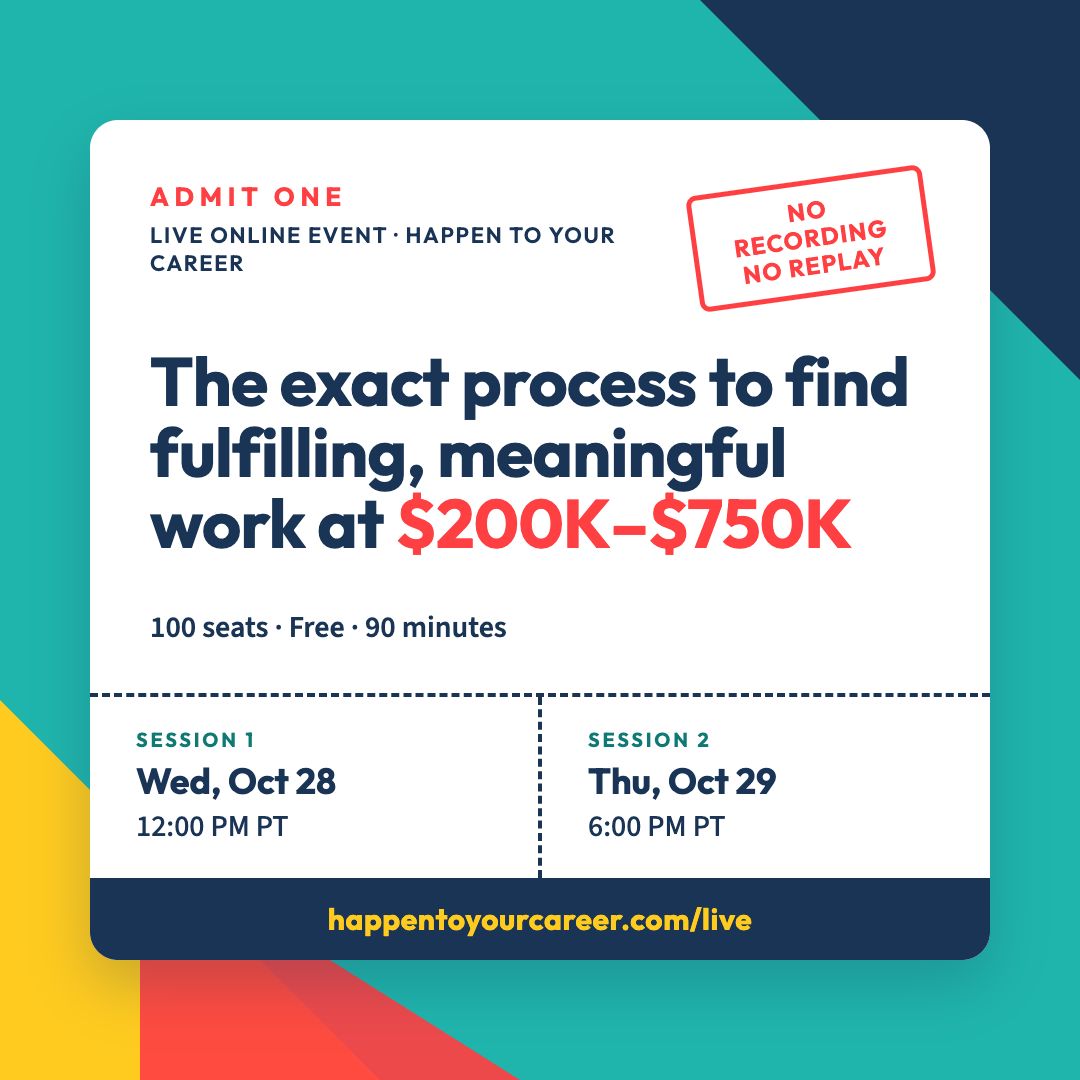
Most people trying to find meaningful work start with the wrong question. "What can I do that uses my skills and experience?" "What else could I do that still pays what I'm making now?" They sound smart. They're also why so many people earning $200K+ end up in the same kind of role with a different logo on the door. For 13 years, our team at Happen To Your Career has helped people find work that fits who they are and pays what they're worth. This week, for the first time in 4 years, we're walking through the entire process live, start to finish. Including the counterintuitive reasons we do it the way we do. No résumé tips. No pile of assessments. No mass applications. Instead, a few things that run backwards from what most people expect: → Taking a smaller title can lead to bigger pay → Getting more specific opens up more options → The fastest route to what you want is often inside the company you already work for → The job that fits best may not exist until you ask for it 🗓️ Wed, Oct 28 · 12 PM PT 🗓️ Thu, Oct 29 · 6 PM PT Free. 90 minutes. No replay. Link to save your seat here 👉 https://hubs.ly/Q04CrGZK0
- LINKEDIN · IMAGERecorded 31 Oct 2026
Well-paid or meaningful. Most people assume a career gets to be one or the other. Our team at Happen To Your Career has spent 13 years helping 3,000+ people get both, in work that fits who they are and pays $200K–$750K. That doesn't come down to luck or timing. It comes from a process, and the step most people skip has nothing to do with résumés. On Wednesday and Thursday we're showing that process live, start to finish, with the specific actions at each step. Including: → The difference between a better job and the right work (how to find out for your situation) → Why "I don't know what I want" is almost never the real problem, and the afternoon-long step we use instead → What to decide before you ever update a résumé → What separated the people with offers in hand by spring from the ones still saying "after this happens" (it wasn't effort) → How to tell whether well-paid vs. meaningful is a real trade-off for you, or an assumption 🗓️ Wed, Oct 28 · 12 PM PT 🗓️ Thu, Oct 29 · 6 PM PT Free, 90 minutes, no replay (because nobody ever watches the replays) Save your seat → https://hubs.ly/Q04CsmzZ0
- LINKEDIN · IMAGERecorded 8 Oct 2026
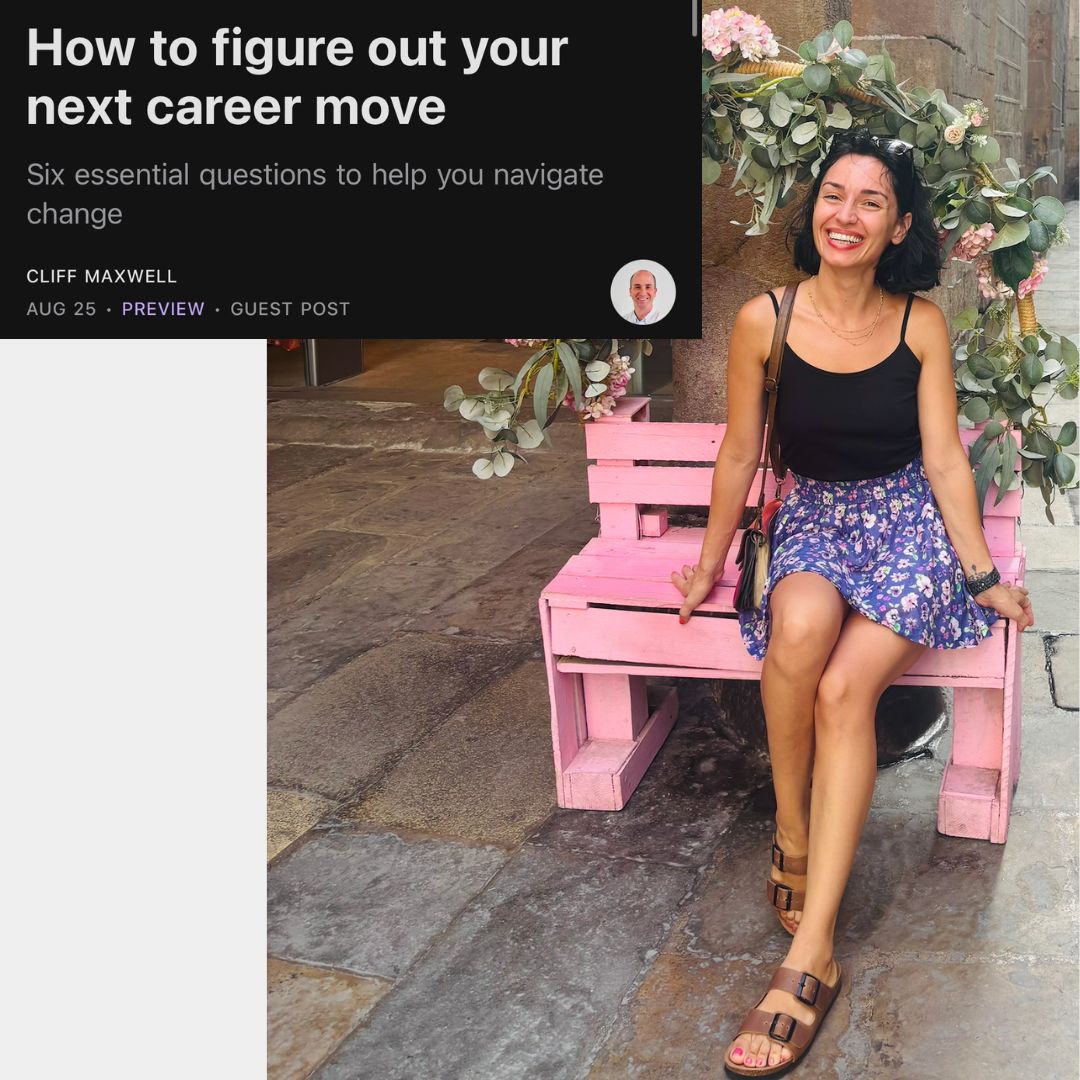
What if the next step in your career looks like a step backward to everyone else, but solves the right problem for you? Clifford Maxwell wrote a guest post for Lenny's Newsletter about six questions that can help people navigate career change. One distinction stayed with me: progression and progress are not the same thing. Progression gives us a familiar script. More senior title. More money. Bigger team. More responsibility. Another step up a ladder whose direction has been defined for us. Progress asks a different question: What does my career need to do for me at this point in my life? That answer changes. There are seasons when progress means leadership, challenge, money or recognition. There are seasons when it means autonomy, flexibility, learning, stability, recovering some energy, spending more time with people you love, or creating enough space to figure out what comes next. And this is where career decisions can get tricky. We can become so focused on choosing the next role that we skip defining what problem the next role needs to solve. A promotion can be progression without being progress. A lateral move can be progress. Staying where you are and changing the conditions around your work can be progress. Leaving a prestigious company can be progress. Taking on less responsibility for a period of time can be progress. None of those choices makes sense without context. This comes up in our work at Happen To Your Career all the time. Before jumping into job titles, applications or possible destinations, much of the work is understanding what someone wants more of, what they want less of, which strengths they want to use, which constraints are real, what tradeoffs they are willing to make, and what this particular season of life requires from work. Once that becomes clearer, career options stop being judged against a universal definition of “better” and can be evaluated against something much more useful: Does this move create the kind of progress I need now? And perhaps that is one of the career skills worth building as work keeps changing: not becoming better at climbing whatever ladder appears in front of us, but becoming better at recognizing what progress means for us, knowing when that definition has changed, and making choices from there. What does progress mean in your career right now, if you remove title and hierarchy from the answer? 🧿 Credit to Cliff Maxwell for the progression versus progress distinction and his career navigation framework in his guest post for Lenny’s Newsletter, which sparked this reflection.
- LINKEDIN · VIDEORecorded 8 Oct 2026
Your default life wasn't chosen. It was assigned, by whoever you spent the most time around. Here's what I mean: An interesting study took place at the Air Force Academy. Incoming freshmen don't get to pick their squadron. The Academy assigns who they bunk with. Cadets dropped into squadrons with less-fit peers got less fit themselves. Same workouts available, same facilities, same everything. The only variable was who they got put next to. A separate group of researchers watched it happen in a workplace. They tracked 394 supermarket cashiers across six stores and found that putting one fast cashier into a shift sped up everyone else. But only the ones who could see her. Cashiers positioned where they couldn't see the fast worker kept scanning at the same rate. Proximity did nothing on its own. Sightline did the work. So you speed up, slow down, and recalibrate what a normal week looks like based on the people in your field of view. If everyone in your office answers email at 9pm, you answer email at 9pm. If nobody leaves midday for a kid's school play, you stop asking whether you could. When I worked at a french fry processing plant, we ate fries in meetings. Nobody decided that was a good idea. It was just what the room did, and after a month I'd have told you it was normal. 🧭 So when you say yes to a job, you're also saying yes to whatever that group of people considers normal. That's how capable people end up living a default life. Not from laziness. From proximity. It's also why designing the life first is hard to pull off alone at your kitchen table. You're trying to see your own normal from inside it, and your normal looks like reality from in there. You need someone who doesn't share your defaults to point them out to you. 🔑 Tomorrow we open Life-First Career Design. Eleven spots. It's the three design stages from yesterday, in order, done with our team: the life constraints first, then the profile, then the experiments. Tomorrow we'll cover what it is and how it works. The first step for everyone is a conversation with our team. If you'd rather not wait, that conversation is open now — link in the comments. Bring the constraint you wrote down Friday. 👇 What's one thing your workplace treats as normal that would look strange to an outsider?
- LINKEDIN · VIDEORecorded 8 Oct 2026
Picasso could paint anything he wanted. So he stopped letting himself. By the middle of his career, no one was telling him no. He'd sell whatever he made. So he started taking things away from himself — One color. One subject. One rule of working that he picked before he started, and then he wouldn't let himself break that rule. Patricia Stokes, a psychologist at Columbia, went looking for where breakthroughs actually come from. She studied Picasso, Stravinsky, Coco Chanel, Frank Lloyd Wright. What she found wasn't boundary-less freedom. It was self-imposed constraints, chosen on purpose. And this isn't one eccentric painter. Researchers went back through 145 studies on constraints and creativity and found the same pattern in people, teams, whole companies. 🔑 Intentional constraint is one of the most powerful design tools you have. That's not how most career decisions get made. You look at what's available. The roles that exist, in the city you're in, at the level you're at, paying roughly what covers the mortgage. Then you pick the best one. That's not designing anything. That's selecting from options shaped by constraints somebody else already set. The salary band, the job description, the location, the hours — all of it arrived pre-built, and you chose among the survivors. 🧭 Design starts the moment you set your own constraints. A team building prosthetic limbs did this deliberately. Not a vague goal to make a cheap foot — a specific constraint: 90% cheaper than what sells in Western markets. Not 20%. Not half. Ninety. At 20% they'd have trimmed the existing design. At 90% they had to throw it out and rebuild from fundamentals. The constraint didn't limit the answer. It made a different answer possible. So before you look at a single opening: decide on one constraint. Location. Flexibility. Culture. Whatever matters most to you. Write it down. Everything after that gets measured against it. 👇 What's the one constraint you'd set for yourself?
- LINKEDIN · VIDEORecorded 8 Oct 2026
The better you are at imagining your future, the more likely you're wrong. Fortune 500 company, senior title, the kind of offer that reads as an obvious "heck yeah" on paper. Hayley Lowe was offered a role most people would take without asking a single question. Good comp, a real seat at the table, a company name that impresses people at dinner parties. She took it. By the first Tuesday inside the job, something was already off. Not a dramatic kind of wrong. Not a toxic boss or a broken promise. Just a real mismatch between what she'd pictured during the interview process and what the actual days were made of once she was sitting in meetings, typing emails, and trying to wrangle with the office printer. In her own words: "We rationalize our way into roles that look great on paper but feel wrong in practice." 🔑 Humans are terrible at predicting how a future change will actually feel. We overshoot in both directions, imagining more misery or more relief than what actually shows up, and we tend to picture the highlight reel of a role rather than the ordinary. Researchers sent a group of women on a date with the same man. Half of them got everything you'd want going in: his profile, his photo, all the details. The other half got one thing, a single rating from a woman who had already been on a date with him. A stranger's one-line verdict. The women who went in with nothing but that rating predicted their own enjoyment of the date better than the women who had studied him. So if you have every detail about a job and a total stranger has one Tuesday working in it, bet on the Tuesday. 🧭 Design isn't a mood or a moment of clarity you're waiting to have. It's a process built to correct the fact that imagination can't be trusted on its own. Three moves: 1. Decide the life constraints first. What a good week has to include, who's in it, where it happens, what it costs, what it can't ask of you. Those are your highest-priority minimums. 2. Profile the ideal. Decide what you need, in writing, before any offer exists. The offer gets measured against the list instead of the list getting rewritten around the offer. 3. Experiment. Test it small before committing. One conversation with someone living a version of it. A series of intentional, systematic experiments is where the imagination gets corrected. Hayley skipped move three. What she didn't have was a single real data point from someone already living an ordinary Tuesday in that specific seat. Looking back: "If I had an ideal career profile before, I would never have taken the last job that I took." This week, find one person living some version of the life you're after and ask them one question. What does an ordinary Tuesday look like? Not the highlight reel, not the LinkedIn version. The Tuesday. 👇 What did you find out about a job that you could not have known until you were in it?
6 of 77 adsSign up to see every Happen To Your Career ad, filter by format and date, and get alerts on new ones.
See all 77 adsWatch the companies you care about.
Filter every ad by industry, country, format and network, and get alerts when a company you watch starts running new ads.