Not on air · 2 of 3 networks checked
Fokus Learning Design
- fokusgroup.io
- Design Services
- US
- 5 employees
Fokus Learning Design’s ads on LinkedIn, Meta and Google, recorded by adsrunning. Browse the latest here for free. Sign up free to see all 20. Watch Fokus Learning Design on any plan to get each new one in your feed.
Watchlist included in every plan
| Network | Status | Live ads | Nov 2025LinkedIn activity · 52 weeksNov 2026 | Checked | Next step |
|---|---|---|---|---|---|
| None recorded | 0 | Checked 4 Nov 2026 | See all 20 ads → | ||
| Meta | Not checked | — | |||
| None recorded | 0 | No ads found on the Google Ads Transparency Center | Checked 29 Oct 2026 | Collect them with the API → |
Fokus Learning Design has no live LinkedIn ads. We recorded no Google ads on 29 Oct 2026.
Latest ads
- LINKEDIN · IMAGERecorded 19 Sept 2026
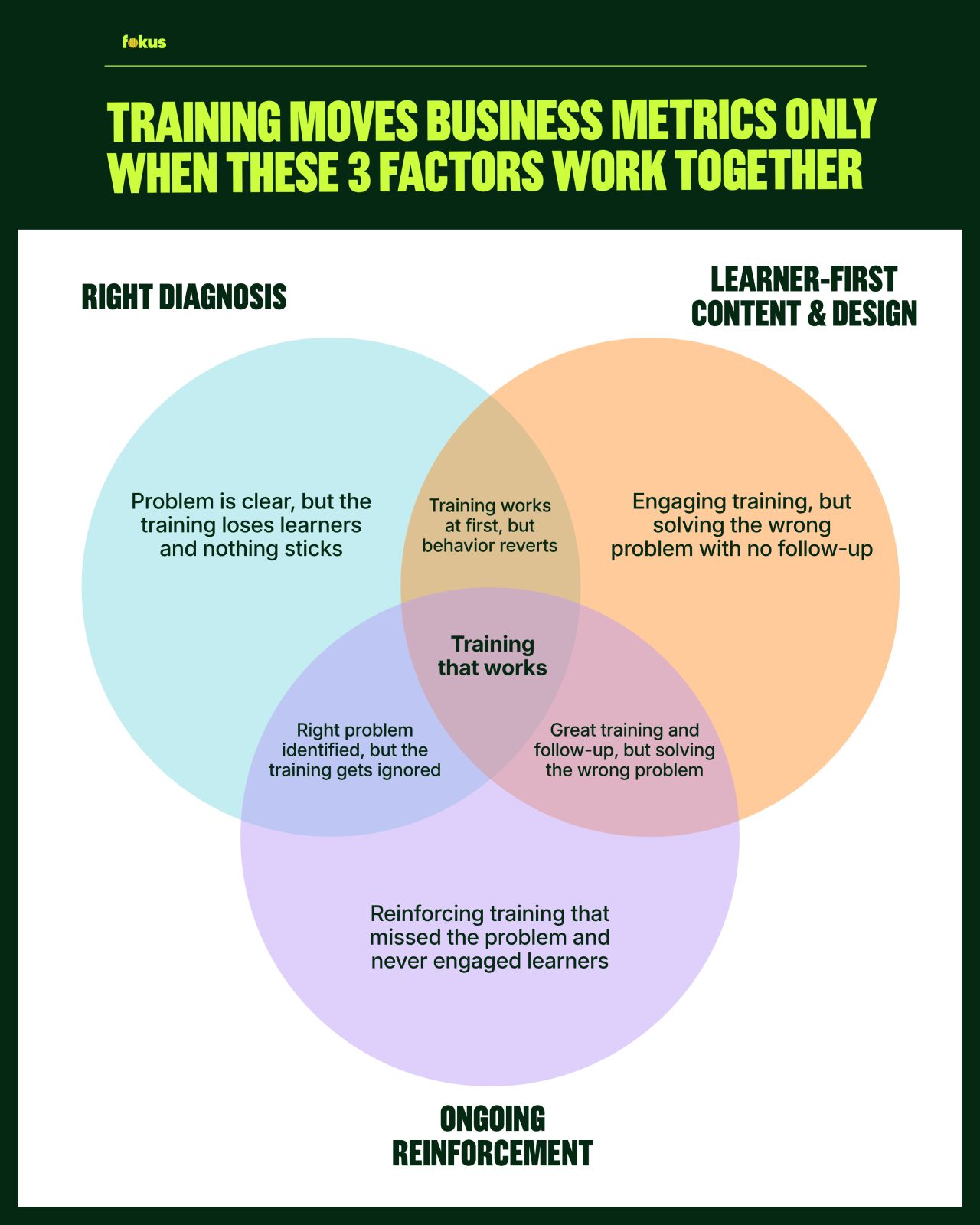
Training moves business metrics only when these three factors work together: 1. Right Diagnosis Most training requests arrive as solutions. "We need a module on the new system." "Build us a refresher on the refund policy." But it’s important to take a step back and question the reasoning behind the request. Because if it’s a system or process issue, no training can solve it. You only waste training budget. And if it is indeed a training problem, then the next thing to understand is if it’s a knowledge gap or a skill gap. Because no amount of knowledge training can fix a skill gap. And vice versa. So the right diagnosis of the problem is the first step to make training work. Signs this factor is missing: - Teams pass every assessment but struggle on live calls - You keep receiving training requests on the same topic - The same performance problems keep coming back 2. Learner-first Content and Design Content should focus on the learner’s job, not the source material or SME decks. That means building content around the tasks learners perform, prioritized by frequency, complexity, and business risk. And of course, delivering it with a design that manages cognitive load and helps learners retain what they learn. Signs this factor is missing: - Learners complete the training but can't apply it when it matters - Training looks like internal documentation with a next button - Learners complain the training is not relevant to their actual job 3. Ongoing Reinforcement A single module can only do so much. What changes behavior is what happens in the weeks after. Like ongoing practice, coaching, and manager check-ins. Because without a reinforcement plan, even well-designed training fades. Learners go back to doing things the way they did before. Signs this factor is missing: - Performance improves right after training, then reverts within weeks - Managers have no resources to reinforce what’s taught in training - There is no plan for what happens after a training module ships - If you had to pick one that most training programs skip, which would it be?
- LINKEDIN · IMAGERecorded 19 Sept 2026
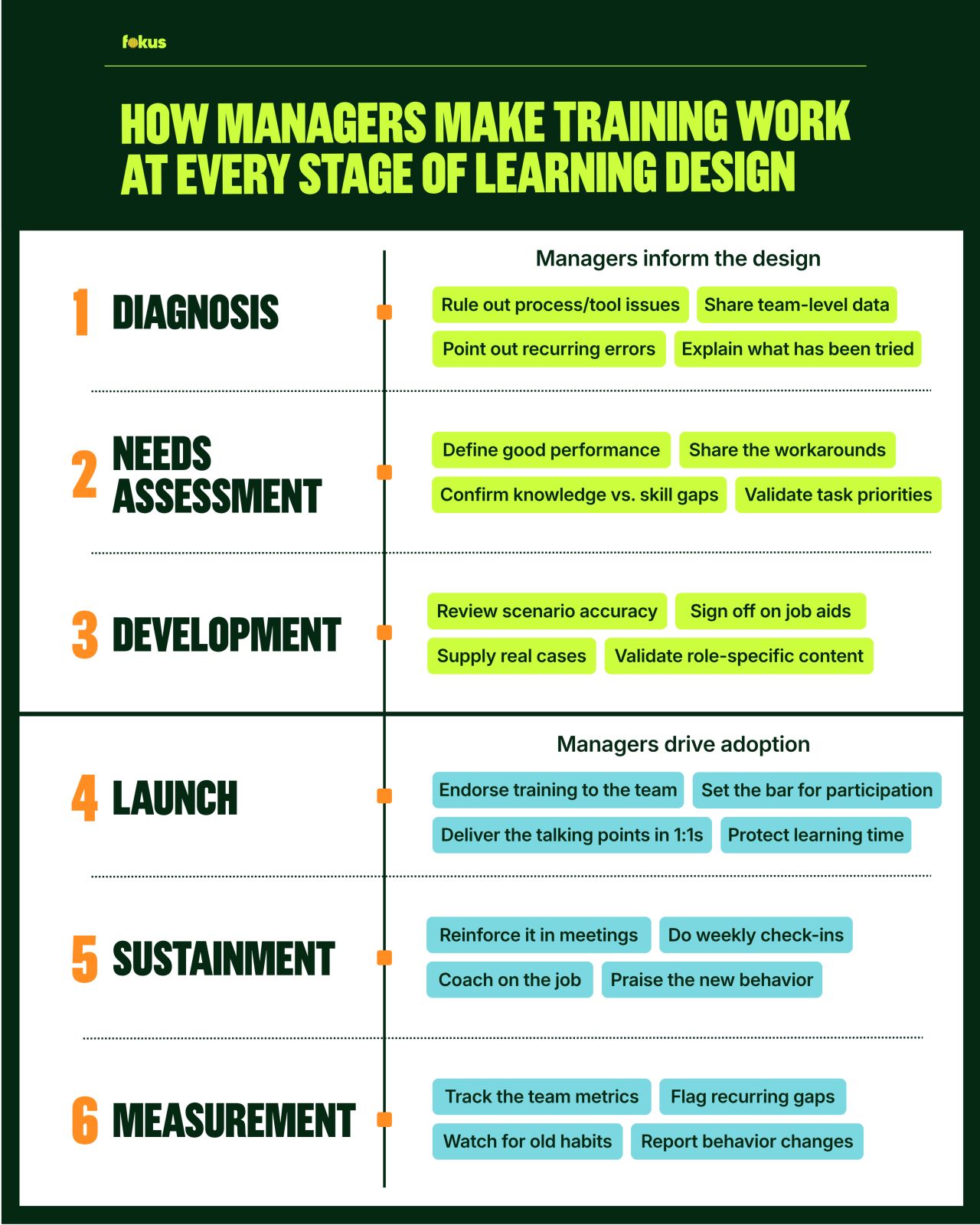
Managers are the most underused resource to make training work. I say underused because… Most L&D teams only involve them for some development feedback and launch week. But in my experience, involving them deeply at each stage drastically increases the chances of training’s success. There are a few reasons behind this: - Managers know their team members, their skills, and struggles the best - They can track and influence learners’ behavior every day - They are measured on the same metrics the training is meant to move That's why we build manager involvement into every program in a structured way. During design, we include them at every stage. After the launch, we give them talking points, coaching prompts, and check-in guides to keep training alive. I mapped the main actions at each stage below. What's the best way you've found to include managers during learning design?
- LINKEDIN · IMAGERecorded 19 Sept 2026
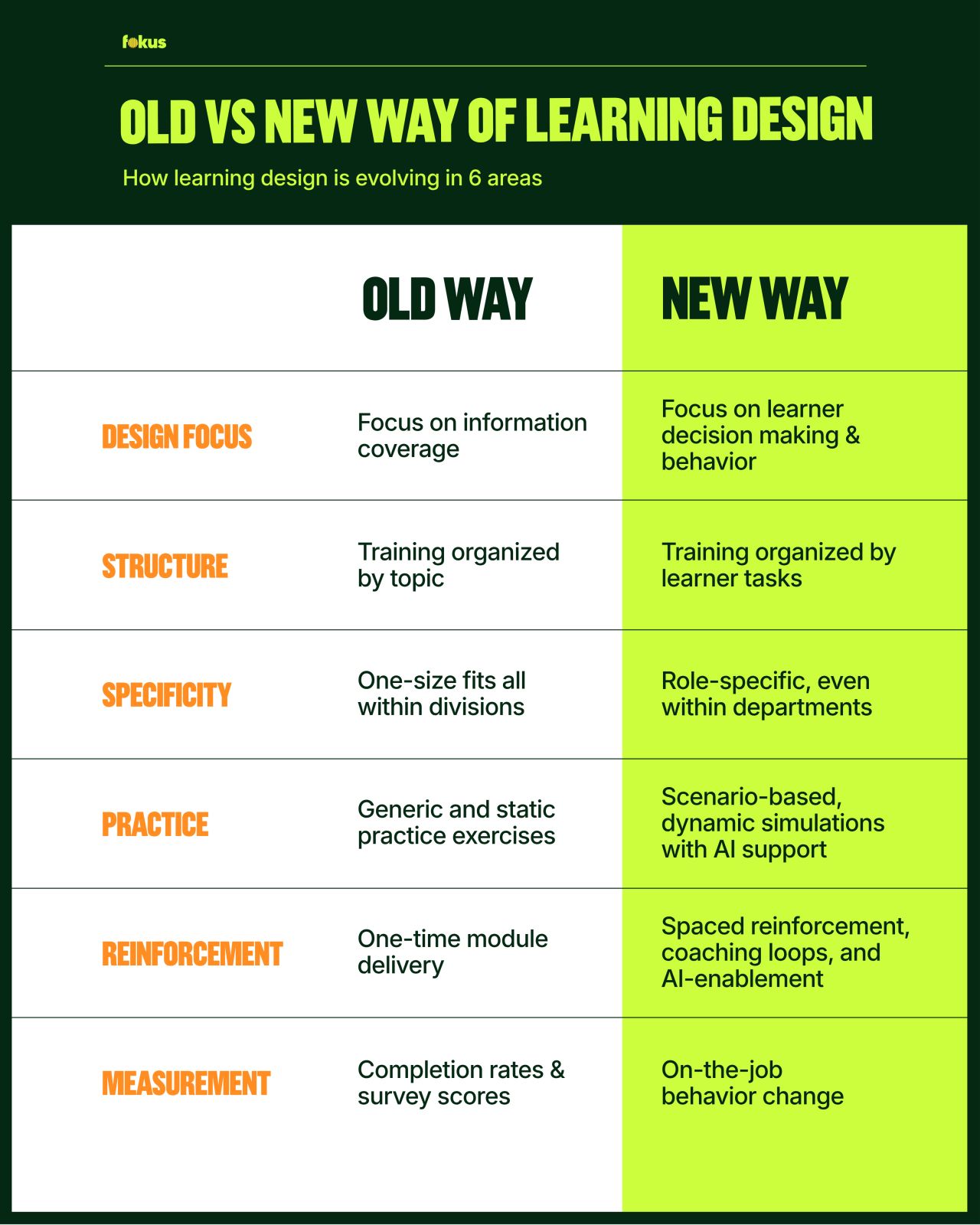
Everyone agrees the old learning design approach is broken. But what should the new one look like? Based on what I’m seeing, learning design is evolving in 6 areas: 1. Design focus In the old way, everything started with the source material. The focus was covering all the information. But now, content comes last. Learning design starts with the learner’s job, decisions, and behavior. 2. Structure As content came first before, training programs were organized by topic. Like “communication skills” or “account management.” But more and more organizations are organizing modules by the learners’ workflows now. So both learners and managers know which training program helps with which tasks. 3. Specificity Companies loved one-size-fits-all training before. It was seen as cost-effective. Build one training, use it for a whole division. But both companies and learning designers realized this is not effective. So the training is now designed to be as specific as possible to the role. 4. Practice Practice exercises used to be generic and disconnected from the actual job. Answer a multiple-choice quiz. Or watch a video and click "next." The new approach uses scenario-based simulations. AI also makes simulations more realistic, even simulating challenging customer interactions using voice. So learners practice the situations they will encounter and prepare in a safe environment. 5. Reinforcement Learning reinforcement was almost non-existent before. Training finished when the module was done. But today, we know what happens after a learner finishes a module is where training lives or dies. So sustaining learning is a core factor in every training design. 6. Measurement The old L&D approach over-focused on completion rates and satisfaction scores from learners. Today what matters is on-the-job behavior change. This also helps position L&D as a core driver of business results within companies, rather than a mere support function. -- Curious to hear from you. What changes do you see in learning design besides these?
- LINKEDIN · IMAGERecorded 19 Sept 2026
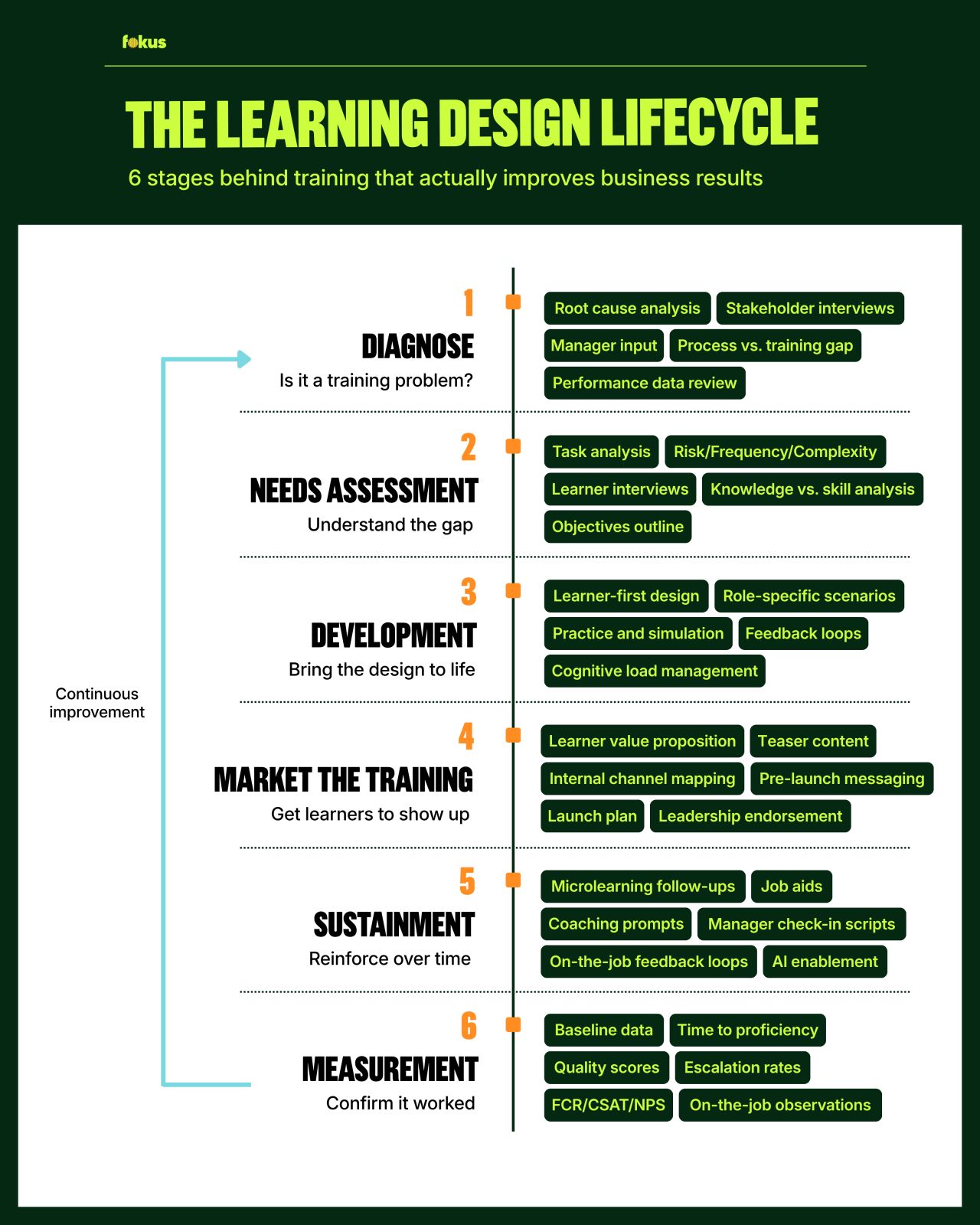
Most L&D departments over-focus on the launch of training. But what happens long before and long after it determines whether the training works. Before you build anything, you have to figure out whether training is even the right solution. Then separate knowledge gaps from skill gaps. Then build it around the scenarios learners actually face on the job. And after the launch, the behavior has to stay alive. Because without reinforcement, even good training fades within weeks. Skip the before work, and you're building training that might not solve the actual problem. Skip the after work, and you see good completion rates while business metrics stay flat. That's six stages of work. Most training programs skip two or three of them. We mapped the learning design lifecycle below. What would you add to your next training from here?
- LINKEDIN · IMAGERecorded 19 Sept 2026
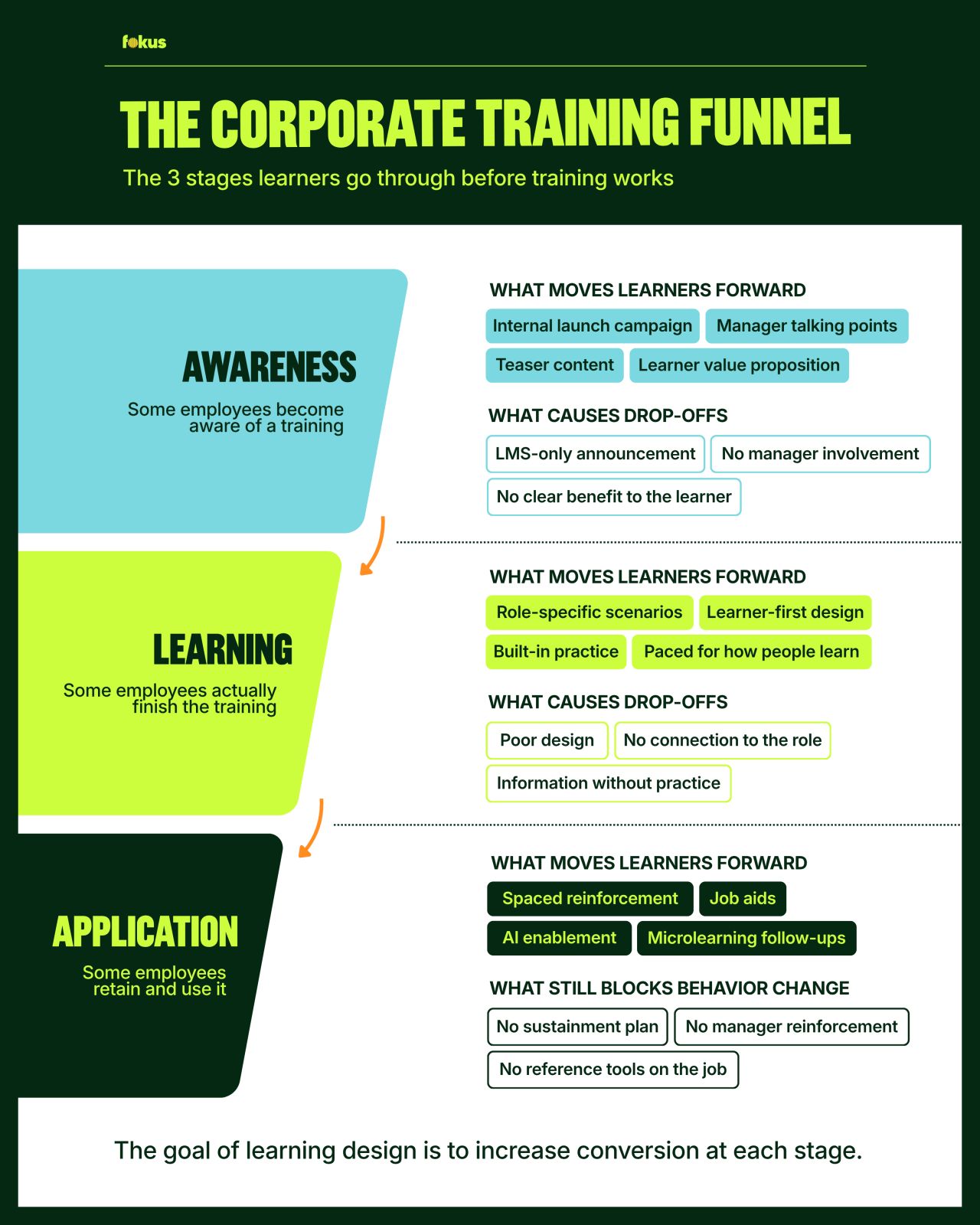
It took me years to realize my job as a learning designer is conversion. Getting more learners from one stage to the next. If you run L&D at a large company, you'll recognize this. Learners drop off at every stage of a training program. Some never hear about it. Others finish the module but never use it on a live call. By the time you reach behavior change, the group has narrowed at every step. So training works like a funnel. And for a long time, I focused all my energy on one stage of it: building the best possible training. But a well-designed program can't fix the fact that nobody knew it existed. And it can't survive three weeks of silence after launch. So now when I work with L&D teams, we design for three stages. Before the training, during it, and after it. Each stage has different leaks, and each one needs different design decisions. And the goal is to increase conversion at every stage.
- Text-only"Our customer-facing teams are underperforming. We need new training.” But training can't fix performance problems caused by: - User experience of internal systems - Hiring wrong-fit people for the role - Misaligned incentives - Broken processes - Personal issues - Lack of tools That being said, training can definitely fix the performance problems caused by: - Reps not following a process - Reps not knowing a new policy or feature - Reps having the knowledge but not being able to execute under pressure - New hire ramp-up taking too long - Low adoption of an internal tool - Reps giving different answers to the same customer questions - Reps not knowing what to do when customer interactions go off-track That’s why it’s crucial to diagnose the problem before defaulting to new training. And I say this as a learning designer. Because I've seen teams coming to us after spending months building a training program, hitting 90% completion, and seeing no change. Only for us to find out the problem was somewhere else. So yes, training is a powerful tool. But only when the problem is a training problem.LINKEDIN · TEXT-ONLYRecorded 19 Sept 2026
6 of 20 adsSign up to see every Fokus Learning Design ad, filter by format and date, and get alerts on new ones.
See all 20 adsWatch the companies you care about.
Filter every ad by industry, country, format and network, and get alerts when a company you watch starts running new ads.