On air · 1 of 3 networks
Earth Insight
- earth-insight.org
- US
- 13 employees
Earth Insight’s ads on LinkedIn, Meta and Google, recorded by adsrunning. Browse the latest here for free. Sign up free to see all 101. Watch Earth Insight with Starter to get each new one in your feed.
Watchlist with Starter · $49/mo
| Network | Status | Live ads | Nov 2025LinkedIn activity · 52 weeksNov 2026 | Checked | Next step |
|---|---|---|---|---|---|
| Running | 98 | Checked 30 Oct 2026 | See all 101 ads → | ||
| Meta | None recorded | 0 | No active ads recorded on the Meta Ad Library | Checked 19 Oct 2026 | Collect them with the API → |
| None recorded | 0 | No ads found on the Google Ads Transparency Center | Checked 27 Oct 2026 | Collect them with the API → |
Earth Insight has 98 live LinkedIn ads. Its Facebook page had no active ads on 19 Oct 2026, and we recorded no Google ads on 27 Oct 2026.
Latest ads
- LINKEDIN · VIDEOSince 28 Oct 2026
Target 3 of the Global Biodiversity Framework (GBF), often referred to as "30x30", calls on countries to effectively conserve at least 30% of the world's land, water, and sea by 2030, especially areas of particular importance for biodiversity. Achieving 30x30 requires not only expanding protected and conserved area coverage, but ensuring that these areas deliver meaningful conservation outcomes. "High integrity 30x30 implementation" requires conservation that is effective, equitable, and durable; prioritizes areas of particular importance for biodiversity; maintains ecological integrity and connectivity; upholds the rights, governance and contributions of Indigenous Peoples and local communities; and safeguards these areas from extractive and other large-scale industrial activities incompatible with biodiversity conservation. There are three key interrelated challenges for high-integrity 30x30 implementation. First, extractive concessions and large-scale industrial activities are undermining the ecological outcomes of protected and conserved areas counted toward 30x30 progress. Second, Indigenous territories and community-managed lands, among the most biodiverse and intact landscapes on Earth, face escalating industrial pressures despite their critical contributions to biodiversity conservation. Third, many areas of highest biodiversity importance, including Key Biodiversity Areas, high-integrity ecosystems, and intact landscapes and seascapes, remain outside effective protection, revealing a critical quality gap in quantitative conservation targets. However, these threats to conservation are not inevitable. There are at least three complementary pathways that may help Parties strengthen the integrity of 30x30 implementation. First, strong legal standards and enforcement of exclusion zones that prohibit large-scale industrial activities within protected and conserved areas are essential for safeguarding ecological integrity and ensuring that protected areas deliver meaningful biodiversity outcomes. Second, rights-based conservation approaches that recognize Indigenous Peoples' and local communities' tenure, governance, and stewardship consistently produce more durable, equitable, and effective conservation outcomes than state-led protection alone. Third, achieving the ambition of high-integrity 30x30 requires transformative policy alignment, including conservation finance, cross-sector governance, and political commitment that addresses the underlying drivers of biodiversity loss rather than relying on incremental conservation measures alone. 30x30 is an unprecedented opportunity— but its success will not be determined by hectares alone. High-integrity 30x30 implementation requires protecting the right places, protecting them effectively, respecting the people who steward them, and addressing the economic and industrial pressures that threaten them. Video Narration: Kevin Patel #30x30 #COP17Armenia #BiodiversityAction
- LINKEDIN · VIDEOSince 28 Oct 2026
Target 3 of the Global Biodiversity Framework (GBF), often referred to as "30x30", calls on countries to effectively conserve at least 30% of the world's land, water, and sea by 2030, especially areas of particular importance for biodiversity. Achieving 30x30 requires not only expanding protected and conserved area coverage, but ensuring that these areas deliver meaningful conservation outcomes. "High integrity 30x30 implementation" requires conservation that is effective, equitable, and durable; prioritizes areas of particular importance for biodiversity; maintains ecological integrity and connectivity; upholds the rights, governance and contributions of Indigenous Peoples and local communities; and safeguards these areas from extractive and other large-scale industrial activities incompatible with biodiversity conservation. Formal designation as a protected or conserved area does not by itself ensure protection from incompatible industrial activities. Legal and policy frameworks may continue to permit such activities, or existing protections may be inadequately implemented or enforced. High-integrity 30x30 implementation therefore requires both clear restrictions on incompatible activities and effective enforcement of protections already in place. The growing use of legal and policy measures focused on addressing these issues can help by restricting fossil fuel extraction in areas designated for conservation, through enforceable rules that define where new development will not be permitted and how existing rights and concessions will be addressed to avoid undermining ecological outcomes. For example, in December 2025, the Ghanaian government officially revoked a regulation that permitted mining in Forest Reserves, including in forests of critical importance to biodiversity. This important announcement means that mining concessions can no longer be given out in Ghana's protected forests, which cover over nine million hectares. Political decisions and legal instruments such as these can provide mechanisms for addressing conflicts between protected-area objectives and industrial development agendas. Strict exclusion zones are critical for all extractive and large-scale industrial activities in areas of particular importance for biodiversity, and especially important for fossil fuels while supporting a broader transition away from fossil fuels. An IISD analysis released in 2026 found a steady increase in fossil fuel production restrictions since the 1970s, with a sharp acceleration since the 2010s. This growing momentum presents an important opportunity for high-integrity 30x30 implementation: removing or retiring fossil fuel concessions and blocks that overlap with areas of high biodiversity importance. Preventing new fossil fuel development and retiring incompatible blocks and concessions can help ensure that conservation designations secure lasting ecological protection. Video Narration: Kevin Patel #30x30 #COP17Armenia #BiodiversityAction
- LINKEDIN · IMAGESince 20 Nov 2025
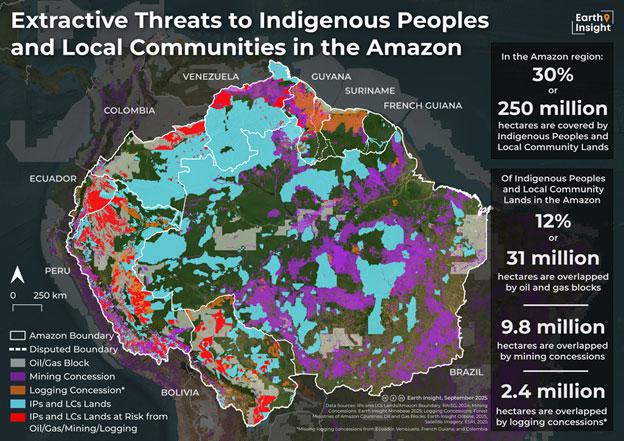
🌍 The world’s forests cannot wait. In this op-ed in IPS Inter Press Service (IPS), Juan Jintiach Global Alliance of Territorial Communities (GATC) and Florencia Librizzi, Esq., Earth Insight highlight why Indigenous and local leadership is central to achieving climate and biodiversity goals. 👉 Read the op-ed: https://lnkd.in/draRc7bF 📄 See the full report: https://lnkd.in/g2CZZ6F7 Key Takeaways: 🌳 Urgent and measurable threats: Amazon: 31 M ha of Indigenous lands overlap oil and gas blocks; 9.8 M ha threatened by mining. Congo: 38% of community forests and carbon-rich peatlands (~30 B tons of carbon) at risk. Indonesia & Mesoamerica: Indigenous lands face widespread timber, mining, and extraction pressures. 💡 Indigenous stewardship: GATC communities steward at least 958 M ha across 24 tropical forest countries. They’re not just protecting forests, they’re providing critical solutions for climate, biodiversity, and local livelihoods. 🌍 COP30 and beyond: World leaders must move beyond symbolic recognition to concrete action. The Brazzaville Declaration (https://lnkd.in/deJwUkJF) provides the roadmap: securing land rights, guaranteeing FPIC, ensuring direct financing, protecting defenders’ lives, and integrating traditional knowledge into global policies. 🌱 Protecting forests means centering the people who have sustained them for generations. #IndigenousRights #GATC #COP30 #ClimateJustice #ForestStewardship #Biodiversity #EarthInsight
- LINKEDIN · VIDEORecorded 30 Oct 2026
Target 3 of the Global Biodiversity Framework (GBF), often referred to as "30x30", calls on countries to effectively conserve at least 30% of the world's land, water, and sea by 2030, especially areas of particular importance for biodiversity. Achieving 30x30 requires not only expanding protected and conserved area coverage, but ensuring that these areas deliver meaningful conservation outcomes. "High integrity 30x30 implementation" requires conservation that is effective, equitable, and durable; prioritizes areas of particular importance for biodiversity; maintains ecological integrity and connectivity; upholds the rights, governance and contributions of Indigenous Peoples and local communities; and safeguards these areas from extractive and other large-scale industrial activities incompatible with biodiversity conservation. Formal designation as a protected or conserved area does not by itself ensure protection from incompatible industrial activities. Legal and policy frameworks may continue to permit such activities, or existing protections may be inadequately implemented or enforced. High-integrity 30x30 implementation therefore requires both clear restrictions on incompatible activities and effective enforcement of protections already in place. Geographical exclusions are often understood as an upstream application of the mitigation hierarchy, giving effect to its first and preferred step: avoidance. In areas where industrial development would be incompatible with conservation objectives, avoidance requires preventing development altogether where it is likely to have negative impacts on protected and conserved areas and particularly sensitive areas of biodiversity importance, rather than relying on subsequent minimization, restoration or offsetting. Such measures are also important for ensuring that conservation does not reproduce or exacerbate existing inequities. Indigenous peoples and local communities often bear disproportionate social, cultural, and economic costs when extractive activities are permitted in or around areas they govern, depend upon, or hold customary rights to. Establishing clear exclusion zones, while respecting Indigenous peoples' territorial sovereignty, tenure, governance systems, and free, prior and informed consent, can help prevent conservation areas from becoming sites of continued industrial pressure. While each jurisdiction is unique and approaches will vary according to specific legal and political contexts, these developments point to a policy opportunity for high-integrity 30x30 implementation: using conservation targets as a catalyst for resolving longstanding conflicts between biodiversity protection and industrial development, and taking steps toward implementing enforceable exclusion zones for activities incompatible with biodiversity conservation and protecting the rights and interests of the people who steward these areas. Video Narration: Kevin Patel #30x30 #COP17Armenia #BiodiversityAction
- LINKEDIN · VIDEORecorded 30 Oct 2026
Target 3 of the Global Biodiversity Framework (GBF), often referred to as "30x30", calls on countries to effectively conserve at least 30% of the world's land, water, and sea by 2030, especially areas of particular importance for biodiversity. Achieving 30x30 requires not only expanding protected and conserved area coverage, but ensuring that these areas deliver meaningful conservation outcomes. "High integrity 30x30 implementation" requires conservation that is effective, equitable, and durable; prioritizes areas of particular importance for biodiversity; maintains ecological integrity and connectivity; upholds the rights, governance and contributions of Indigenous Peoples and local communities; and safeguards these areas from extractive and other large-scale industrial activities incompatible with biodiversity conservation. Strong legal standards and enforcement of extractive exclusion policies that prohibit large-scale industrial activities within protected and conserved areas are essential for safeguarding ecological integrity and ensuring that protected areas deliver meaningful biodiversity outcomes. For example, in pursuit of the CBD's Aichi Targets, the predecessor to the GBF, Canada rapidly developed efforts to expand its marine conservation network to meet its international conservation commitments. However, the rapid designation of marine protected areas (MPAs) without meaningful protection and enforcement measures does not guarantee meaningful conservation outcomes. In response to strong public opposition, Canada introduced the Marine Protected Area Protection Standard in 2019 establishing minimum conservation requirements for newly designated federal MPAs. The Standard prohibits four especially damaging industrial activities in MPAs: oil and gas exploration and extraction, mining, dumping, and bottom trawling. By creating legally defined "no-go zones” for activities fundamentally incompatible with biodiversity conservation, the policy represented an important shift from measuring conservation success by area alone toward ensuring that protected areas deliver meaningful ecological outcomes. Canada's experience speaks to the need for strong, enforceable minimum protection standards, including restrictions on fossil fuel development within conservation areas. At the same time, minimum standards alone do not ensure high-integrity 30x30 implementation. As of 2026, many older Canadian MPAs remain governed by management frameworks developed before the Standard, resulting in uneven levels of protection. Even in the presence of strong standards, effective management, monitoring, enforcement, ecological representation, climate resilience, and meaningful Indigenous participation remain essential components of long-term conservation outcomes. Video Narration: Kevin Patel #30x30 #COP17Armenia #BiodiversityAction
- LINKEDIN · VIDEORecorded 28 Oct 2026
Target 3 of the Global Biodiversity Framework (GBF), often referred to as "30x30", calls on countries to effectively conserve at least 30% of the world’s land, water, and sea by 2030, especially areas of particular importance for biodiversity. Achieving 30x30 requires not only expanding protected and conserved area coverage, but ensuring that these areas deliver meaningful conservation outcomes. "High integrity 30x30 implementation" requires conservation that is effective, equitable, and durable; prioritizes areas of particular importance for biodiversity; maintains ecological integrity and connectivity; upholds the rights, governance and contributions of Indigenous Peoples and local communities; and safeguards these areas from extractive and other large-scale industrial activities incompatible with biodiversity conservation. Progress toward Target 3 should be assessed not only by the percentage of land and ocean counted as protected or conserved, but by whether those areas are actually delivering biodiversity outcomes. Governments should prioritize ecological integrity, connectivity, representativeness, effectiveness, equitable governance, and durability of conservation areas, while assessing and addressing the industrial pressures that may undermine their conservation objectives. The 30% target should be understood as a global minimum rather than an ecological ceiling: where maintaining biodiversity, connectivity, ecosystem functions, or avoiding tipping points require levels of conservation, ambition should respond to ecological needs. Governments should also establish clear, enforceable minimum protection standards that prevent new extractive and large-scale industrial activities in protected and conserved areas, prioritising avoidance within the mitigation hierarchy. Existing concessions and industrial activities that overlap with these areas should be reviewed and, where they will negatively impact ecosystem integrity, be retired, withdrawn, redesigned, or phased out. Stronger exclusion measures should also be considered for ecosystems of exceptional biodiversity importance, high ecological integrity, or that are vulnerable to tipping points, where preventing industrial expansion is necessary to maintain ecosystem function. The global commitment to conserve at least 30% of the world’s lands and waters by 2030 represents an unprecedented opportunity to strengthen biodiversity conservation at the scale needed to address the global biodiversity crisis. However, without these safeguards, there is a risk that 30x30 progress will be measured in hectares while biodiversity continues to decline within and beyond areas designated for conservation. Video Narration: Kevin Patel #30x30 #COP17Armenia #BiodiversityAction #ForNature
6 of 101 adsSign up to see every Earth Insight ad, filter by format and date, and get alerts on new ones.
See all 101 adsWatch the companies you care about.
Filter every ad by industry, country, format and network, and get alerts when a company you watch starts running new ads.