Not on air · 2 of 3 networks checked
Converge Bio
- converge-bio.com
- Biotechnology Research
- 59 employees
Converge Bio’s ads on LinkedIn, Meta and Google, recorded by adsrunning. Browse the latest here for free. Sign up free to see all 438. Watch Converge Bio with Starter to get each new one in your feed.
Watchlist with Starter · $49/mo
| Network | Status | Live ads | Nov 2025LinkedIn activity · 52 weeksNov 2026 | Checked | Next step |
|---|---|---|---|---|---|
| None recorded | 0 | Checked 2 Nov 2026 | See all 438 ads → | ||
| Meta | Not checked | — | |||
| Recently | 7 | Ads on the Google Ads Transparency Center | Checked 16 Oct 2026 | Collect them with the API → |
Converge Bio has no live LinkedIn ads. We recorded 7 Google ads on 16 Oct 2026.
Latest ads
- LINKEDIN · IMAGESince 30 Oct 2026
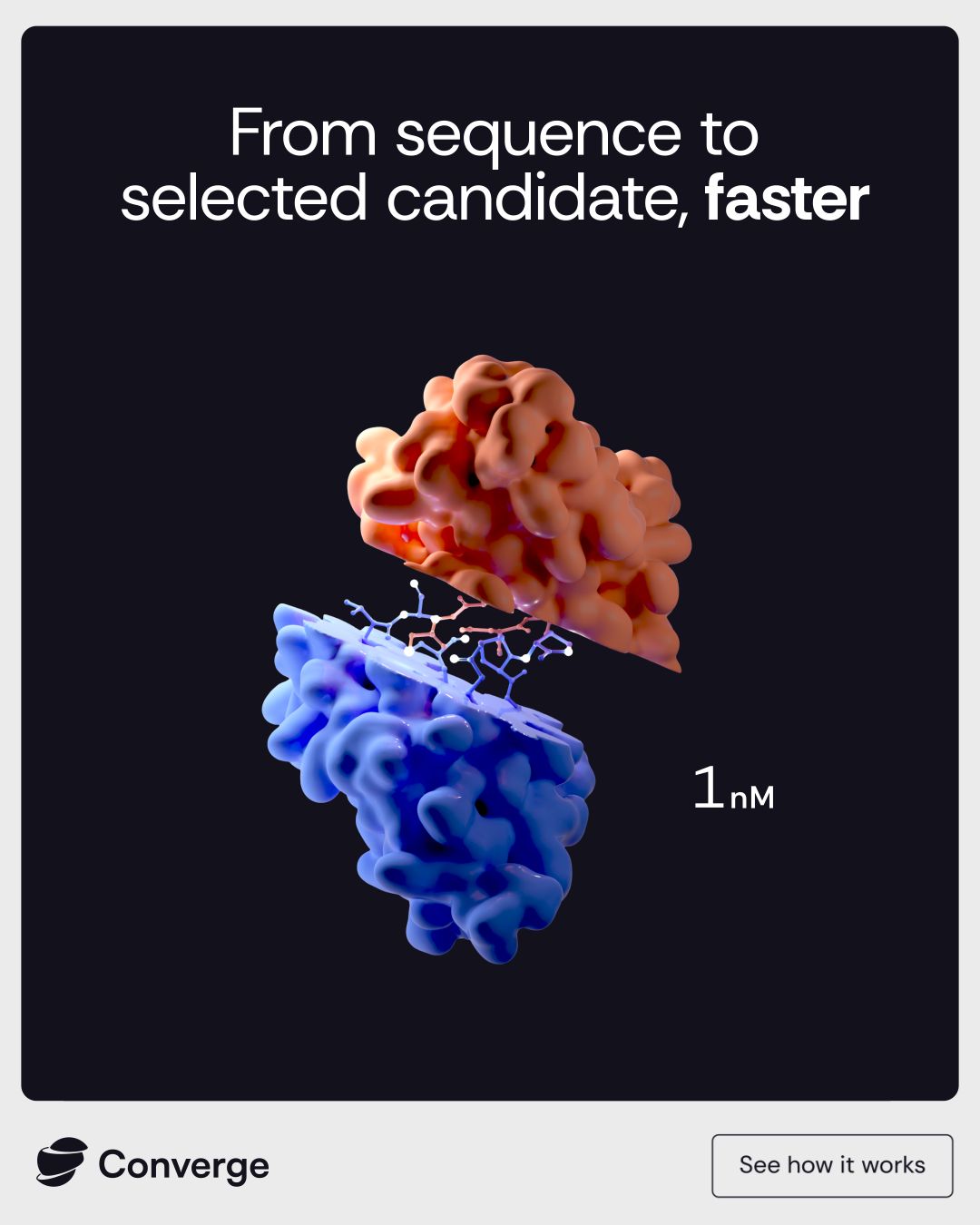
Find better antibody candidates faster - without wasting time on endless screening. Converge helps your team reduce trial-and-error, cut down wet-lab rounds, and accelerate antibody design and optimization. Book a demo →
- LINKEDIN · IMAGESince 30 Oct 2026
Find better antibody candidates faster with Converge’s AI. Reduce wet-lab rounds and accelerate antibody optimization.
- LINKEDIN · VIDEOSince 18 Oct 2026
"If I have seen further, it is by standing on the shoulders of giants." Sir Isaac Newton, 1675 This famous quote captures one of the key aspects of what science is all about: sharing knowledge and building on each other's advancements. If every researcher had to start every scientific project from scratch, science would never progress. When developing a new antibody, there is already a huge amount of prior knowledge that can serve as the starting point for the engineering journey. The question is how to find and make the best use of it. We recently released a tool for antibody designers who are looking for the best possible starting point for a new antibody design project. I'll put the link in the comments below. The tool is based on Converge's massive antibody database and is meant to help the community make the best use of our accumulated knowledge, giving each new project a better starting position from which to advance science. Standing on the shoulders of giants, rather than starting from the ground every time. You can try it here: https://lnkd.in/d_qPREPu
- LINKEDIN · IMAGESince 14 Oct 2026
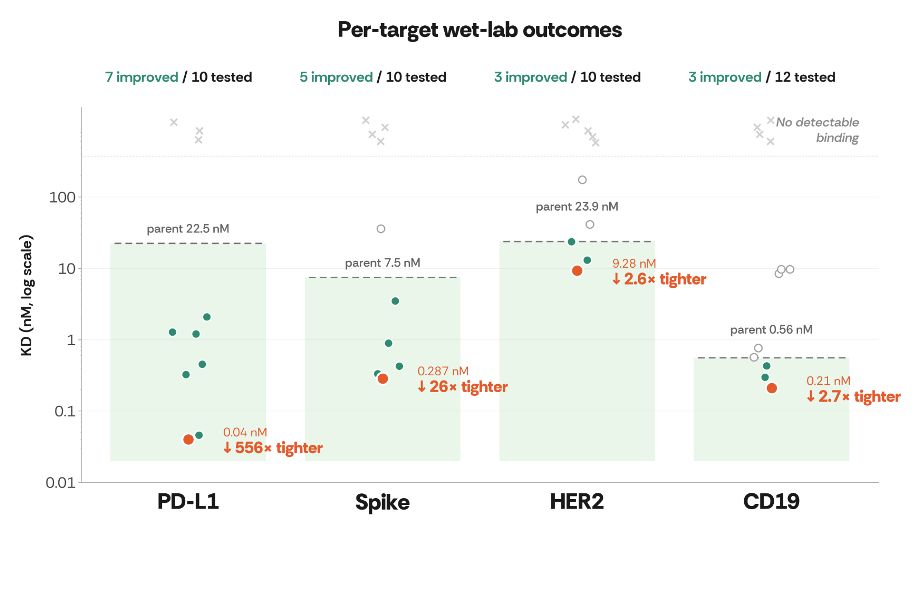
One prompt, four antibody seeds, an eight-hour run, ten variants per seed, four new biobetters. Last month, we reported the creation of a cetuximab biobetter using a single ConvergeAB prompt (link in comments). That result naturally raises a question: does the same approach generalize to other targets? To find out, we designed an antibody optimization campaign to stress-test the platform. We selected four starting antibodies spanning the full optimization continuum: * A discovery-stage PD-L1 binder (22.5 nM) * A validated Spike binder from a relatively young antibody class (7.5 nM) * A HER2 binder from a class with decades of antibody engineering (23.9 nM) * Tafasitamab, an FDA-approved CD19 therapeutic already at sub-nanomolar affinity (0.56 nM) Each represents a different potential failure mode for an antibody foundation model: limited affinity headroom, sparse historical data, or overfitting to specific antigens. The experimental design was simple: For each seed antibody, ConvergeAB was prompted with the antibody sequence and its matching antigen sequence. The run takes approximately eight hours. The result is a ranked list of candidates. For each seed we selected the top ten variants (twelve for CD19, because we had some extra room in the plate..) without additional curation, and sent them directly for experimental validation. In the lab, the variants and their parent antibodies were expressed and purified side-by-side. Binding affinity was measured by SPR, and biophysical properties were evaluated across the panel. Results We identified a higher-affinity binder in every campaign: *PD-L1: 22.5 nM → 0.04 nM (556× improvement in KD, 6 edits) Spike: 7.5 nM → 0.29 nM (26×, 9 edits) HER2: 23.9 nM → 9.28 nM (2.6×, 6 edits) CD19 (tafasitamab): 0.56 nM → 0.21 nM (2.7×, 10 edits) Additional highlights: *Every target produced multiple variants that outperformed the parent antibody (see figure below). *For all four campaigns, the lead variant matched or improved upon the developability profile of the starting antibody (see full case study). *The sequence edits were not random. Our model was at libert to edit any position in the antibody, and yet roughly one-third of the mutations in the best-performing variants occurred in Vernier-zone residues, the framework positions that shape and orient CDR loops, representing approximately a 5-fold enrichment over chance (see full case study). The full case study, including methods, sequences, number of failures, and additional analysis is available on our website (link in comments). Talk to me if you'd like to evaluate ConvergeAB on your own antibody optimization challenge (one prompt, an eight-hour run, and ten variants to test in the lab). See Converge in action: https://lnkd.in/duEJcH6D
- LINKEDIN · VIDEOSince 14 Oct 2026
What if you could find every known antibody against your target in seconds? For the past two years, we've been collecting, extracting, and annotating every antibody sequence we could get our hands on to train our AI models at Converge Bio. In the process, we've built what we believe is the largest structured database of antibody data in the world. Today, were excited to open up this resource to the broader scientific community with the launch of a new research tool designed to help scientists explore the existing antibody landscape and research their therapeutic programs in unprecedented depth. We are calling the tool "Find a Lead". Simply enter your target, and Find a Lead identifies and ranks the antibodies in our database, generating a comprehensive report on each candidate across seven key categories: 1. Affinity and potency measurements: Experimentally measured affinity (KD), EC50, and IC50. 2. Intellectual Property: Patent status, ownership, and estimated expiration dates. 3. Sequence: VH/VL amino acid sequences, CDR annotations, and antibody format. 4. Clinical & Preclinical Maturity: Clinical development stage, in vivo efficacy, and pharmacokinetic data. 5. Developability: Biophysical properties and predicted sequence liabilities. 6. Immunogenicity: Humanness scores and predicted T-cell epitopes. 7. Cross-reactivity: Experimental cross-species binding data. Our goal is simple: make the collective knowledge of antibody discovery more accessible, so scientists can spend less time searching for existing molecules and more time designing better ones. Were opening up Find a Lead with 5 free target searches per user. If you're working in antibody discovery or development, Id love for you to try it out and share your feedback! Try it here (best on desktop): https://lnkd.in/gnyB_ywg
- LINKEDIN · IMAGESince 14 Oct 2026
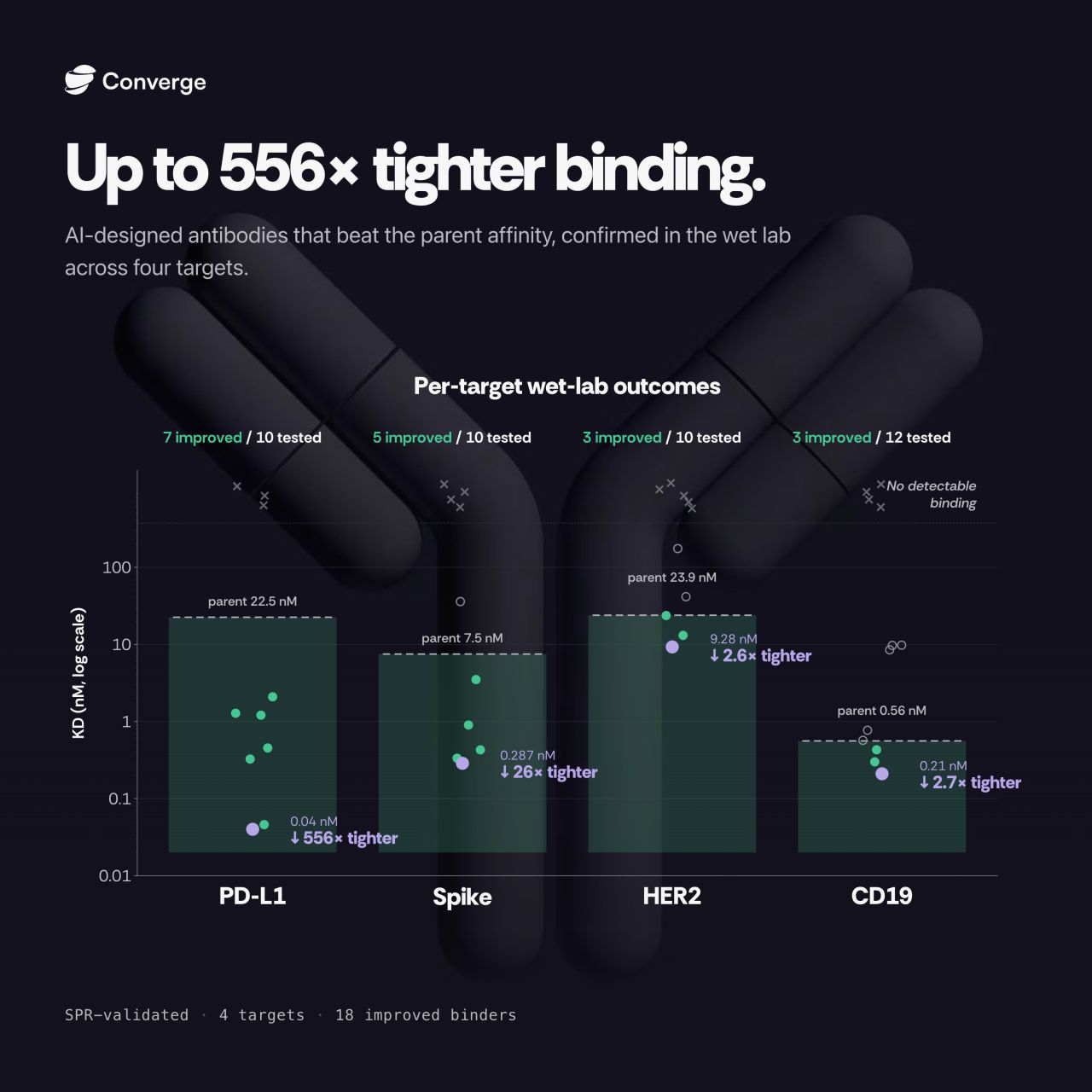
Excited to share excellent lab results from our latest experiment with #ConvergeAB, our antibody optimization foundation model. Our goal: optimize antibody affinity across four distinct targets in a single design round. Results: 556× affinity gain for PD-L1 (22 nM → 40 pM) 26× affinity gain for Covid Spike (7 nM → 287 pM) 2.7× affinity gain for CD19 (560 pM → 210 pM) 2.6× affinity gain for HER2 (24 nM → 9 nM) Developability was improved or maintained across all four targets. Experimental setup: 1. No target-specific fine-tuning of the foundation model 2. ConvergeAB requires only the seed antibody and antigen sequence as a prompt 3. Eight hours of compute following prompt to ConvergeAB 4. Experimental validation performed at Twist Bioscience within four weeks See the full case study with all the data here: https://lnkd.in/ed4fMJG4
6 of 438 adsSign up to see every Converge Bio ad, filter by format and date, and get alerts on new ones.
See all 438 adsWatch the companies you care about.
Filter every ad by industry, country, format and network, and get alerts when a company you watch starts running new ads.