Not on air · 2 of 3 networks checked
Coefficient Giving
- coefficientgiving.org
- Philanthropic Fundraising Services
- US
- 270 employees
Coefficient Giving’s ads on LinkedIn, Meta and Google, recorded by adsrunning. Browse the latest here for free. Sign up free to see all 333. Watch Coefficient Giving on any plan to get each new one in your feed.
Watchlist included in every plan
| Network | Status | Live ads | Nov 2025LinkedIn activity · 52 weeksNov 2026 | Checked | Next step |
|---|---|---|---|---|---|
| None recorded | 0 | Checked 1 Nov 2026 | See all 333 ads → | ||
| Meta | Not checked | — | |||
| None recorded | 0 | No ads found on the Google Ads Transparency Center | Checked 16 Oct 2026 | Collect them with the API → |
Coefficient Giving has no live LinkedIn ads. We recorded no Google ads on 16 Oct 2026.
Latest ads
- LINKEDIN · IMAGESince 21 Jun 2026
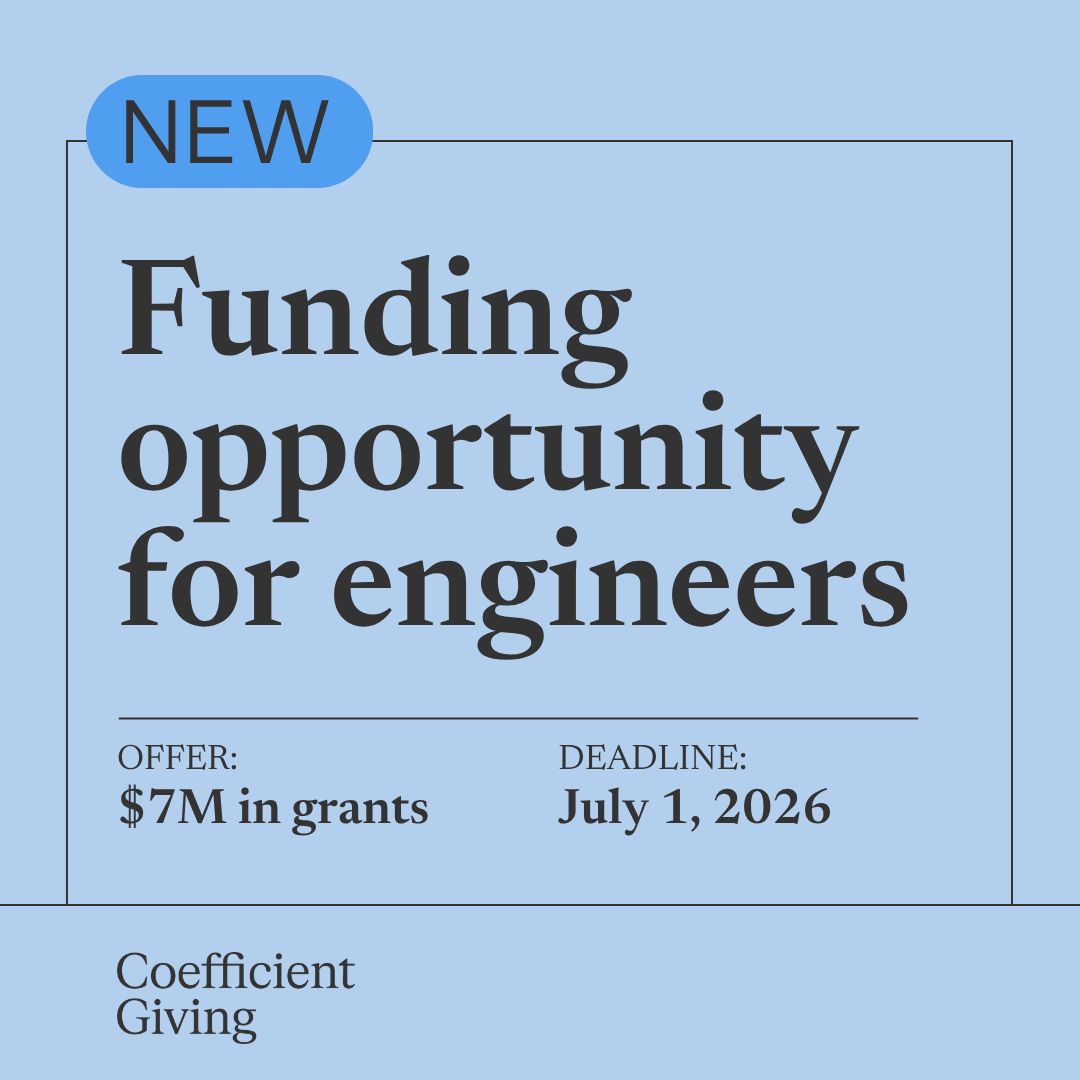
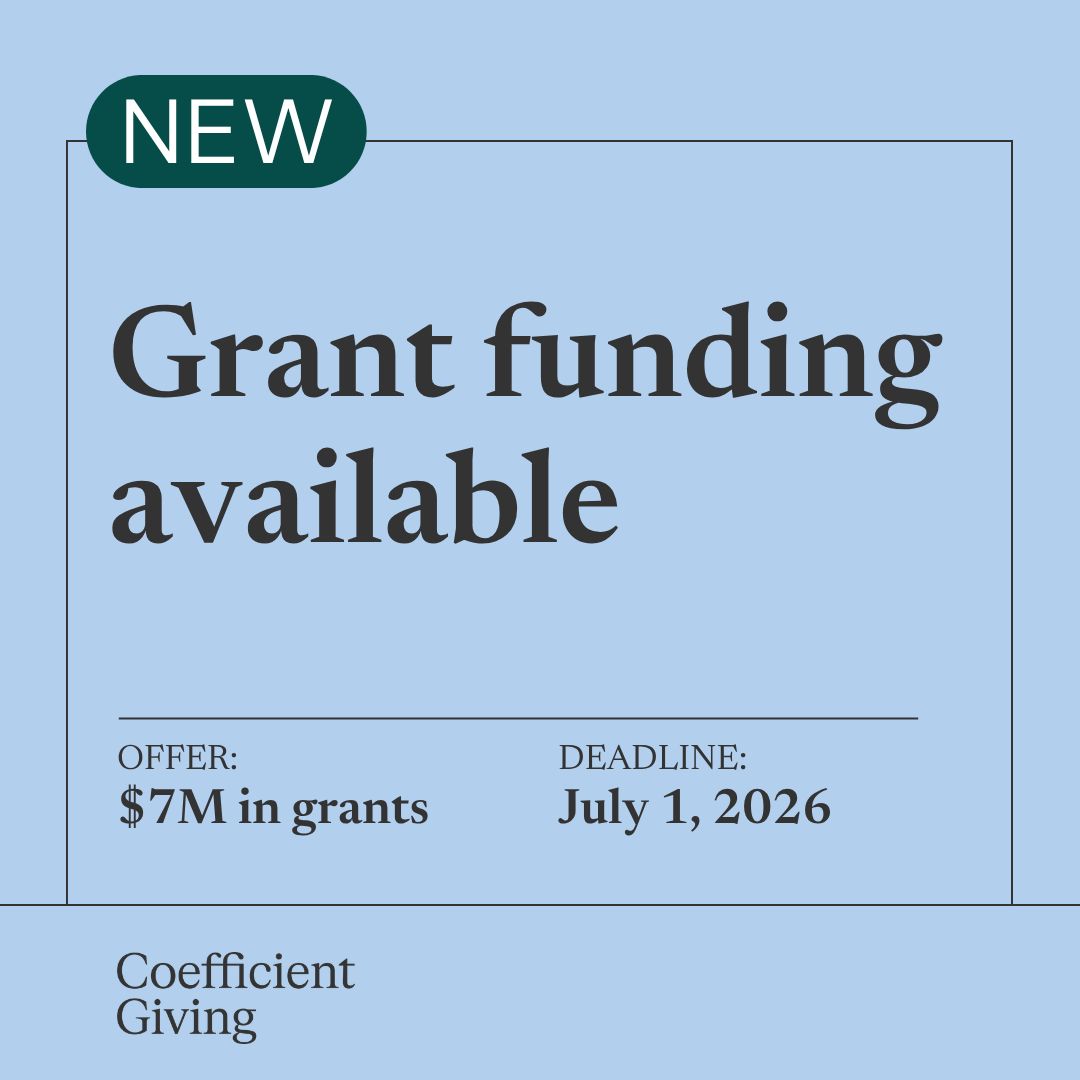
An unsolved engineering problem, $7M in grants, and a July 1 deadline. Here's the case for taking it on. THE PROBLEM Over 100 billion farmed fish are slaughtered each year, and only about 0.5% are reliably stunned first. For the more than a trillion fish caught at sea, no humane method exists at all. - Electrical stunning struggles with variation in fish size, orientation, and water conductivity; mis-stuns and stuns that wear off too early are common. - Percussive systems are built around salmon anatomy and transfer poorly to other species. - Most existing equipment is too power-hungry and bulky for fishing vessels. CONCERNS? "I've never written a research grant." You don't need grant-writing experience. $7M in grants is available. The first step is a short Letter of Intent: a 2,500–3,000 word sketch of your approach, plan, timeline, and budget, not a full proposal. It's scored against a rubric we share in advance. LOIs that meet a minimum quality standard receive a $4,000 honorarium (up to 125 applicants, eligibility restrictions apply). From there, 5–30 applicants are invited to submit a full proposal, due September 30. The LOI deadline is July 1, 2026. "I don't know fish." That's fine. The info package includes everything we consider relevant to the problem, and we're specifically looking for people who can bring outside expertise to it. Many of the most promising approaches will likely come from people new to this problem. "Is this a serious funder?" Coefficient Giving (formerly Open Philanthropy) has funded hundreds of millions of dollars in scientific research since 2014. We expect to spend roughly $7 million on this RFP over the next year, and could spend substantially more depending on application quality. WHO CAN APPLY Individuals, companies of any size (for-profits included), universities, research institutions, and public sector organizations, worldwide. We fund from exploratory research to working prototypes.
- LINKEDIN · IMAGESince 21 Jun 2026
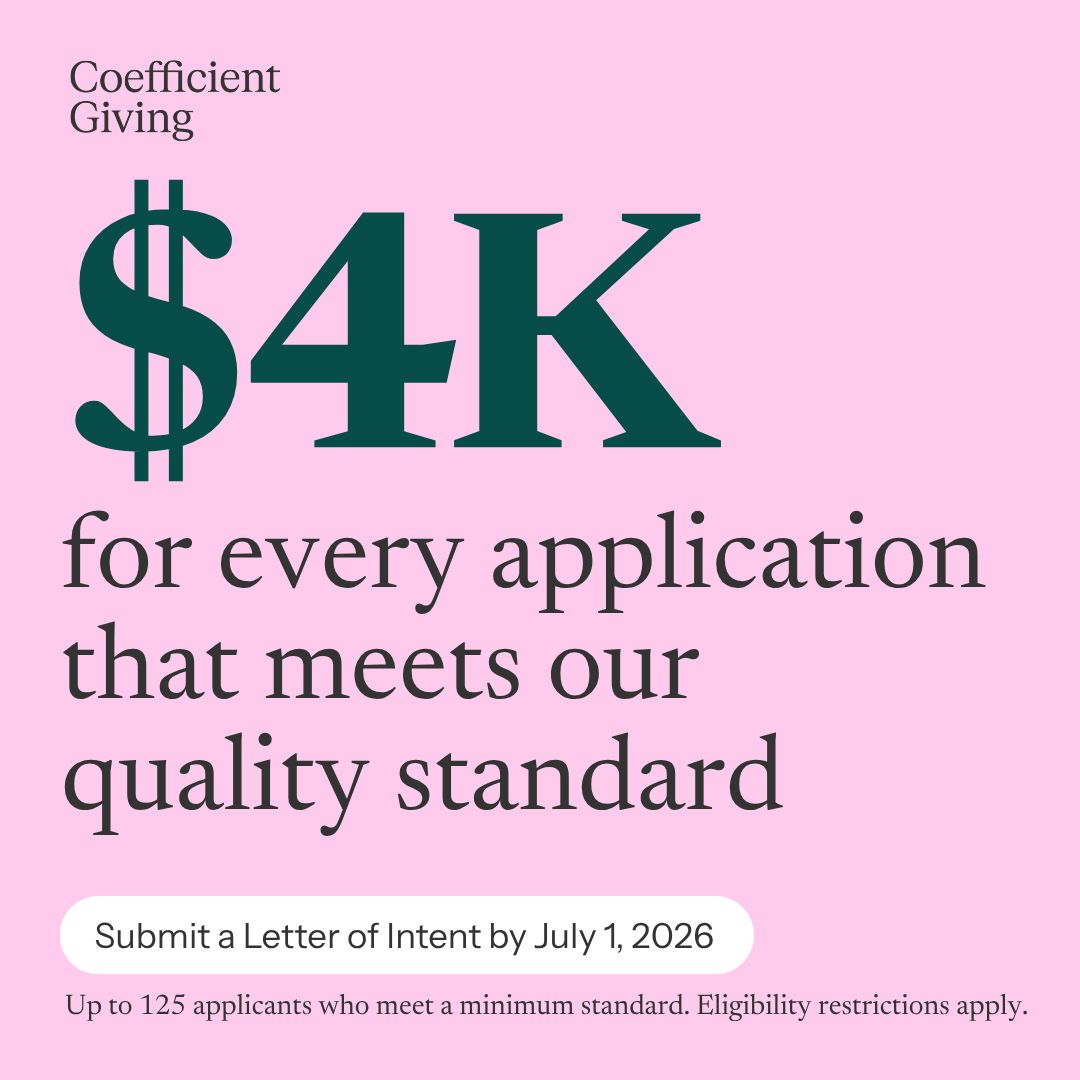
Over 100 billion farmed fish are slaughtered each year, and only about 0.5% are reliably stunned first. For the more than a trillion fish caught at sea, no humane method exists at all. Remarkably few researchers are working on it. Coefficient Giving is offering $7M in grants for new approaches to humane fish slaughter, open across disciplines: engineering, chemistry, biology, anesthesiology, neuroscience, food science, and fields we haven't anticipated. It's not a barrier if you've never worked on fish before. Individuals can apply directly, worldwide; a professorship is not required. $7M in grants is available. The first step is a short Letter of Intent: a 2,500–3,000 word sketch of your approach, plan, timeline, and budget, not a full proposal. It's scored against a rubric we share in advance. LOIs that meet a minimum quality standard receive a $4,000 honorarium (up to 125 applicants, eligibility restrictions apply). From there, 5–30 applicants are invited to submit a full proposal, due September 30. The LOI deadline is July 1, 2026. Leave your details to receive the info package: full RFP, technical context for newcomers, and the evaluation rubric.
- LINKEDIN · IMAGESince 21 Jun 2026
Humane fish slaughter is an unsolved technical problem, and the people most likely to solve it may have never worked on fish. Coefficient Giving (formerly Open Philanthropy), which since 2014 has funded everything from computational protein design to malaria eradication, is committing $7M to new approaches. LOIs close July 1. Below are the reasons you might hold back, and the details that answer them. "This isn't my field." It doesn't need to be. This RFP exists to reach experts working in engineering, chemistry, biology, pharmacology, anesthesiology, neuroscience, food science, and perhaps disciplines we haven't anticipated. Many of the most promising approaches will likely come from people new to the problem. "I don't have time before July 1." The Letter of Intent is 2,500–3,000 words: approach, plan, timeline, budget. A sketch, not a full proposal. The full proposal (due September 30) is only requested from the 5–30 applicants we shortlist, so the heavy lift comes only if we invite it. "Is the effort worth the odds?" LOIs that meet a minimum quality standard receive a $4,000 honorarium whether or not they advance (up to 125 applicants, eligibility restrictions apply). And the evaluation rubric is in the info package, so you can see exactly how LOIs are scored before writing a word. "I'm not a PI." Individuals can apply worldwide, including postdocs and research staff. So can universities, research institutes, and companies. Exploratory studies are fundable. Deadline: July 1, 2026. Submit your details to receive the info package: full RFP, technical context, and the rubric.
- LINKEDIN · IMAGESince 20 Jun 2026
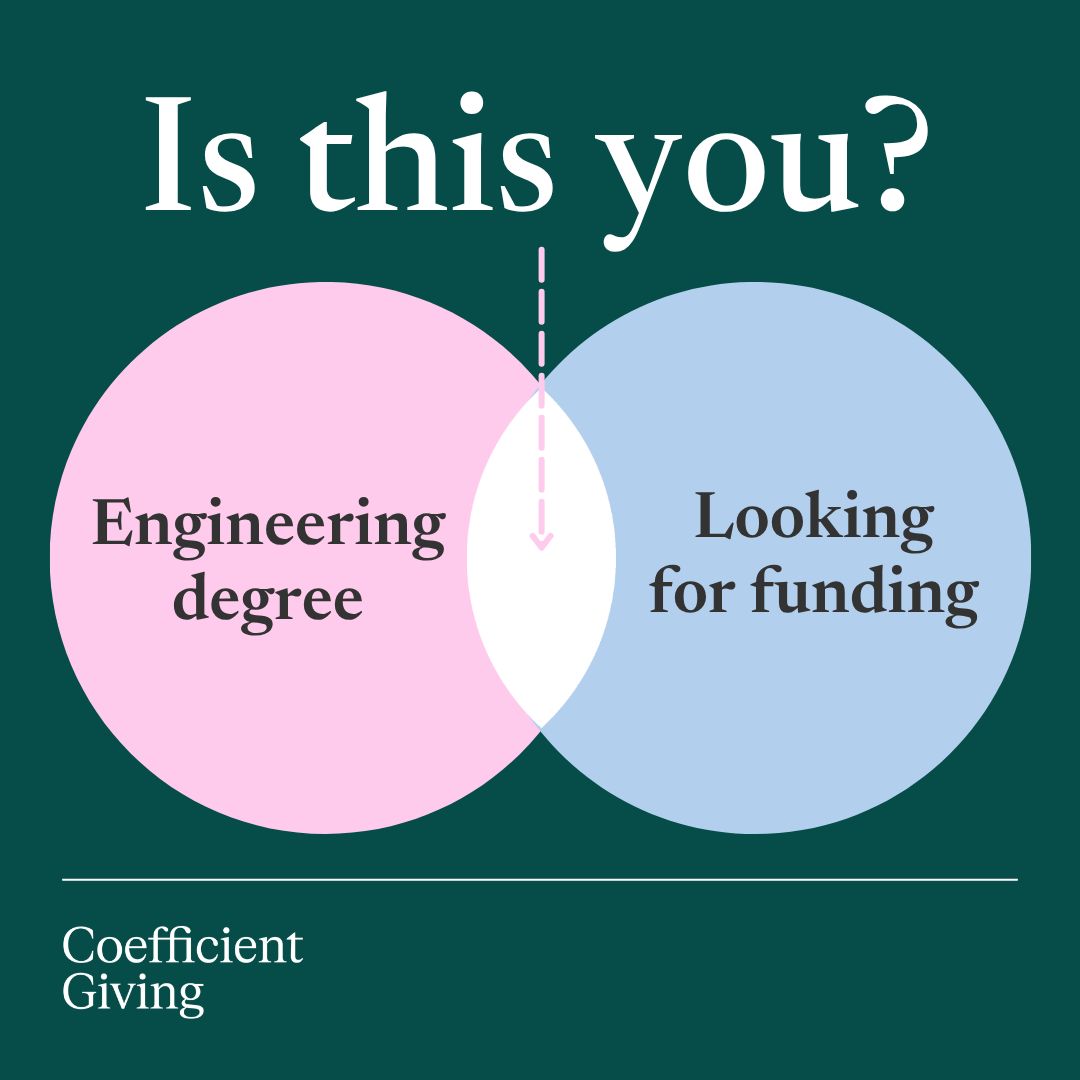
July 1 is the deadline to propose an engineering solution to a problem no one has fully solved: humane slaughter for 100+ billion farmed fish each year. Here's the detail that matters: the first step is lighter than it sounds. $7M in grants is available. The first step is a short Letter of Intent: a 2,500–3,000 word sketch of your approach, plan, timeline, and budget, not a full proposal. It's scored against a rubric we share in advance. LOIs that meet a minimum quality standard receive a $4,000 honorarium (up to 125 applicants, eligibility restrictions apply). From there, 5–30 applicants are invited to submit a full proposal, due September 30. The LOI deadline is July 1, 2026. Never applied for research funding before? Not a barrier. Electrical, mechanical, chemical, automation, or something else entirely: if you can engineer around size variation, water conductivity, or the power and space limits of a fishing vessel, this problem needs you. No fish industry experience required. Submit your details and we'll send you the full information package.
- LINKEDIN · IMAGESince 20 Jun 2026
Coefficient Giving's $7M humane fish slaughter RFP closes July 1. To be considered, you need just one thing: a Letter of Intent. $7M in grants is available. The first step is a short Letter of Intent: a 2,500–3,000 word sketch of your approach, plan, timeline, and budget, not a full proposal. It's scored against a rubric we share in advance. LOIs that meet a minimum quality standard receive a $4,000 honorarium (up to 125 applicants, eligibility restrictions apply). From there, 5–30 applicants are invited to submit a full proposal, due September 30. The LOI deadline is July 1, 2026. An imperfect LOI that is submitted by July 1 beats a perfect one that never gets sent. Start yours today.
- LINKEDIN · IMAGESince 20 Jun 2026
Considering a Letter of Intent for Coefficient Giving's $7M humane fish slaughter RFP? These are some questions that might give people pause: Is my background too far from fish? No. We deliberately opened this RFP to all disciplines: engineering, chemistry, neuroscience, animal welfare science, and fields we haven't anticipated. Many of the most promising approaches will likely come from people new to this problem. Is my idea too early? We fund across the research-to-prototype spectrum. Exploratory studies that scope a problem, applied research, and field prototypes are all welcome. Can my company apply? Yes. For-profit and non-profit organizations, universities, public sector organizations, and individuals are all eligible, worldwide. There are workable funding structures for many for-profit setups. Is the application too time-consuming? The first step is a short Letter of Intent: a 2,500–3,000 word sketch of your approach, plan, timeline, and budget, not a full proposal. It's scored against a rubric we share in advance. LOIs that meet a minimum quality standard receive a $4,000 honorarium (up to 125 applicants, eligibility restrictions apply). From there, 5–30 applicants are invited to submit a full proposal, due September 30. Letters of Intent close July 1, 2026.
6 of 333 adsSign up to see every Coefficient Giving ad, filter by format and date, and get alerts on new ones.
See all 333 adsWatch the companies you care about.
Filter every ad by industry, country, format and network, and get alerts when a company you watch starts running new ads.