Not on air · 2 of 3 networks checked
Autodesk Research
- research.autodesk.com
- Software Development
- US
- 59 employees
Autodesk Research’s ads on LinkedIn, Meta and Google, recorded by adsrunning. Browse the latest here for free. Sign up free to see all 22. Watch Autodesk Research on any plan to get each new one in your feed.
Watchlist included in every plan
| Network | Status | Live ads | Nov 2025LinkedIn activity · 52 weeksNov 2026 | Checked | Next step |
|---|---|---|---|---|---|
| None recorded | 0 | Checked 2 Nov 2026 | See all 22 ads → | ||
| Meta | Not checked | — | |||
| Recently | 10k+ | Ads on the Google Ads Transparency Center | Checked 7 Oct 2026 | Collect them with the API → |
Autodesk Research has no live LinkedIn ads. We recorded 10k+ Google ads on 7 Oct 2026.
Latest ads
- LINKEDIN · VIDEOSince 25 Sept 2026
We measure buildings in extraordinary detail. So how can we measure humans experiencing them? Enlivened Design is an Autodesk Research team exploring the ways neuroscience, architecture, AI, and design can help us better understand human experience in the built environment. Through research and collaborations with The Bartlett School of Architecture, UCL and UCL PALS, the team is investigating questions around cognition, wellbeing, behavior, and place, and what those insights could mean for the way we design. Watch the full story below and let us know how you'd want your spaces designed! #EnlivenedDesign #HumanCenteredDesign #DesignResearch #Architecture #AI #BuiltEnvironment
- LINKEDIN · VIDEOSince 24 Sept 2026
How much do the spaces around us shape the ways we think, feel, learn, and connect? We know the built environment influences human experience. Understanding that relationship, and translating it into something designers can act on, remains a complex research challenge. Enlivened Design, an Autodesk Research team, is exploring that challenge at the intersection of neuroscience, architecture, AI, and design research. In this video, you'll meet a few of the people behind the work, the questions they're asking, and how a collaboration with The Bartlett School of Architecture, UCL and UCL PALS is helping them examine the relationship between people and place from new perspectives. 🔗 See the full story here: https://lnkd.in/gyxUQ_f3 💬 If you’d like to join the conversation, reach out and tell us: What aspects of human experience do you think design needs to understand better? #EnlivenedDesign #AutodeskResearch #HumanCenteredDesign #Neuroarchitecture #DesignResearch #BuiltEnvironment #AI Featured in the story: Dagmara Szkurlat, Kean Walmsley, Tomas Lay Herrera, Lorenzo Villaggi, Fiona Zisch, Hugo Spiers
- LINKEDIN · VIDEOSince 12 Aug 2026
AI, robotics, digital twins, and IoT are reshaping what's possible in construction—and helping us better understand jobsites, workers, and the work itself. That's why we're excited to welcome Reza Akhavian as Autodesk Research's new Visiting Scholar. A professor of Civil and Construction Engineering at San Diego State University, Reza brings deep expertise at the intersection of AI, robotics, digital twins, and IoT. As a Visiting Scholar, he'll contribute to our Intelligent Construction research and help bring broader industry perspectives into the conversation through partnerships and collaborations. Watch the video to hear Reza's vision and join us in welcoming him to the team! 👋 #AutodeskResearch #IntelligentConstruction #DigitalTwins #AI #AECO #Construction #Innovation #Robotics #IoT
- LINKEDIN · IMAGESince 28 May 2026
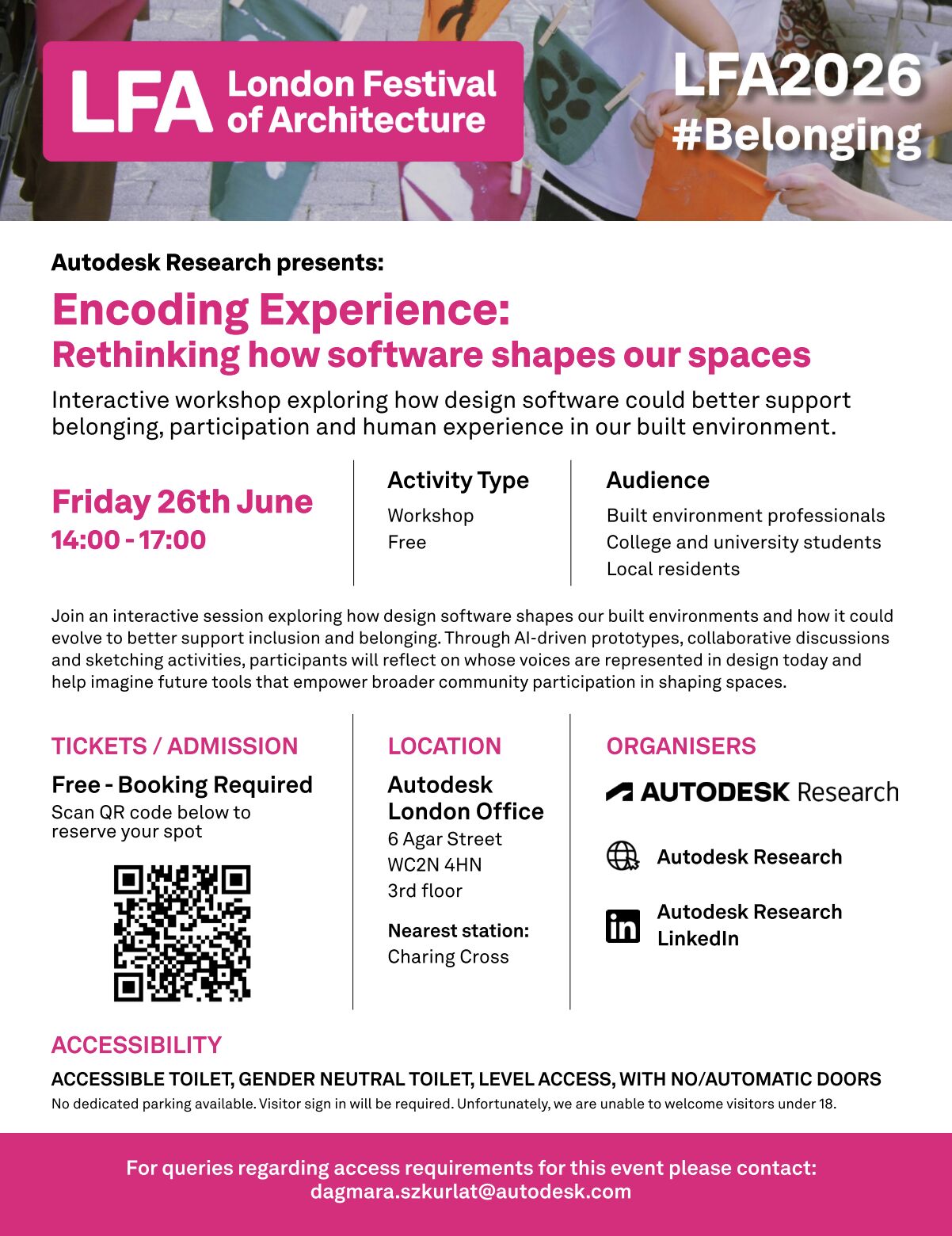
At Autodesk Research, we’ve been exploring a messy but important question: what happens when the software shaping our cities doesn’t fully understand the people living in them? As part of the 2026 London Festival of Architecture, we’re hosting “Encoding Experience: Rethinking How Software Shapes Our Spaces” to explore this question and more. Expect collaborative sketching, prototypes, discussions, unfinished ideas, and probably a few uncomfortable questions. With this year’s LFA theme of "Belonging," it also feels especially relevant to question how AI can fit into the way we're reimagining and building the world around us. If you’re curious about how software influences human behavior in ways we rarely talk about, come join us! 📍Autodesk London office 📅 June 26 🎟️ Register here for free: https://lnkd.in/g2-NBfH7 #belonging #LFA2026 #AutodeskResearch #Architecture #AI #DesignTechnology #HumanCenteredDesign #FutureOfDesign #BuiltEnvironment
- LINKEDIN · IMAGESince 19 Mar 2026
From F1 engineering puzzles to reshaping how AI and physics rethink design, J. Nathan Kutz, Director of Physics-Informed AI at Autodesk Research, shares what drew him here, where the cutting edge of AI in science and engineering is moving, and what breakthroughs he’s excited about next: "For me, whether it’s sport, art, or research, it all comes back to community and shared curiosity. I’m excited to build that same spirit within Autodesk Research by creating an environment where collaboration is open, ideas move freely, and people feel recognized for the work they do. That’s how momentum builds. And that’s how innovation happens." 👉 Read the full interview here: https://lnkd.in/eHq3tsaN
- LINKEDIN · IMAGERecorded 9 Sept 2026
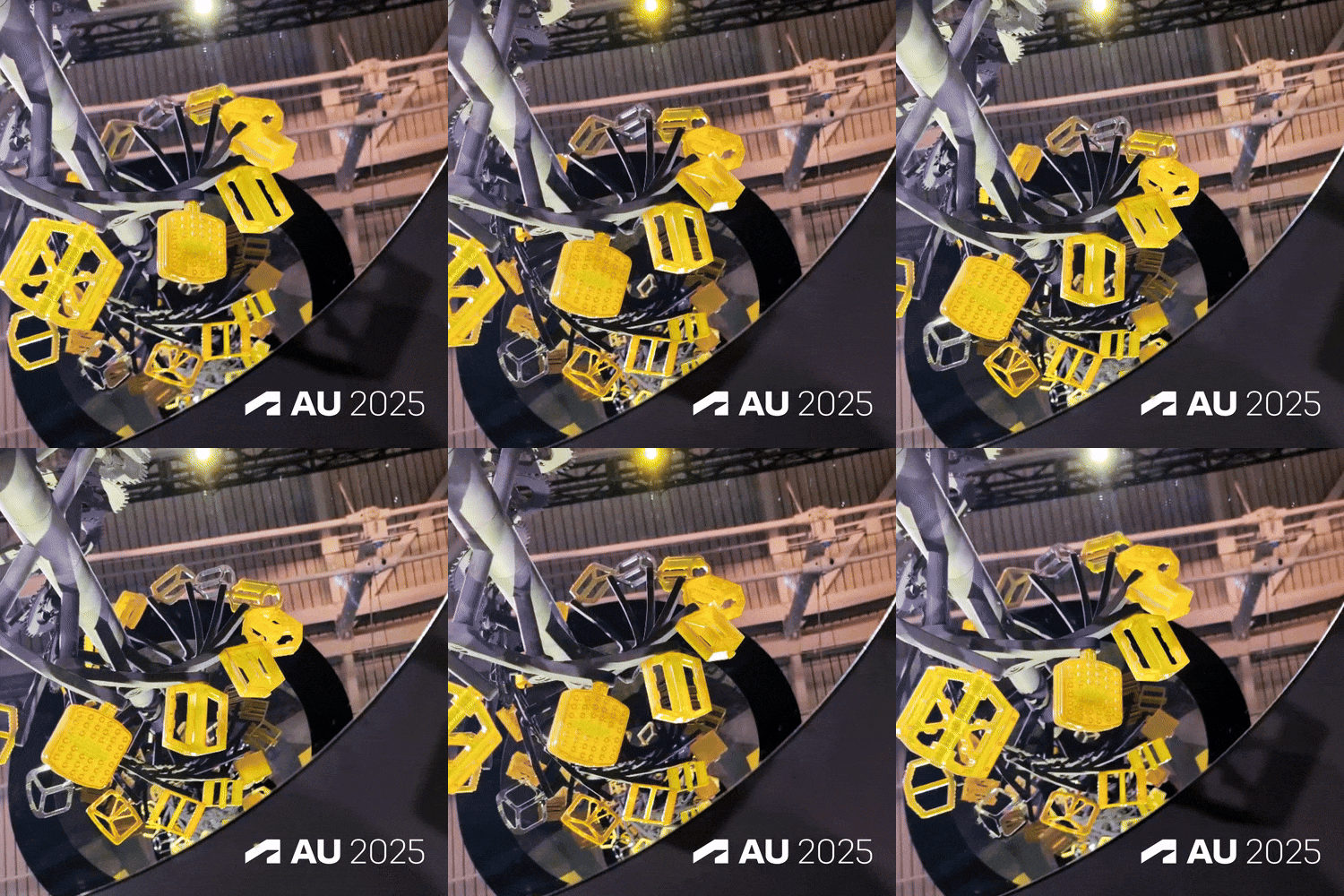
One of the artifacts from the #AU2025 expo floor was designed and manufactured right in our Autodesk Technology Centers! Titled "AI Cycle: From Data to Design," the piece features twenty-eight bicycle pedals from a licensed training dataset spiral in a double helix, culminating in a central AI-generated pair that represents the phenotype—the tangible expression of generative intelligence. Each pedal in the helix represents the training dataset used to develop our generative AI model. Created using Autodesk Fusion, the structure showcases white spheres within yellow resin, making the typically invisible geometry of machine learning visible. Fabrication highlights include translucent yellow pedals printed with a Stratasys J55 and precision-machined central aluminum pedals, showcasing our AI model's capabilities. The EOS Additive Minds team contributed sustainable crank arms, printed using PA 950 HD material. An interactive display allows handling of additional pedals, fabricated using various advanced methods. This sculpture embodies Autodesk’s generative AI foundation model for geometry that learns from real-world data to generate editable CAD objects. Like a design genome, it visualizes the evolution from input to output. Concept Design: Noa Kaplan, PhD Design for Manufacturing: Michael Koehle 3D Printing: Jamie N., Haley Fox, Dave Krzeminski, PhD CNC Machining: Melissa Ramos Hybrid Manufacturing: Brian (Seung Ho) Jeong Rotating Pedestal: Ian Kimmerly, Orion Beach, David Cole, Steven Thompson Project Coordination: Robert Bowerman, Mikaela Holmes, Adam Allard, Mary Elizabeth Yarbrough, Joseph Aronis, Taylor Tobin, Alana Mongkhounsavath, Kimberly Jacobchik Special thanks to the EOS Additive Minds team, who partnered with us to fabricate the crank arm assemblies in their Texas facility using sustainable PA 950 HD—demonstrating not just cutting-edge technology but also a shared commitment to re-usability and exceptional quality. #generativeAI #AI #MakeAnything #AutodeskResearch #Fusion

6 of 22 adsSign up to see every Autodesk Research ad, filter by format and date, and get alerts on new ones.
See all 22 adsWatch the companies you care about.
Filter every ad by industry, country, format and network, and get alerts when a company you watch starts running new ads.