On air · 1 of 3 networks
AMC Bridge, Inc.
- amcbridge.com
- US
- 420 employees
AMC Bridge, Inc.’s ads on LinkedIn, Meta and Google, recorded by adsrunning. Browse the latest here for free. Sign up free to see all 302. Watch AMC Bridge, Inc. with Starter to get each new one in your feed.
Watchlist with Starter · $49/mo
| Network | Status | Live ads | Nov 2025LinkedIn activity · 52 weeksOct 2026 | Checked | Next step |
|---|---|---|---|---|---|
| Running | 6 | Checked 30 Oct 2026 | See all 302 ads → | ||
| Meta | None recorded | 0 | No active ads recorded on the Meta Ad Library | Checked 17 Oct 2026 | Collect them with the API → |
| Recently | 54 | Ads on the Google Ads Transparency Center | Checked 2 Oct 2026 | Collect them with the API → |
AMC Bridge, Inc. has 6 live LinkedIn ads. Its Facebook page had no active ads on 17 Oct 2026, and we recorded 54 Google ads on 2 Oct 2026.
Latest ads
- LINKEDIN · IMAGESince 19 Oct 2026
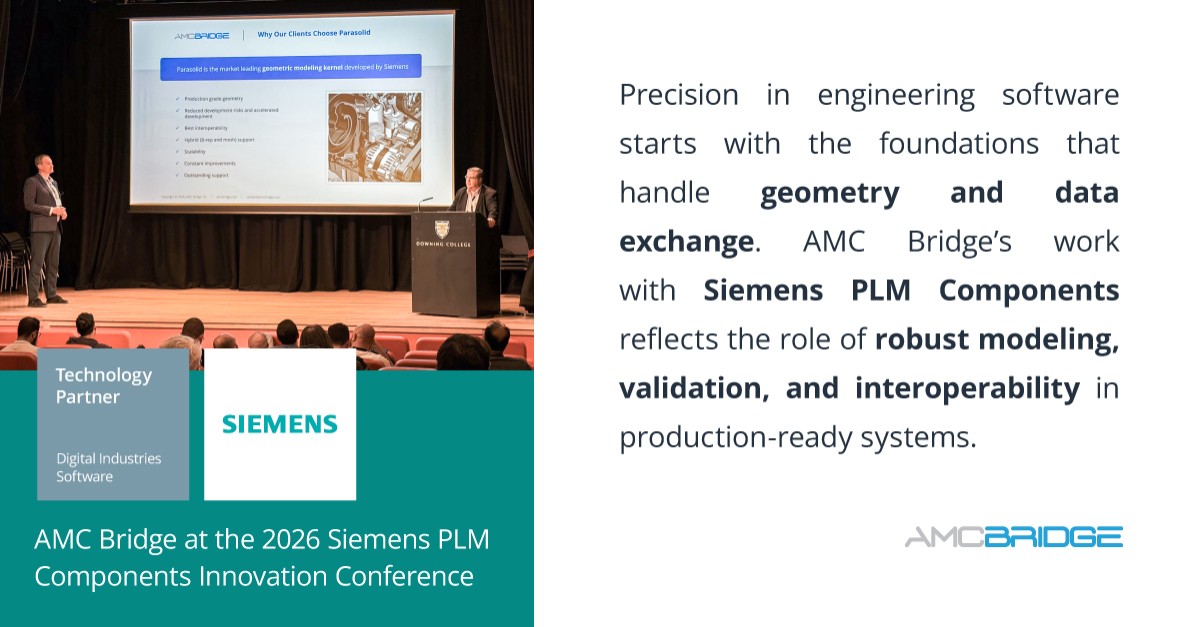
Why do even the most advanced engineering teams still struggle with fragmented toolchains, unstable geometry, and slow design‑to‑manufacturing cycles? As products become more complex and timelines tighten, ensuring that modeling, validation, and data flow work seamlessly across the entire lifecycle is the real challenge. This is where robust component technologies and deep implementation expertise make a measurable difference. From precise geometry handling to reliable interoperability and scalable digital threads, the right foundation can significantly reduce development friction and accelerate time to value. In this article, we explore how long‑term, hands‑on experience with Siemens PLM Components translates into practical solutions for modern engineering challenges and what it takes to make them work in real production environments. Read more to see what’s behind resilient, high‑performance engineering systems: https://lnkd.in/ei2CQ2CJ
- LINKEDIN · IMAGESince 19 Oct 2026
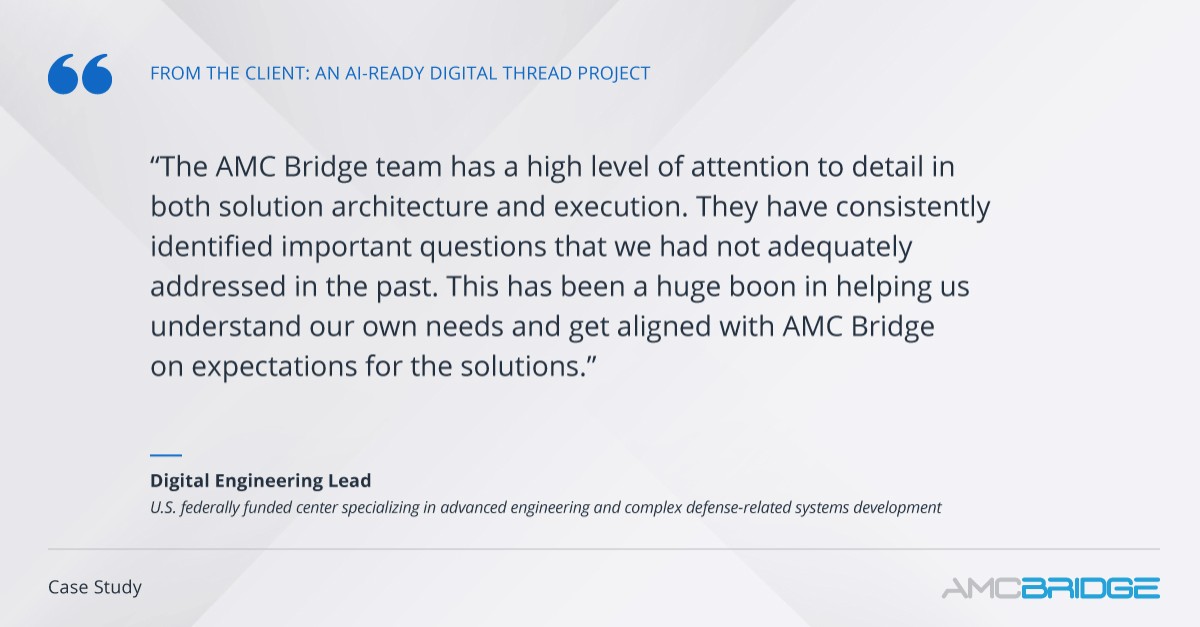
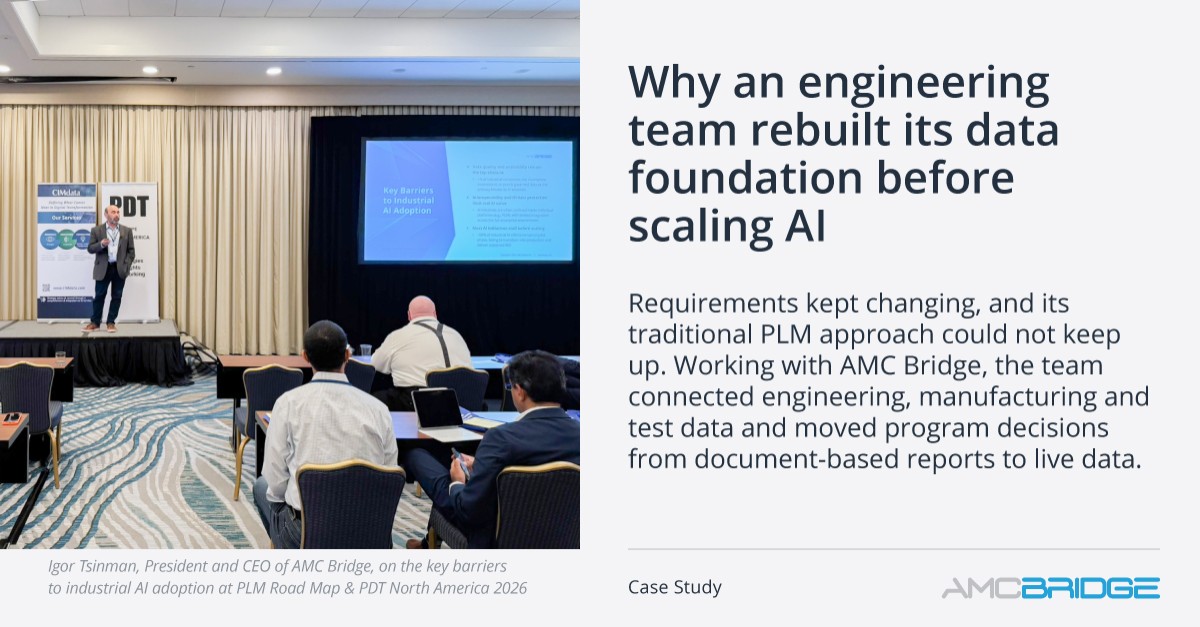
In complex engineering programs, the costliest decisions come late: committing to a build, approving a design change, signing off on test readiness. When engineering, manufacturing and test data sit in separate systems, those decisions rest on partial information, and problems surface when they are most expensive to fix. Engineering and software teams spend their capacity keeping data aligned by hand. AI initiatives meant to improve these decisions stall for the same reason. One of our clients reached this point as its programs became more dynamic and involved more disciplines. Its data was spread across disconnected tools, and leaders had limited visibility across engineering, manufacturing and test. Its traditional PLM approach couldn't keep up with changing requirements and iterative development. Working with AMC Bridge, the client built one digital thread that connects its CAD, simulation, PLM, ERP and test systems. Program teams now see the current state of the system in real time. They can trace requirements through design, build and validation, and they spend less effort coordinating across teams and systems. The client also gained the structured data foundation that scaling AI requires. This kind of integration has been AMC Bridge's core work for more than 25 years. We connect engineering software across the product lifecycle, so product data stays consistent from design to production. If fragmented engineering data is slowing your engineering decisions or holding back your AI plans, the case study shows where this client started and how the digital thread took shape: https://lnkd.in/ewHKQNCN
- LINKEDIN · IMAGESince 19 Oct 2026
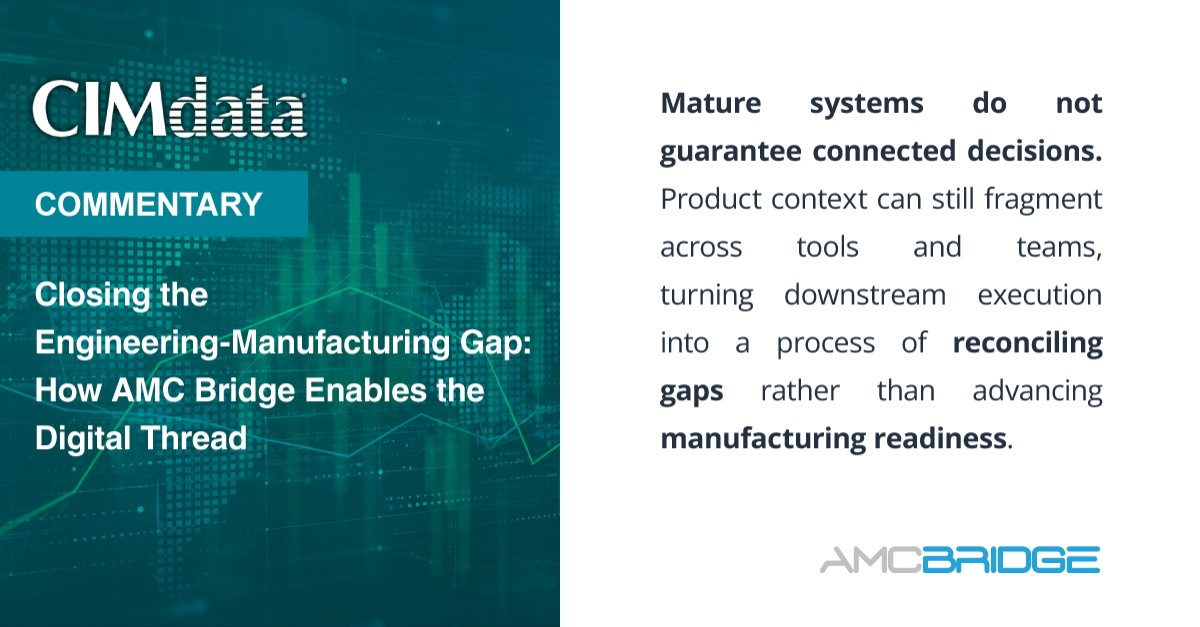
Most manufacturing organizations struggle because the systems don’t line up. On paper, CAD, PLM, ERP, and manufacturing tools look mature. In practice, engineering data is spread across platforms, ownership isn’t always clear, and changes don’t move cleanly downstream. By the time work reaches manufacturing, teams are often reconciling gaps, guessing intent, or working around inconsistencies. That’s usually where delays, rework, and supplier issues tend to start. The root of the problem is often how these environments were designed, not integration alone. Many legacy setups optimize for engineering productivity but tend to fall apart once lifecycle execution is involved. As products grow more complex – more configurations, mixed mechanical and electrical content, stricter compliance – the cracks widen. In too many cases, BOMs still get rebuilt by hand, simulation data stays locked in engineering, and change traceability weakens right when precision matters most. The same limitations are now showing up in AI initiatives. AI struggles because the data isn’t ready. When product definitions, changes, and engineering context aren’t consistently connected, AI has nothing reliable to work from. What this leads to are narrow experiments that never quite make it into day‑to‑day operations. At AMC Bridge, we focus on closing this gap by unifying engineering and manufacturing data into reliable lifecycle flows, reducing manual handoffs, bringing critical insights earlier into decision‑making, and shaping PLM environments around how people actually work. The outcome shows better manufacturing readiness, shorter NPI/NPD cycles, fewer late surprises, and a solid foundation for AI that can move beyond experimentation. Read the full expert commentary by CIMdata here: https://lnkd.in/eYYsDqxr
- LINKEDIN · IMAGESince 19 Oct 2026
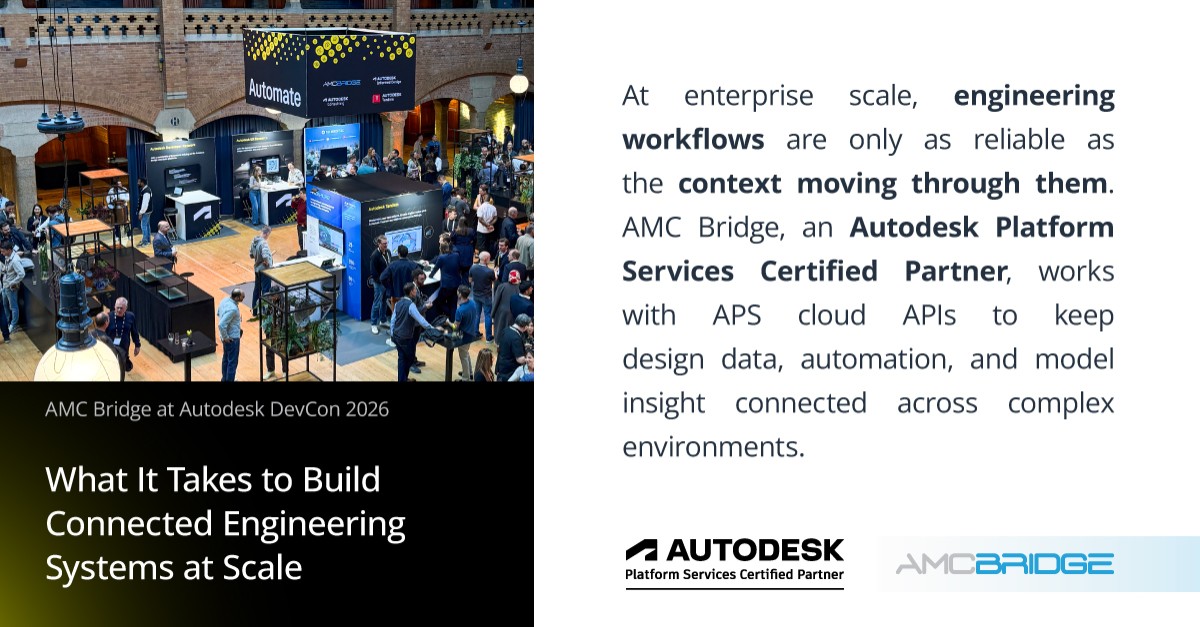
Building connected engineering systems at scale requires more than integrations: it demands a clear architecture, strong governance, and APIs designed for long‑term growth. Autodesk Platform Services provides the foundation, and at AMC Bridge we apply it to solve complex, enterprise‑level engineering challenges for our customers. Unpack the architecture behind the engineering here: https://lnkd.in/eS4ZfDR4
- LINKEDIN · IMAGESince 19 Oct 2026
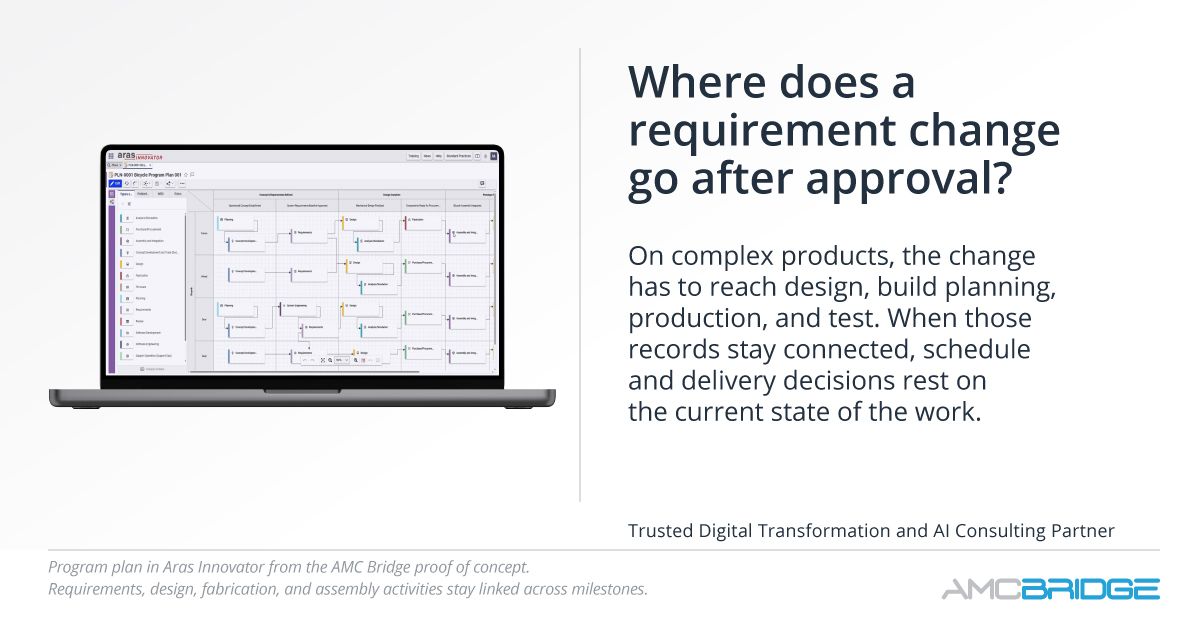
Reviews of complex products and programs come down to one question: is the work where the plan says it is? If the answer is uncertain, decisions about schedule, budget, and delivery commitments rest on assumptions. That uncertainty usually builds up quietly. A requirement change reaches the test team after the procedures are written, and validation slips. A production deviation is accepted to keep the line moving, and weeks later it shows up as a failed test and rework. A milestone looks on track until it turns out that two teams have been working from different configurations. Each system involved is accurate on its own terms, yet none of them shows how a change in one affects the rest. Together, these gaps push problems toward the stage where fixes cost the most and delays are hardest to recover. AMC Bridge has spent more than 25 years implementing, extending, and integrating PLM platforms. In a recent proof of concept on Aras Innovator, our team linked requirements, system architecture, build planning, manufacturing execution, and test results in one traceable model. It offers a practical way to see how status can keep up with the work as it happens. If keeping status reliable gets harder as your products and programs grow, our team would be glad to discuss your situation and how a connected approach could apply to it. See the proof of concept and contact our team: https://lnkd.in/eNuSQUWy
- LINKEDIN · IMAGESince 19 Oct 2026
In complex engineering programs, the costliest decisions come late: committing to a build, approving a design change, signing off on test readiness. When engineering, manufacturing and test data sit in separate systems, those decisions rest on partial information, and problems surface when they are most expensive to fix. Engineering and software teams spend their capacity keeping data aligned by hand. AI initiatives meant to improve these decisions stall for the same reason. One of our clients reached this point as its programs became more dynamic and involved more disciplines. Its data was spread across disconnected tools, and leaders had limited visibility across engineering, manufacturing and test. Its traditional PLM approach couldn't keep up with changing requirements and iterative development. Working with AMC Bridge, the client built one digital thread that connects its CAD, simulation, PLM, ERP and test systems. Program teams now see the current state of the system in real time. They can trace requirements through design, build and validation, and they spend less effort coordinating across teams and systems. The client also gained the structured data foundation that scaling AI requires. This kind of integration has been AMC Bridge's core work for more than 25 years. We connect engineering software across the product lifecycle, so product data stays consistent from design to production. If fragmented engineering data is slowing your engineering decisions or holding back your AI plans, the case study shows where this client started and how the digital thread took shape: https://lnkd.in/ewHKQNCN
6 of 302 adsSign up to see every AMC Bridge, Inc. ad, filter by format and date, and get alerts on new ones.
See all 302 adsWatch the companies you care about.
Filter every ad by industry, country, format and network, and get alerts when a company you watch starts running new ads.